
 África
 Asia
Asia Europa
 América do Sur
 Australia e Oceanía
 Antártida
 Océano Pacífico
 Océano Atlántico
 Océano Índico
 Océano Glacial Ártico
 Mar Mediterráneo
 Mar Vermello
 Mar Caribe
 Mar do Coral
 Mar da China Meridional
 Mar de Filipinas
 Mar de Andamán
 Mar do Norte
 Mar de Timor e de Arafura
 Golfo de Bengala
 Golfo de California
Large velvet ant
 Pica
PicaThe large velvet ant is not really an ant. It is a wasp, and the females have no wings and look like fuzzy ants. It lives in parts of Europe, Asia and North Africa, in heaths, moors, grasslands and woodland. Its sting is painful, but it is not aggressive.1


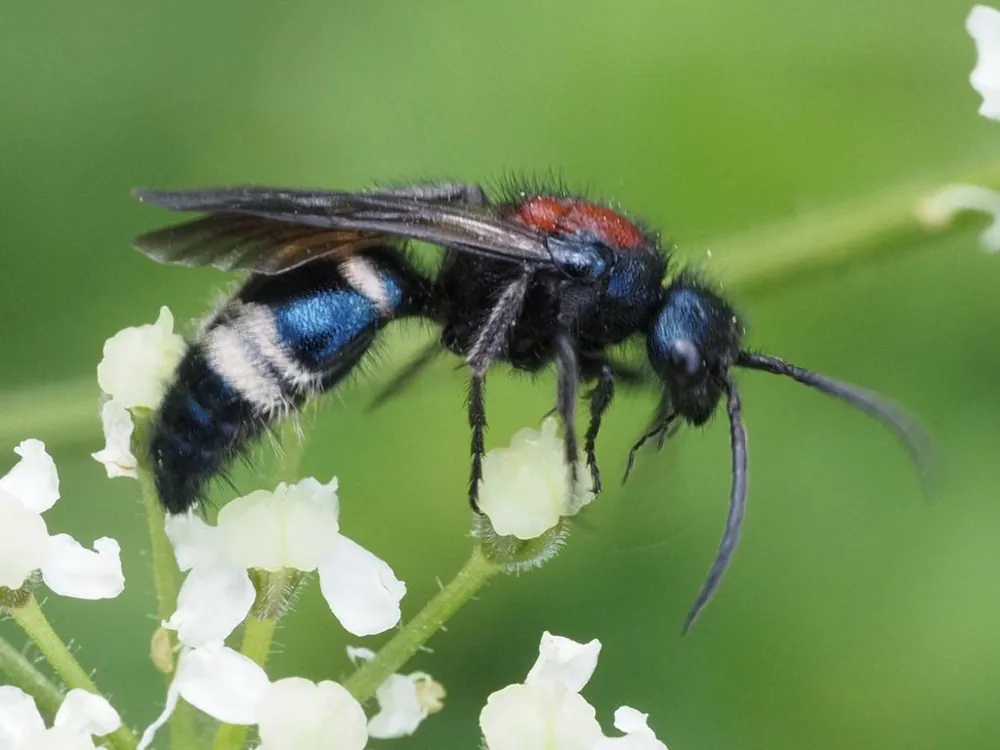
 Como recoñecelo
- Males are dark red on the tip of the mandibles (jaws) and on the thorax.1
- The first and second segments of the abdomen have bands of long silver bristles.1
- The tip of the abdomen and much of the body are covered in long black bristles.1
- Females have a red mesonotum (the upper middle part of the thorax) and silver-spotted flanks along the abdomen.1
- Some males are completely black, and colour varies between individuals.1
Poder da pezoña
A pezoña sae por un ferrete.
Que fai a súa pezoña?
The sting is painful. Its venom is much less toxic than the venom of a honeybee.1
Que perigoso é para as persoas?
Perigo para as persoas: DolorosoPode doer moito, pero case nunca é grave.The wasp is not aggressive and only stings people when handled. Its sting is painful but less toxic than a honeybee's.1
Que fai cando ten medo?
When threatened, it stridulates by rubbing a raised structure called the plectrum over ridges on its abdomen, which makes a sound.1
 Se pica
- Rasca para quitar o ferrete da abella e arrefría a zona.
- Se a persoa ten dificultade para respirar, a cara ou a gorxa inchadas, ou sente que se vai desmaiar, é unha emerxencia alérxica: chama ao teu número de emerxencias e usa o seu autoinxector de adrenalina se ten un.
Chama sempre primeiro ao teu número de emerxencias (112, 000, 911). Isto son consellos xerais de primeiros auxilios, non consello médico. Primeiros auxilios básicos
 Mantente a salvo
- Nunca toques, collas nin molestes un animal salvaxe, aínda que sexa pequeno e aínda que pareza durmido ou morto.
- Déixalle espazo. Se atopas un, mantén a calma, recúa amodo e déixao ir polo seu camiño.
- Se un te pica: mantén a calma, non te movas, chama ao teu número de emerxencias (112, 000, 911) ou vai rápido a un hospital. Lembra como era, unha foto axuda.
Non vai a por ti. Usa a súa pezoña para cazar comida ou para defenderse, e prefire con moito agocharse. Máis sobre como estar a salvo
En que lugar do mundo?
Que tamaño ten?
Canto mide?
 tan pequeno que cabe na túa unlla
Que tamaño ten Large velvet ant comparado CONTIGO?
Só son contas no teu navegador. Non se garda nin se envía nada a ningures.
Que rápido é?


Datos
Their thick, armoured skin is so strong that related species in North America have been reported to escape from the mouths of lizards and frogs.1
Females can sneak into the nests of paper wasps and steal their food stores, possibly because they can disguise their scent so the paper wasps cannot detect them.1
The size of the adult wasp depends partly on the size of its host: wasps raised in honeybees are smaller than those raised in bumblebees.1
Females are wingless, but males have wings.1
Males die soon after emerging in autumn, while females hibernate over winter, sometimes in the host nest or at the roots of low plants.1
Desmontamitos
Mito: The nickname "cow killer" means the sting can kill cows.
Verdade: The nickname is inappropriate. Its sting is painful, but its venom is much less toxic than a honeybee's, and it is not aggressive.1
De onde veñen os datos
- Mutilla europaea (Wikipedia (CC BY-SA 4.0))
- Mutilla europaea (iNaturalist): nomes e clasificación.
- Venom Wiki: o nivel de perigo, o tamaño típico e a velocidade estimada son nosos. Mira como os calculamos: Como valoramos o perigo.
Cada dato desta páxina ten un número que leva á súa fonte. Se nos equivocamos nalgo, sentímolo, somos fans dos animais, non unha revista científica. Dínolo en [email protected] e arranxarémolo.
 O escorpión ten fame! Venom Wiki é un proxecto dunha soa persoa: gratis, sen anuncios e sen rastrexadores. Unha pequena propina axuda a mantelo en liña.Dálle de comer ao escorpión
Máis do mesmo grupo: Abellas, avespas e avespóns
 Asian giant hornetAbellas, avespas e avespónsPode matar
 Common waspAbellas, avespas e avespónsSó doe
 European hornetAbellas, avespas e avespónsSó doe
 Western honey beeAbellas, avespas e avespónsSó doe
 Giant honey beeAbellas, avespas e avespónsPrecisa un médico
 Asian hornetAbellas, avespas e avespónsSó doe
Tamén vive en: Europa
 Common European adderVíboras e outras serpes da familiaPrecisa un médico
 Spanish flyOutros animais velenososPrecisa un médicoNon tocar
 Fire salamanderRas velenosas, sapos e tritónsSó doeNon tocar
 Blunt-nosed viperVíboras e outras serpes da familiaPode matar
 Nose-horned viperVíboras e outras serpes da familiaPode matar
 Ottoman viperVíboras e outras serpes da familiaPode matar