
 África
 Asia
Asia Europa
 América do Sur
 Australia e Oceanía
 Antártida
 Océano Pacífico
 Océano Atlántico
 Océano Índico
 Océano Glacial Ártico
 Mar Mediterráneo
 Mar Vermello
 Mar Caribe
 Mar do Coral
 Mar da China Meridional
 Mar de Filipinas
 Mar de Andamán
 Mar do Norte
 Mar de Timor e de Arafura
 Golfo de Bengala
 Golfo de California
Southern black widow
 Morde
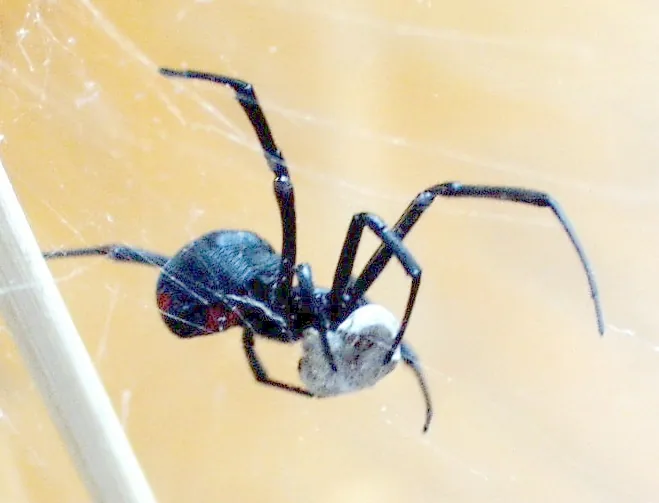
MordeThe southern black widow is a venomous spider that lives in North America. Mature females are shiny black with a red hourglass mark on their underside. Its bite can cause pain and other symptoms, but it is rarely fatal to healthy people.1


 Como recoñecelo
- Mature females are shiny black, with a red hourglass-shaped mark on the underside of a very rounded abdomen.1
- Many females have an orange or red patch on the top of the abdomen, just above the spinnerets.1
- Mature females have a body length of 8–13 mm, not counting the legs. Males are 3–6 mm.1
- Juveniles look very different. They have a grey to black abdomen with white stripes across it, spotted with yellow and orange.1
- Males are either purple, or look more like the juveniles.1
Adoita confundirse con: It is often confused with the false widows (genus Steatoda) and with the closely related northern (L. variolus) and western (L. hesperus) black widows.1
Poder da pezoña
A pezoña sae polos seus cairos ou dentes cando morde.
Que fai a súa pezoña?
The venom contains alpha-latrotoxin, a neurotoxic venom that attacks the nerves. It causes pain and other symptoms, which are collectively called latrodectism.1
Que perigoso é para as persoas?
Perigo para as persoas: GraveUnha mordedura precisa un médico. As mortes son moi raras.Deaths in healthy adults are exceedingly rare. No deaths were reported among 23,409 documented Latrodectus bites in the US from 2000 to 2008, though about 2,000 bites happen each year. Only mature females can bite people.1
 Boas novas: os médicos teñen un medicamento (antiveleno) ou un tratamento para isto.1
 Se morde
- Lava a mordedura e ponlle unha bolsa de xeo para a dor. Busca axuda médica se a dor é forte, se se estende ou se a persoa se sente mal.
Chama sempre primeiro ao teu número de emerxencias (112, 000, 911). Isto son consellos xerais de primeiros auxilios, non consello médico. Primeiros auxilios básicos
 Mantente a salvo
- Nunca toques, collas nin molestes un animal salvaxe, aínda que sexa pequeno e aínda que pareza durmido ou morto.
- Déixalle espazo. Se atopas un, mantén a calma, recúa amodo e déixao ir polo seu camiño.
- Se un te morde: mantén a calma, non te movas, chama ao teu número de emerxencias (112, 000, 911) ou vai rápido a un hospital. Lembra como era, unha foto axuda.
Non vai a por ti. Usa a súa pezoña para cazar comida ou para defenderse, e prefire con moito agocharse. Máis sobre como estar a salvo
En que lugar do mundo?
Que tamaño ten?
Canto mide?
 tan pequeno que cabe na túa unlla
Que tamaño ten Southern black widow comparado CONTIGO?
Só son contas no teu navegador. Non se garda nin se envía nada a ningures.
Que rápido é?


Datos
In 1933, Allan Blair let himself be bitten by one of these spiders to study its venom in humans and to convince sceptics that it could be dangerous.1
Females will occasionally eat their mates after reproduction.1
Only mature females can bite people. Their hollow, needle-like mouthparts are about 1 mm long, which is long enough to inject venom into people.1
The brown widow (Latrodectus geometricus) competes with black widows for territory. In areas where they share space, it can displace them.1
Males live only about three to four months, while females can live for up to three years.1
Desmontamitos
Mito: A black widow bite is usually fatal.
Verdade: Black widow bites are rarely fatal to healthy people. No deaths from the US species were reported among 23,409 documented bites from 2000 to 2008.1
Para expertos en pezoñas
- Nome científico
- Latrodectus mactans
- Grupo
- Arañas
- Familia
- Theridiidae2
- Orde
- Araneae
- Continentes
- América do Norte
- Crías
- A female can produce four to nine egg sacs in one summer, each holding about 100–400 eggs, which she guards in a silken container.1
- Esperanza de vida
- uns 3 anos1
- Perigo para as persoas
- 3 / 5: Grave3
De onde veñen os datos
- Latrodectus mactans (Wikipedia (CC BY-SA 4.0))
- Latrodectus mactans (iNaturalist): nomes e clasificación.
- Venom Wiki: o nivel de perigo, o tamaño típico e a velocidade estimada son nosos. Mira como os calculamos: Como valoramos o perigo.
Cada dato desta páxina ten un número que leva á súa fonte. Se nos equivocamos nalgo, sentímolo, somos fans dos animais, non unha revista científica. Dínolo en [email protected] e arranxarémolo.
 O escorpión ten fame! Venom Wiki é un proxecto dunha soa persoa: gratis, sen anuncios e sen rastrexadores. Unha pequena propina axuda a mantelo en liña.Dálle de comer ao escorpión
 Brown recluse
 Northern black widow
 Western black widow
 Bold jumping spider
 Golden silk orb-weaver
 Central American wandering spider
 Terciopelo
 Eastern coral snake
 Eastern diamondback rattlesnake
 Eyelash viper
 Timber rattlesnake
 Western diamondback rattlesnake