
 África
 Asia
Asia Europa
 América do Sur
 Australia e Oceanía
 Antártida
 Océano Pacífico
 Océano Atlántico
 Océano Índico
 Océano Glacial Ártico
 Mar Mediterráneo
 Mar Vermello
 Mar Caribe
 Mar do Coral
 Mar da China Meridional
 Mar de Filipinas
 Mar de Andamán
 Mar do Norte
 Mar de Timor e de Arafura
 Golfo de Bengala
 Golfo de California
Texas coral snake
 Morde
MordeThe Texas coral snake is a venomous snake with bright black, yellow and red rings. It lives in the southern and southwestern United States and in parts of northeastern and central Mexico. Its bite can cause paralysis, so it is important to recognise it and keep well away.1



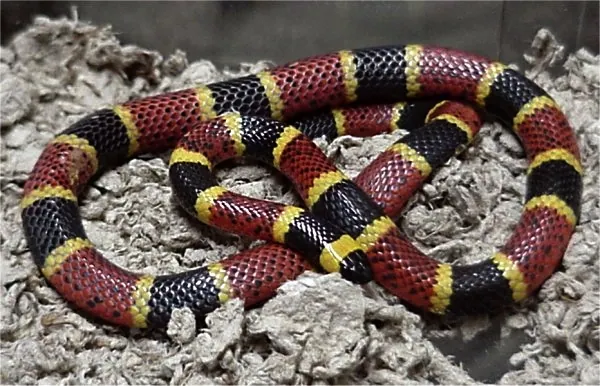
 Como recoñecelo
- Black, yellow and red rings, with the rings running onto the belly.1
- Smooth scales, a rounded head and round pupils.1
- Somewhat larger and stouter than the eastern coral snake.1
- Males are typically smaller than females.1
- Shy and secretive, and mostly active at night.1
Adoita confundirse con: Nonvenomous snakes copy the coral snake's colours as a form of Batesian mimicry. In the United States, the venomous coral snakes can be told apart by red rings touching yellow rings. The common rhyme "red and yellow, kill a fellow" is not always accurate because colours vary, and relying on it is dangerous.1
Poder da pezoña
A pezoña sae polos seus cairos ou dentes cando morde.
Que fai a súa pezoña?
The snake has a pair of fixed, grooved fangs at the front of the upper jaw, and venom is injected through them. Its venom contains a neurotoxin, which attacks the nerves, and a myotoxin, which damages muscle. Bite victims may experience paralysis or myolysis (muscle breakdown), which can be potentially lethal.1
Que perigoso é para as persoas?
Perigo para as persoas: GraveUnha mordedura precisa un médico. As mortes son moi raras.Before antivenom was available, the fatality rate of coral snake bites was estimated at 10%. Deaths were mainly caused by breathing or heart failure from paralysis. A single bite can deliver 10–12 mg of dry venom, about twice the lethal dose for an adult human of 5–7 mg. Many bites deliver no venom at all, known as dry bites.1
 Boas novas: os médicos teñen un medicamento (antiveleno) ou un tratamento para isto.1
Que fai cando ten medo?
When grabbed suddenly, or sometimes just when touched, it may thrash about, swing around and bite.1
 Se morde
- Remove any jewellery from a bitten limb, in case of severe swelling. Wrap the bite area moderately tightly in a wide cloth, and move the bitten limb as little as possible. Take the bite victim to the nearest hospital as soon as possible for advanced treatment, such as antivenom.1
- Mantén a persoa quieta e tranquila e vai rápido a un hospital, aínda que a mordedura pareza pequena: os síntomas poden comezar horas despois.
Chama sempre primeiro ao teu número de emerxencias (112, 000, 911). Isto son consellos xerais de primeiros auxilios, non consello médico. Primeiros auxilios básicos
 Mantente a salvo
- Nunca toques, collas nin molestes un animal salvaxe, aínda que sexa pequeno e aínda que pareza durmido ou morto.
- Déixalle espazo. Se atopas un, mantén a calma, recúa amodo e déixao ir polo seu camiño.
- Se un te morde: mantén a calma, non te movas, chama ao teu número de emerxencias (112, 000, 911) ou vai rápido a un hospital. Lembra como era, unha foto axuda.
Non vai a por ti. Usa a súa pezoña para cazar comida ou para defenderse, e prefire con moito agocharse. Máis sobre como estar a salvo
En que lugar do mundo?
Que tamaño ten?
Canto mide?
 mide coma 2,5 gatos domésticos do fociño á cola
 mide coma 7 bananas postas en fila
 podería percorrer 100 metros en 73 segundos (o humano máis rápido precisa 9,6)
Que tamaño ten Texas coral snake comparado CONTIGO?
Só son contas no teu navegador. Non se garda nin se envía nada a ningures.
Que rápido é?


Datos
A single bite can deliver about twice the lethal dose for an adult human, yet many bites inject no venom at all.1
The Texas coral snake eats other snakes, including venomous ones, and will even eat its own kind.1
Colour variants exist in the wild, including albino, anerythristic, pastel and completely black (melanistic) snakes.1
Desmontamitos
Mito: "Red and yellow, kill a fellow. Red on black, friend of Jack" is a reliable way to tell a coral snake from a harmless look-alike.
Verdade: The rhyme is not always accurate because colour patterns vary, and relying on it is dangerous to both people and snakes.1
De onde veñen os datos
- Texas coral snake (Wikipedia (CC BY-SA 4.0))
- Micrurus tener (iNaturalist): nomes e clasificación.
- Venom Wiki: o nivel de perigo, o tamaño típico e a velocidade estimada son nosos. Mira como os calculamos: Como valoramos o perigo.
Cada dato desta páxina ten un número que leva á súa fonte. Se nos equivocamos nalgo, sentímolo, somos fans dos animais, non unha revista científica. Dínolo en [email protected] e arranxarémolo.
 O escorpión ten fame! Venom Wiki é un proxecto dunha soa persoa: gratis, sen anuncios e sen rastrexadores. Unha pequena propina axuda a mantelo en liña.Dálle de comer ao escorpión
 Eastern coral snake
 Central American coral snake
 Sonoran coral snake
 Allen's coral snake
 Brown's coral snake
 Dumeril's coral snake
 Terciopelo
 Eastern diamondback rattlesnake
 Eyelash viper
 Timber rattlesnake
 Western diamondback rattlesnake
 Arizona bark scorpion