
 África
 Asia
Asia Europa
 América do Sur
 Australia e Oceanía
 Antártida
 Océano Pacífico
 Océano Atlántico
 Océano Índico
 Océano Glacial Ártico
 Mar Mediterráneo
 Mar Vermello
 Mar Caribe
 Mar do Coral
 Mar da China Meridional
 Mar de Filipinas
 Mar de Andamán
 Mar do Norte
 Mar de Timor e de Arafura
 Golfo de Bengala
 Golfo de California
Yellow-bellied toad
 Veleno na pel
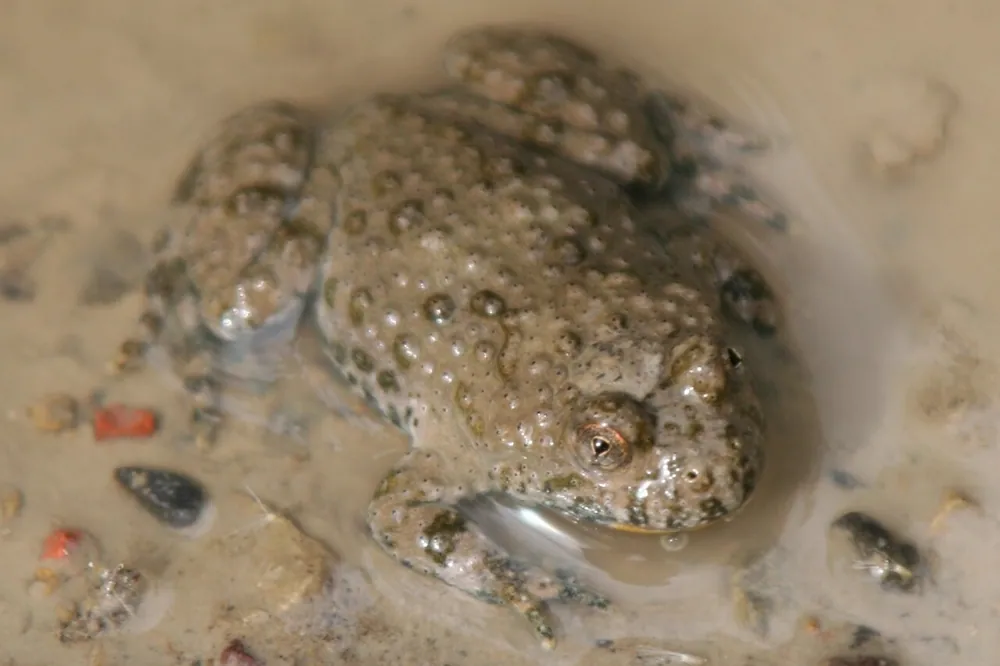
The yellow-bellied toad is a small toad with a bright yellow and black belly that it shows only when it feels threatened. It lives mainly in mountain areas of western Europe. Its skin toxins are not fatal to people, but they can harm smaller animals.1
 Como recoñecelo
- Grey-brown or dark brown and green upper body, often with faded, bright spots1
- Bright yellow to orange patches on the underside, usually covering more than half of the belly1
- Underside is grey-blue to black-blue between the yellow patches1
- Compact body and a rounded snout1
- Heart-shaped pupils, with the eardrums not visible1
- Warty skin with raised swirls on the back1
Adoita confundirse con: The European fire-bellied toad (Bombina bombina) is a close relative and lives in the same region. The yellow-bellied toad has a more compact body that is not as flat.1
Poder do veleno
A súa pel é velenosa. É perigoso tocalo, lambelo ou comelo.
Que fai o seu veleno?
The toad has toxins in its skin, released through the warts on its back when it is threatened. The toxin is not fatal to humans, but it can cause significant discomfort to most animals and is fatal to smaller ones.1
Que perigoso é para as persoas?
Perigo para as persoas: LeveComa unha picadura de abella ou menos. Practicamente inofensivo para as persoas.The toxin is not fatal to humans, although it can still cause discomfort to most animals.1
Que fai cando ten medo?
It stays still and camouflaged most of the time, and when threatened it shows its yellow belly, puffs up its chest and releases toxins from its warts.1
 Se alguén o tocou ou o comeu
- Se alguén tocou un: lava ben as mans e non toques os ollos nin a boca. Se un neno ou unha mascota lambeu ou comeu un: chama ao centro de toxicoloxía ou ao teu número de emerxencias.
Chama sempre primeiro ao teu número de emerxencias (112, 000, 911). Isto son consellos xerais de primeiros auxilios, non consello médico. Primeiros auxilios básicos
 Mantente a salvo
- Nunca toques, collas nin molestes un animal salvaxe, aínda que sexa pequeno e aínda que pareza durmido ou morto.
- Déixalle espazo. Se atopas un, mantén a calma, recúa amodo e déixao ir polo seu camiño.
- Se o tocaches ou o comiches: non esfregues os ollos nin a boca, lava as mans e busca axuda médica.
Non vai a por ti. O seu veleno só está aí para que ninguén o coma. Máis sobre como estar a salvo
En que lugar do mundo?
Que tamaño ten?
Canto mide?
Canto pesa?
 máis curto ca o teu dedo meniño
 tan lixeiro que non o notarías na man
 podería percorrer 100 metros en 180 segundos (o humano máis rápido precisa 9,6)
Que tamaño ten Yellow-bellied toad comparado CONTIGO?
Só son contas no teu navegador. Non se garda nin se envía nada a ningures.
Que rápido é?


Datos
When a male is threatened or wants to attract a female, he kicks his hind legs into a small pond to make a wave-like pattern. This marks his territory and only works in ponds of a certain depth.1
They can change the shade of their colour to suit lighter or darker surroundings by moving pigment within their cells.1
Yellow-bellied toads breed in unpredictable places, such as shallow pools that can disappear overnight. Within their family, they are the only species that chooses such sites.1
Their life span ranges from 5 to 23 years, and climate plays a large role in how long an individual lives.1
Males have longer forelimbs than females, which is thought to help them during mating and fights with other males.1
Para expertos en pezoñas
- Nome científico
- Bombina variegata
- Grupo
- Ras velenosas, sapos e tritóns
- Familia
- Bombinatoridae2
- Orde
- Anura
- Continentes
- Europa
- Crías
- Females can lay over 200 eggs at one time, but typically lay about 40. Eggs are laid in ponds, and tadpoles develop rapidly.1
- Como lle vai na natureza
- Endangered in Germany1
- Perigo para as persoas
- 1 / 5: Leve3
De onde veñen os datos
- Yellow-bellied toad (Wikipedia (CC BY-SA 4.0))
- Bombina variegata (iNaturalist): nomes e clasificación.
- Venom Wiki: o nivel de perigo, o tamaño típico e a velocidade estimada son nosos. Mira como os calculamos: Como valoramos o perigo.
Cada dato desta páxina ten un número que leva á súa fonte. Se nos equivocamos nalgo, sentímolo, somos fans dos animais, non unha revista científica. Dínolo en [email protected] e arranxarémolo.
 O escorpión ten fame! Venom Wiki é un proxecto dunha soa persoa: gratis, sen anuncios e sen rastrexadores. Unha pequena propina axuda a mantelo en liña.Dálle de comer ao escorpión
Máis do mesmo grupo: Ras velenosas, sapos e tritóns
 Fire salamanderRas velenosas, sapos e tritónsSó doeNon tocar
 Common toadRas velenosas, sapos e tritónsSó doeNon tocar
 European fire-bellied toadRas velenosas, sapos e tritónsInofensivo
 Iberian ribbed newtRas velenosas, sapos e tritónsInofensivo
 Natterjack toadRas velenosas, sapos e tritónsInofensivo
 Alpine salamanderRas velenosas, sapos e tritónsInofensivo
Tamén vive en: Europa
 Common European adderVíboras e outras serpes da familiaPrecisa un médico
 Spanish flyOutros animais velenososPrecisa un médicoNon tocar
 Common waspAbellas, avespas e avespónsSó doe
 European hornetAbellas, avespas e avespónsSó doe
 Western honey beeAbellas, avespas e avespónsSó doe
 Blunt-nosed viperVíboras e outras serpes da familiaPode matar