
 Afrika
 Ázsia
Ázsia Európa
 Dél-Amerika
 Ausztrália és Óceánia
 Antarktisz
 Csendes-óceán
 Atlanti-óceán
 Indiai-óceán
 Északi-sarki-óceán
 Földközi-tenger
 Vörös-tenger
 Karib-tenger
 Korall-tenger
 Dél-kínai-tenger
 Fülöp-tenger
 Andamán-tenger
 Északi-tenger
 Timor-tenger és Arafura-tenger
 Bengáli-öböl
 Kaliforniai-öböl
Gila monster
 Harapások
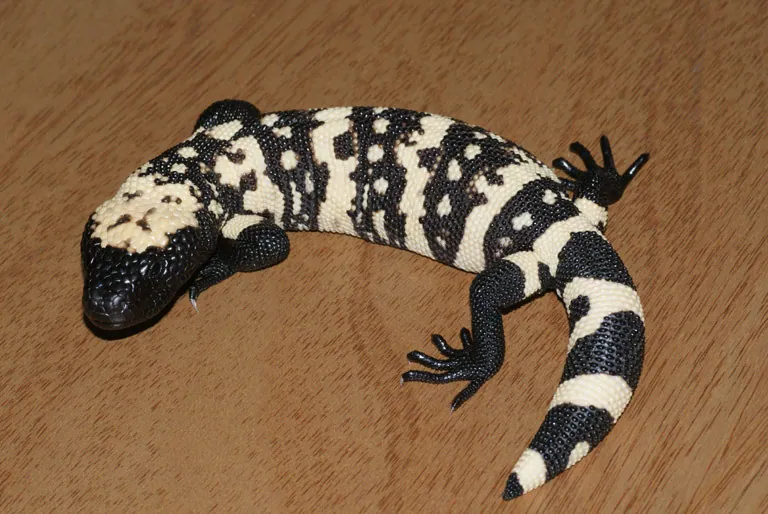
The Gila monster is a heavy, slow-moving lizard with a venomous bite. It lives in the south-western United States and the Mexican state of Sonora. It is the only venomous lizard native to the United States, but it rarely poses a real threat to people.1



 Hogyan ismerd fel
- Adults are yellow to pink on a black background.1
- Hatchlings have a simple, uniform pattern that is less colourful, and it changes over their first 6 months.1
- It has a heavy body, a stout snout and a massive head.1
- Adults can reach 56 cm in total length.1
- Males often have larger, more triangular heads than females.1
Gyakran összetévesztik ezzel: Its closest relatives are beaded lizards, which live in Mexico and Guatemala. In the United States, the Gila monster is the only venomous lizard.1
Méregerő
Harapáskor a méreg a méregfogain vagy a fogain keresztül jut ki.
Mit tesz a mérge?
The venom is made in glands in the lower jaw and flows along grooves in the lower teeth into the bite. It contains more than a dozen peptides and other substances, which cause pain and swelling. Four potentially lethal toxins have been found, which can cause bleeding inside the organs.1
Mennyire veszélyes az emberre?
Veszély az emberre: SúlyosA harapással orvoshoz kell menni. Haláleset nagyon ritka.The venom is usually not fatal to healthy adults. One death has been confirmed since 1930, on 16 February 2024. Earlier deaths involved adults who were drunk or whose bite was treated badly. Bites are painful and can cause shock, but the lizard is sluggish and rarely a real threat.1
Mit csinál, ha megijed?
Its bright colours may warn predators to keep away, because it can inflict pain.1
 Ha harap
- Bites are painful and need emergency medical care, because the venom may cause shock. Get medical help as quickly as possible.1
- Mosd ki a sebet, tartsd nyugodtan a sérültet, és kérj orvosi segítséget.
Mindig először a segélyhívó számot hívd (112, 000, 911). Ez általános elsősegély-tájékoztató, nem orvosi tanács. Elsősegély alapjai
 Maradj biztonságban
- Soha ne érints meg, ne fogj meg és ne bosszants vadállatot, még ha kicsi is, és még ha alszik vagy döglöttnek tűnik is.
- Hagyj neki helyet. Ha találkozol eggyel, maradj nyugodt, lassan lépj hátra, és hagyd, hogy menjen a maga útján.
- Ha megharap: maradj nyugodt, ne mozogj, hívd a segélyhívó számot (112, 000, 911), vagy juss el gyorsan kórházba. Jegyezd meg, hogyan nézett ki, egy fotó sokat segít.
Nem akar elkapni téged. A mérgét arra használja, hogy élelmet fogjon vagy megvédje magát, és sokkal szívesebben elbújik. Még több a biztonságról
Hol él a világban?
Mekkora?
Milyen hosszú?
Milyen nehéz?
 olyan hosszú, mint 3 banán egymás után
 olyan hosszú, mint 18 játék építőkocka egy sorban
 150 másodperc alatt futná le a 100 métert (a leggyorsabb embernek 9,6 kell)
Mekkora Gila monster hozzád képest?
Csak matek a böngésződben. Semmit nem mentünk és nem küldünk el sehova.
Milyen gyors?


Tények
Exendin-4, one of the venom's peptides, led to the development of GLP-1 receptor agonists, which treat type 2 diabetes and obesity.1
Young Gila monsters can swallow up to half of their body weight in a single meal.1
It can store fat in its tail and survive a whole season on three to four large meals in spring.1
Its venom is thought to have evolved mainly for defence, because its prey is mostly eggs, small animals and other helpless prey.1
It can climb trees, cacti and fairly straight, rough-surfaced walls.1
Its teeth are replaced throughout its life, and broken teeth are replaced by the teeth behind them.1
Tévhitromboló
Tévhit: Its bite is always fatal, and its breath is poisonous.
Az igazság: The venom is usually not fatal to healthy adult humans. One death has been confirmed since 1930.1
Honnan származnak a tények
- Gila monster (Wikipedia (CC BY-SA 4.0))
- Heloderma suspectum (iNaturalist): nevek és rendszertan.
- Venom Wiki: a veszélyszint, a tipikus méret és a sebességbecslés a saját értékelésünk. Nézd meg, hogyan számoljuk ki: Hogyan értékeljük a veszélyt.
Ezen az oldalon minden tény mellett van egy szám, amely a forrására mutat. Ha valamit elrontottunk, bocsi, mi állatrajongók vagyunk, nem tudományos folyóirat. Írj nekünk ide: [email protected], és kijavítjuk.
 A skorpió éhes! A Venom Wiki egyszemélyes projekt: ingyenes, reklámok és nyomkövetés nélkül. Egy kis borravaló segít, hogy online maradjon.Etesd meg a skorpiót
 Mexican beaded lizard
 Chiapan beaded lizard
 Guatemalan beaded lizard
 Rio Fuerte beaded lizard
 Komodo dragon
 Desert monitor
 Érdes lándzsakígyó
 Eastern coral snake
 Eastern diamondback rattlesnake
 Eyelash viper
 Timber rattlesnake
 Western diamondback rattlesnake