
 Africa
 Asia
Asia Europa
 Sud America
 Australia e Oceania
 Antartide
 Oceano Pacifico
 Oceano Atlantico
 Oceano Indiano
 Oceano Artico
 Mar Mediterraneo
 Mar Rosso
 Mar dei Caraibi
 Mar dei Coralli
 Mar Cinese Meridionale
 Mar delle Filippine
 Mare delle Andamane
 Mare del Nord
 Mar di Timor e Mar degli Arafura
 Golfo del Bengala
 Golfo di California
Asian hornet
 Punture
The Asian hornet is a hornet from Southeast Asia that has spread to many other countries, including most of Europe, where it is an invasive species. It is a concern because it hunts honeybees and its stings can be serious for people.1


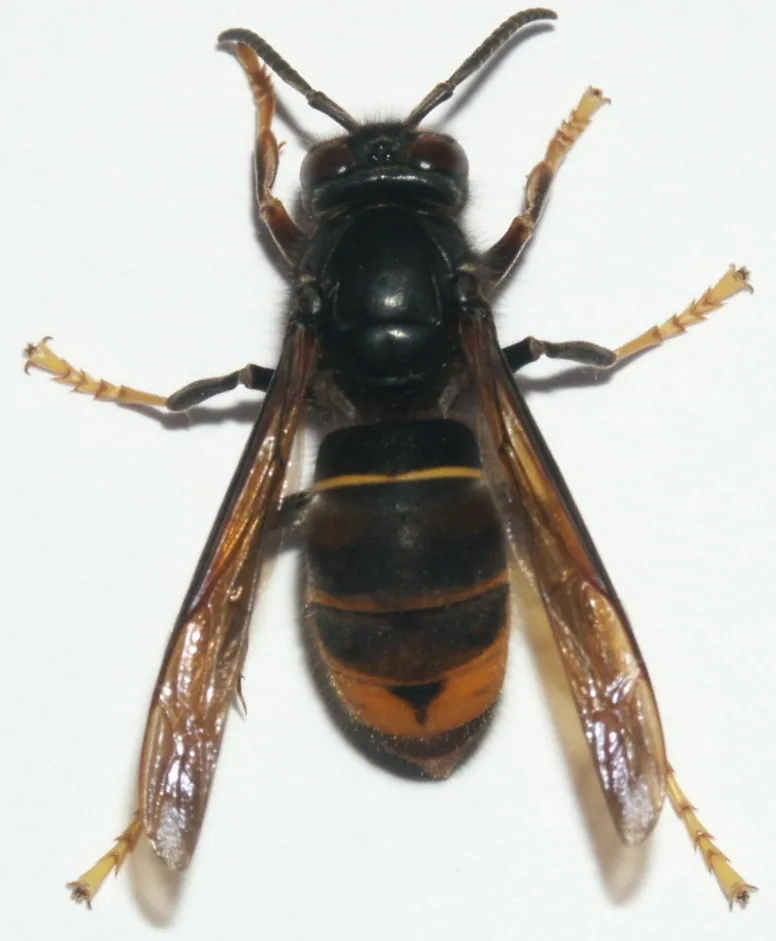
 Come riconoscerlo
- Queens are about 3 cm long, males about 2.4 cm and workers about 2 cm, so it is significantly smaller than the European hornet.1
- Its legs (tarsi) are yellow, which gives it the name yellow-legged hornet.1
- The thorax is velvety brown or black, with a brown abdomen.1
- Each abdominal segment has a narrow yellow border at the back, except the fourth segment, which is orange.1
- The head is black and the face is yellow.1
Spesso confuso con: It looks like the European hornet (V. crabro), which is much larger. Its nest exit is usually on the side rather than at the bottom.1
Potere del veleno
Il veleno esce da un pungiglione.
Cosa fa il suo veleno?
Multiple stings have caused anaphylactic shock, a severe allergic reaction, in people who were hospitalised in France.1
Quanto è pericoloso per le persone?
Pericolo per le persone: DolorosoPuò fare davvero male, ma non è quasi mai grave.Although the species is not aggressive, people have been attacked after disturbing nests. A man in Galicia, Spain, was killed in 2017 after being stung over 20 times while pruning an apple tree. Several people have died in south west France, including in 2019 and 2020. Because of its larger size, its stings are more serious than those of western honeybees.1
Cosa fa quando ha paura?
When it feels its nest is threatened, it charges in a group.1
 Se punge
- Raschia via il pungiglione d'ape e raffredda la zona.
- Se la persona fa fatica a respirare, ha il viso o la gola gonfi, o si sente svenire, è un'emergenza allergica: chiama il numero di emergenza e usa il suo autoiniettore di adrenalina, se ne ha uno.
Chiama sempre prima il numero di emergenza (112, 000, 911). Queste sono indicazioni generali di primo soccorso, non consigli medici. Primo soccorso di base
 Stai al sicuro
- Non toccare, catturare o stuzzicare mai un animale selvatico, anche se è piccolo e anche se sembra addormentato o morto.
- Lasciagli spazio. Se ne incontri uno, resta calmo, indietreggia piano e lascialo andare per la sua strada.
- Se uno ti punge: resta calmo, stai fermo, chiama il numero di emergenza (112, 000, 911) o vai subito in ospedale. Ricorda com'era, una foto aiuta.
Non ce l'ha con te. Usa il veleno per procurarsi il cibo o per difendersi, e preferisce di gran lunga nascondersi. Altro su come stare al sicuro
Dove nel mondo?
Quanto è grande?
Quanto è lungo?
 lungo più o meno come una graffetta
 potrebbe attraversare in volo un intero campo da calcio in 13 secondi
Quanto è grande Asian hornet rispetto a TE?
Solo calcoli nel tuo browser. Niente viene salvato o inviato da nessuna parte.
Quanto è veloce?


Informazioni
In its native range, its main prey is the eastern honeybee, which defends the hive by balling hornets and raising the temperature inside the ball to a level that kills the hornet.1
A hornet hunting honeybees holds a territory of about 0.5 m² above a beehive and catches bees as they return to the hive.1
It is believed to have reached France in boxes of pottery from China in 2004.1
A colony often starts a nest in a low shrub, then abandons it after some months and builds a new one high in a tree, possibly to avoid parasites.1
Young queens leave the colony in late autumn and hibernate over winter.1
Sfatiamo i miti
Mito: Asian hornets are aggressive and will attack anyone who comes near.
Verità: The species is not aggressive, but it will charge in a group when it feels its nest is threatened.1
Da dove vengono le informazioni
- Asian hornet (Wikipedia (CC BY-SA 4.0))
- Vespa velutina (iNaturalist): nomi e classificazione.
- Venom Wiki: il livello di pericolo, la taglia tipica e la stima della velocità sono nostri. Guarda come li calcoliamo: Come valutiamo il pericolo.
Ogni informazione in questa pagina ha un numero che rimanda alla sua fonte. Se abbiamo sbagliato qualcosa, scusa, siamo appassionati di animali, non una rivista scientifica. Scrivici a [email protected] e lo correggeremo.
 Lo scorpione ha fame! Venom Wiki è un progetto di una sola persona: gratis, senza pubblicità e senza tracker. Una piccola mancia aiuta a tenerlo online.Dai da mangiare allo scorpione
Altri dello stesso gruppo: Api, vespe e calabroni
 Asian giant hornetApi, vespe e calabroniPuò uccidere
 Common waspApi, vespe e calabroniFa solo male
 European hornetApi, vespe e calabroniFa solo male
 Western honey beeApi, vespe e calabroniFa solo male
 Giant honey beeApi, vespe e calabroniServe un medico
 European paper waspApi, vespe e calabroniFa solo male
 Scorpione giallo palestinese
 Cobra indiano
 Echide carenata
 Cobra reale
 Vipera soffiante
 Vipera di Russell