
 Africa
 Asia
Asia Europa
 Sud America
 Australia e Oceania
 Antartide
 Oceano Pacifico
 Oceano Atlantico
 Oceano Indiano
 Oceano Artico
 Mar Mediterraneo
 Mar Rosso
 Mar dei Caraibi
 Mar dei Coralli
 Mar Cinese Meridionale
 Mar delle Filippine
 Mare delle Andamane
 Mare del Nord
 Mar di Timor e Mar degli Arafura
 Golfo del Bengala
 Golfo di California
By-the-wind sailor
 Tentacoli urticanti
The by-the-wind sailor is a small, deep blue animal that floats on the surface of the open ocean. It is not a single creature but a colony of tiny linked animals, and it moves by catching the wind with a small stiff sail. Its stinging tentacles are generally harmless to people, but they can irritate the skin.1

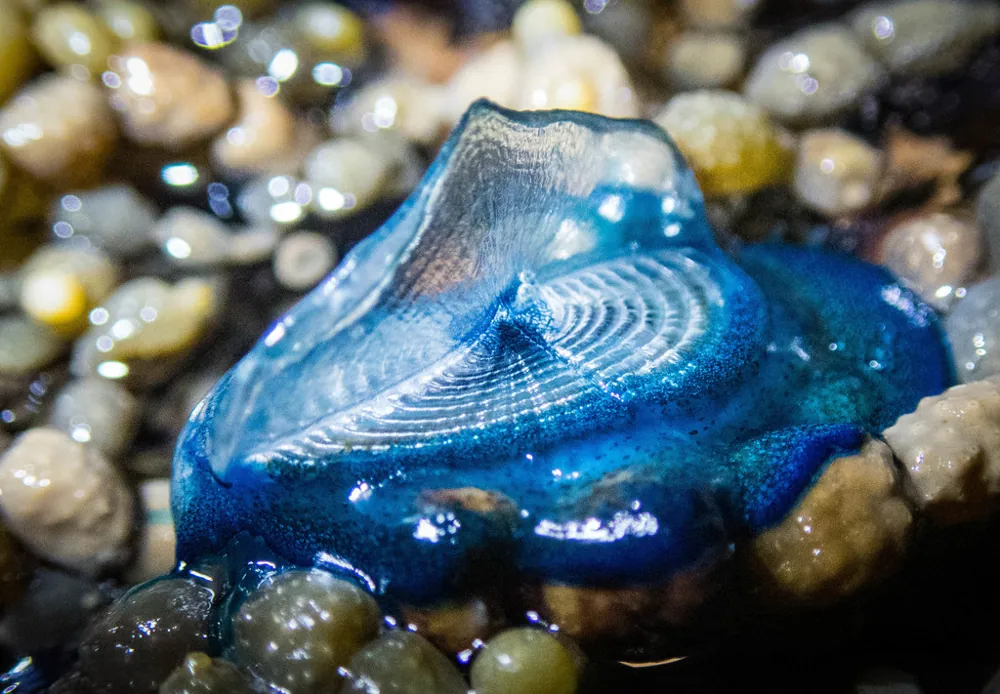
 Come riconoscerlo
Potere del veleno
Migliaia di minuscole cellule urticanti scattano quando qualcosa le tocca.
Cosa fa il suo veleno?
Its nematocysts contain toxins that are effective against its prey, which are mostly plankton. The nematocysts are relatively benign to humans, but each person may respond differently to the toxin. Contact may cause irritation to exposed skin.1
Quanto è pericoloso per le persone?
Pericolo per le persone: LieveCome una puntura d'ape o meno. In pratica innocuo per le persone.It is relatively harmless to humans. Its main effect is possible skin irritation after contact. Mass strandings can leave large numbers of dying and rotting animals on beaches.1
 Se punge
- Esci dall'acqua e togli i tentacoli rimasti (con i guanti o un panno).
- Per le cubomeduse tropicali: versa aceto sulle punture per almeno 30 secondi, chiama aiuto e preparati a fare la RCP. Per le caravelle portoghesi e la maggior parte delle altre: sciacqua con acqua di mare, poi acqua calda per il dolore.
Chiama sempre prima il numero di emergenza (112, 000, 911). Queste sono indicazioni generali di primo soccorso, non consigli medici. Primo soccorso di base
 Stai al sicuro
- Non toccare, catturare o stuzzicare mai un animale selvatico, anche se è piccolo e anche se sembra addormentato o morto.
- Lasciagli spazio. Se ne incontri uno, resta calmo, indietreggia piano e lascialo andare per la sua strada.
- Se uno ti punge: resta calmo, stai fermo, chiama il numero di emergenza (112, 000, 911) o vai subito in ospedale. Ricorda com'era, una foto aiuta.
Non ce l'ha con te. Usa il veleno per procurarsi il cibo o per difendersi, e preferisce di gran lunga nascondersi. Altro su come stare al sicuro
Dove nel mondo?
Quanto è grande?
Quanto è lungo?
 lungo come 2 mattoncini da costruzione in fila
 potrebbe nuotare per tutta la lunghezza di una grande piscina (50 m) in 180 secondi
Quanto è grande By-the-wind sailor rispetto a TE?
Solo calcoli nel tuo browser. Niente viene salvato o inviato da nessuna parte.
Quanto è veloce?

Informazioni
Its floating colonies are mirror images of each other, either 'left-handed' or 'right-handed', and this affects where they drift. In the northern Pacific, one form tends to drift to North America and the other to eastern Asia, such as Japan.1
Each blue 'animal' with a sail is really a colony of linked polyps that share food through a canal system.1
Each colony is either all male or all female.1
Its sail is not a fin. It works like a sail, so the animal tends to drift downwind at a small angle to the wind.1
Its tiny jellyfish carry zooxanthellae, single-celled organisms that use sunlight to provide energy, a feature also found in corals.1
It has no means of moving other than its sail, so it depends on prevailing winds, and mass strandings on beaches happen in many parts of the world.1
Sfatiamo i miti
Mito: Each blue sail is a single, simple animal.
Verità: Each apparent individual is a colony of many connected polyps that share food and divide the work between feeding, reproductive and protective polyps.1
Per gli esperti di veleni
- Nome scientifico
- Velella velella
- Gruppo
- Meduse e altri urticanti marini
- Famiglia
- Porpitidae2
- Ordine
- Anthoathecata
- Continenti
- Oceano Pacifico, Oceano Atlantico, Oceano Indiano, Mar Mediterraneo, Oceano Meridionale, Antartide, Gli oceani
- Cuccioli
- Each colony's feeding polyps (gonozooids) bud off thousands of tiny jellyfish, each about 1 mm wide, over several weeks. These develop into a free-swimming larva called a conaria, which grows into a new floating colony.1
- Pericolo per le persone
- 1 / 5: Lieve3
Da dove vengono le informazioni
- Velella (Wikipedia (CC BY-SA 4.0))
- Velella velella (iNaturalist): nomi e classificazione.
- Venom Wiki: il livello di pericolo, la taglia tipica e la stima della velocità sono nostri. Guarda come li calcoliamo: Come valutiamo il pericolo.
Ogni informazione in questa pagina ha un numero che rimanda alla sua fonte. Se abbiamo sbagliato qualcosa, scusa, siamo appassionati di animali, non una rivista scientifica. Scrivici a [email protected] e lo correggeremo.
 Lo scorpione ha fame! Venom Wiki è un progetto di una sola persona: gratis, senza pubblicità e senza tracker. Una piccola mancia aiuta a tenerlo online.Dai da mangiare allo scorpione
Altri dello stesso gruppo: Meduse e altri urticanti marini
 Vespa di mareMeduse e altri urticanti mariniMortaleNon toccare
 Irukandji jellyfishMeduse e altri urticanti mariniPuò uccidereNon toccare
 Portuguese man o' warMeduse e altri urticanti mariniServe un medicoNon toccare
 Lion's mane jellyfishMeduse e altri urticanti mariniFa solo maleNon toccare
 Moon jellyfishMeduse e altri urticanti mariniInnocuo
 Common kingslayerMeduse e altri urticanti mariniPuò uccidereNon toccare
Vive anche in: Oceano Pacifico
 Cono geografoMolluschi cono e polpiMortale
 Polpo dagli anelli blu maggioreMolluschi cono e polpiMortale
 Pesce palla giapponeseAltri animali tossiciMortale
 Polpo dagli anelli blu meridionaleMolluschi cono e polpiMortale
 Hawksbill sea turtleAltri animali tossiciPuò uccidere
 Reef stonefishPesci velenosiPuò uccidereNon toccare