
 Africa
 Asia
Asia Europa
 Sud America
 Australia e Oceania
 Antartide
 Oceano Pacifico
 Oceano Atlantico
 Oceano Indiano
 Oceano Artico
 Mar Mediterraneo
 Mar Rosso
 Mar dei Caraibi
 Mar dei Coralli
 Mar Cinese Meridionale
 Mar delle Filippine
 Mare delle Andamane
 Mare del Nord
 Mar di Timor e Mar degli Arafura
 Golfo del Bengala
 Golfo di California
Crown-of-thorns starfish
 Spine velenose
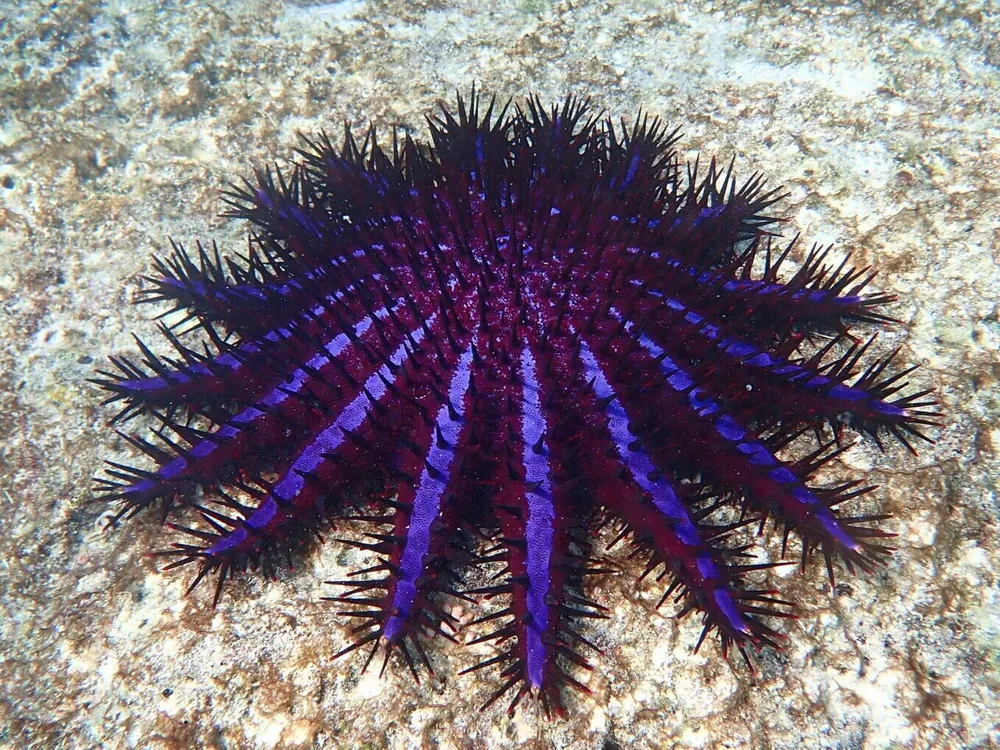
The crown-of-thorns starfish is a large starfish with long, sharp spines that look like a crown of thorns. It lives on coral reefs across the Indo-Pacific, from the Red Sea to the west coast of Central America, and it is most common around Australia. It feeds on hard coral, so it can change the reefs it lives on.1

 Come riconoscerlo
- Adults are normally 25 to 35 cm across.1
- Up to 21 arms, with long, stiff, very sharp spines that are 4 to 5 cm long on the top and sides of the arms.1
- Colour varies with diet or region: purple, purple-blue, reddish grey or brown with red spine tips, or green with yellow spine tips.1
- The body is flexible and can bend and twist around coral surfaces.1
Spesso confuso con: A close relative, Acanthaster brevispinus, lives on soft sea floors at moderate depths rather than on coral reefs. The two are considered sibling species.1
Potere del veleno
Spine aguzze portano il veleno. Calpestarlo o afferrarlo fa male.
Cosa fa il suo veleno?
The spines do not inject venom. When they pierce skin, tissue containing saponins (detergent-like chemicals) is left in the wound. In humans this causes a sharp, stinging pain that can last several hours, persistent bleeding, and nausea and swelling that may last a week or more.1
Quanto è pericoloso per le persone?
Pericolo per le persone: GraveSe le sue spine ti trafiggono, vai dal medico. Le morti sono molto rare.The spines can cause sharp pain, long-lasting bleeding, nausea and swelling. Brittle spines can break off and stay in the tissue.1
 Se le sue spine ti trafiggono
- Spines that become embedded in the tissue must be removed surgically.1
- Metti la ferita in acqua calda, calda quanto la persona riesce a sopportare senza scottarsi, e cerca aiuto medico per togliere le spine. Non scavare per toglierle da solo.
Chiama sempre prima il numero di emergenza (112, 000, 911). Queste sono indicazioni generali di primo soccorso, non consigli medici. Primo soccorso di base
 Stai al sicuro
- Non toccare, catturare o stuzzicare mai un animale selvatico, anche se è piccolo e anche se sembra addormentato o morto.
- Lasciagli spazio. Se ne incontri uno, resta calmo, indietreggia piano e lascialo andare per la sua strada.
- Se le sue spine ti trafiggono: resta calmo, stai fermo, chiama il numero di emergenza (112, 000, 911) o vai subito in ospedale. Ricorda com'era, una foto aiuta.
Non ce l'ha con te. Usa il veleno per procurarsi il cibo o per difendersi, e preferisce di gran lunga nascondersi. Altro su come stare al sicuro
Dove nel mondo?
Quanto è grande?
Quanto è lungo?
 lungo come 11 mattoncini da costruzione in fila
 più lento di una chiocciola da giardino
Quanto è grande Crown-of-thorns starfish rispetto a TE?
Solo calcoli nel tuo browser. Niente viene salvato o inviato da nessuna parte.
Quanto è veloce?

.jpg)
Informazioni
An individual starfish can consume up to 6 square metres of living coral reef per year.1
When taken out of water, its soft body ruptures and collapses, but its spines can recover their shape if it is put back in the water while still alive.1
Its body contains detergent-like saponins, so keeping starfish in small volumes of water with aeration produces large amounts of foam.1
It is one of the largest starfish in the world.1
It has lost the usual five-fold symmetry of starfish as it grew more arms, although it begins life with five-fold symmetry.1
Sfatiamo i miti
Mito: Its spines inject venom like a snake or stinging animal.
Verità: It has no mechanism for injecting toxin. Its spines pierce skin and leave saponin-containing tissue in the wound.1
Per gli esperti di veleni
- Nome scientifico
- Acanthaster planci
- Gruppo
- Ricci, stelle e vermi
- Famiglia
- Acanthasteridae2
- Ordine
- Valvatida
- Continenti
- Oceano Indiano, Oceano Pacifico, Mar Rosso, Mar dei Coralli, Mar delle Filippine, Mar Cinese Meridionale, Mare delle Andamane, Mar Arabico e Golfo Persico, Mar di Timor e Mar degli Arafura, Golfo del Bengala, Gli oceani
- Cuccioli
- It releases vast amounts of eggs and sperm (gametes) during mass spawning events in summer, and the eggs contain saponins similar to those in adults.1
- Pericolo per le persone
- 3 / 5: Grave3
Da dove vengono le informazioni
- Crown-of-thorns starfish (Wikipedia (CC BY-SA 4.0))
- Acanthaster planci (iNaturalist): nomi e classificazione.
- Venom Wiki: il livello di pericolo, la taglia tipica e la stima della velocità sono nostri. Guarda come li calcoliamo: Come valutiamo il pericolo.
Ogni informazione in questa pagina ha un numero che rimanda alla sua fonte. Se abbiamo sbagliato qualcosa, scusa, siamo appassionati di animali, non una rivista scientifica. Scrivici a [email protected] e lo correggeremo.
 Lo scorpione ha fame! Venom Wiki è un progetto di una sola persona: gratis, senza pubblicità e senza tracker. Una piccola mancia aiuta a tenerlo online.Dai da mangiare allo scorpione
Altri dello stesso gruppo: Ricci, stelle e vermi
 Flower urchinRicci, stelle e vermiPuò uccidere
 Fire urchinRicci, stelle e vermiServe un medicoNon toccare
 Bearded firewormRicci, stelle e vermiFa solo maleNon toccare
 Black long-spined urchinRicci, stelle e vermiFa solo maleNon toccare
 BloodwormRicci, stelle e vermiFa solo male
 Bobbit wormRicci, stelle e vermiFa solo male
Vive anche in: Oceano Indiano
 Vespa di mareMeduse e altri urticanti mariniMortaleNon toccare
 Cono geografoMolluschi cono e polpiMortale
 Polpo dagli anelli blu maggioreMolluschi cono e polpiMortale
 Polpo dagli anelli blu meridionaleMolluschi cono e polpiMortale
 Hawksbill sea turtleAltri animali tossiciPuò uccidere
 Irukandji jellyfishMeduse e altri urticanti mariniPuò uccidereNon toccare