
 Africa
 Asia
Asia Europa
 Sud America
 Australia e Oceania
 Antartide
 Oceano Pacifico
 Oceano Atlantico
 Oceano Indiano
 Oceano Artico
 Mar Mediterraneo
 Mar Rosso
 Mar dei Caraibi
 Mar dei Coralli
 Mar Cinese Meridionale
 Mar delle Filippine
 Mare delle Andamane
 Mare del Nord
 Mar di Timor e Mar degli Arafura
 Golfo del Bengala
 Golfo di California
Spotted jelly
 Tentacoli urticanti
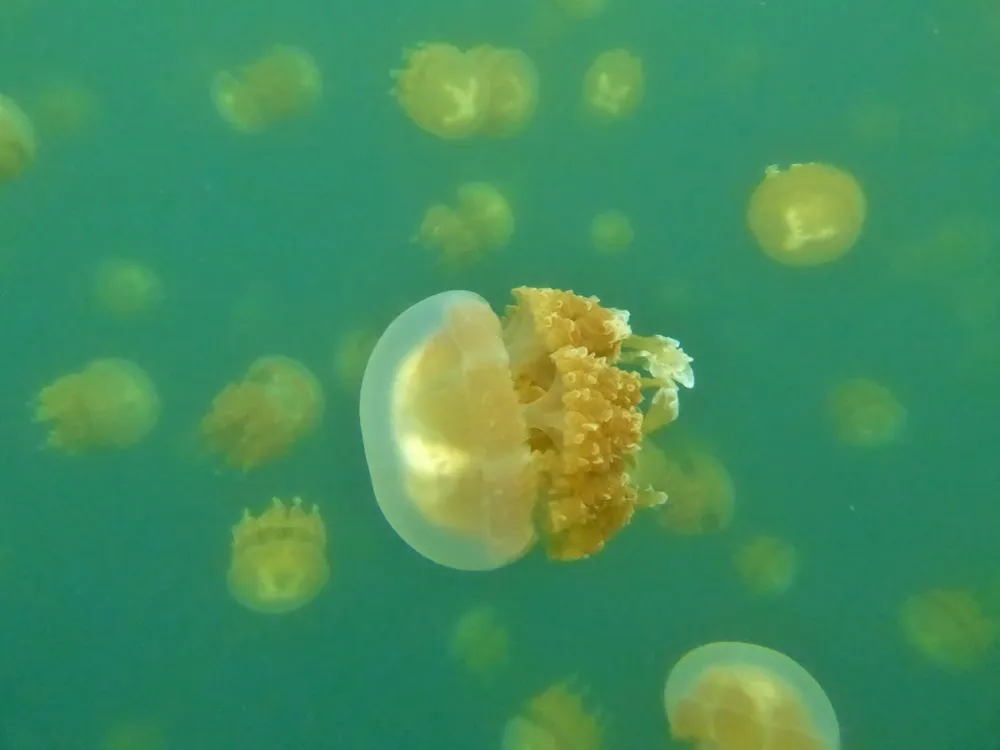
The spotted jelly is a jellyfish with spots on the top of its bell, the rounded body. It lives in the warm Indo-Pacific oceans, and in some saltwater lakes in Palau and Indonesia. Its lake populations are famous because they have lost most of their sting.1


 Come riconoscerlo
- Distinctive spots on the top of the bell1
- Colour ranges from greenish blue to olive green, from the algae living in its tissues1
- Eight rhopalia (sensory organs) along the edge of the bell1
- Eight frilled oral arms, each ending in a club-like appendage1
- Numerous small mouths along the bottom of the oral arms, unlike many other jellies1
Potere del veleno
Migliaia di minuscole cellule urticanti scattano quando qualcosa le tocca.
Cosa fa il suo veleno?
The venom is protein-based and is delivered by stinging cells called nematocytes (cnidocytes) on the upper surfaces of the oral arms. In jellyfish living in marine lakes, conditions in the lake are thought to break down this venom, so those populations do not sting humans.1
Quanto è pericoloso per le persone?
Pericolo per le persone: LieveCome una puntura d'ape o meno. In pratica innocuo per le persone.Jellyfish in the open ocean have stinging cells on their oral arms. Populations in marine lakes, such as Jellyfish Lake in Palau, do not sting humans.1
 Se punge
- Esci dall'acqua e togli i tentacoli rimasti (con i guanti o un panno).
- Per le cubomeduse tropicali: versa aceto sulle punture per almeno 30 secondi, chiama aiuto e preparati a fare la RCP. Per le caravelle portoghesi e la maggior parte delle altre: sciacqua con acqua di mare, poi acqua calda per il dolore.
Chiama sempre prima il numero di emergenza (112, 000, 911). Queste sono indicazioni generali di primo soccorso, non consigli medici. Primo soccorso di base
 Stai al sicuro
- Non toccare, catturare o stuzzicare mai un animale selvatico, anche se è piccolo e anche se sembra addormentato o morto.
- Lasciagli spazio. Se ne incontri uno, resta calmo, indietreggia piano e lascialo andare per la sua strada.
- Se uno ti punge: resta calmo, stai fermo, chiama il numero di emergenza (112, 000, 911) o vai subito in ospedale. Ricorda com'era, una foto aiuta.
Non ce l'ha con te. Usa il veleno per procurarsi il cibo o per difendersi, e preferisce di gran lunga nascondersi. Altro su come stare al sicuro
Dove nel mondo?
Quanto è grande?
Quanto è lungo?
 lungo come 9 mattoncini da costruzione in fila
Quanto è grande Spotted jelly rispetto a TE?
Solo calcoli nel tuo browser. Niente viene salvato o inviato da nessuna parte.
Quanto è veloce?


Informazioni
Lake populations of spotted jellies have lost most of their ability to sting, probably after being cut off in marine lakes long ago.1
Each day, spotted jellies rise to the surface and follow the sun from east to west, so their algae can photosynthesise.1
Lake jellyfish are over three times wider than ocean ones, yet their tentacles are about the same length.1
Unlike many jellies, spotted jellies have several small mouths along their oral arms.1
A sea anemone called Entacmaea medusivora preys on spotted jellies, catching them in its tentacles.1
At night they stay lower in the water column.1
Sfatiamo i miti
Mito: All spotted jellies sting people.
Verità: Ocean populations have stinging cells, but the jellyfish in marine lakes such as Jellyfish Lake in Palau do not sting humans.1
Da dove vengono le informazioni
- Spotted jelly (Wikipedia (CC BY-SA 4.0))
- Mastigias papua (iNaturalist): nomi e classificazione.
- Venom Wiki: il livello di pericolo, la taglia tipica e la stima della velocità sono nostri. Guarda come li calcoliamo: Come valutiamo il pericolo.
Ogni informazione in questa pagina ha un numero che rimanda alla sua fonte. Se abbiamo sbagliato qualcosa, scusa, siamo appassionati di animali, non una rivista scientifica. Scrivici a [email protected] e lo correggeremo.
 Lo scorpione ha fame! Venom Wiki è un progetto di una sola persona: gratis, senza pubblicità e senza tracker. Una piccola mancia aiuta a tenerlo online.Dai da mangiare allo scorpione
Altri dello stesso gruppo: Meduse e altri urticanti marini
 Australian box jellyfishMeduse e altri urticanti mariniMortaleNon toccare
 Irukandji jellyfishMeduse e altri urticanti mariniPuò uccidereNon toccare
 Portuguese man o' warMeduse e altri urticanti mariniServe un medicoNon toccare
 Lion's mane jellyfishMeduse e altri urticanti mariniFa solo maleNon toccare
 Moon jellyfishMeduse e altri urticanti mariniInnocuo
 Common kingslayerMeduse e altri urticanti mariniPuò uccidereNon toccare
Vive anche in: Oceano Pacifico
 Geography coneMolluschi cono e polpiMortale
 Greater blue-ringed octopusMolluschi cono e polpiMortale
 Japanese pufferfishAltri animali tossiciMortale
 Southern blue-ringed octopusMolluschi cono e polpiMortale
 Hawksbill sea turtleAltri animali tossiciPuò uccidere
 Reef stonefishPesci velenosiPuò uccidereNon toccare