
 Afrika
 Azia
Azia Erópa
Erópa Amerika ya Sude
 Australia & Océanie
 Antarctique
 Océan Pacifique
 Océan Atlantique
 Océan Indien
 Océan Arctique
 Mer Méditerranée
 Mer Rouge
 Mer des Caraïbes
 Mer de Corail
 Mer de Chine méridionale
 Mer des Philippines
 Mer d'Andaman
 Mer du Nord
 Mer de Timor & Mer d'Arafura
 Golfe du Bengale
 Golfe de Californie
Bald-faced hornet
 Kotuba
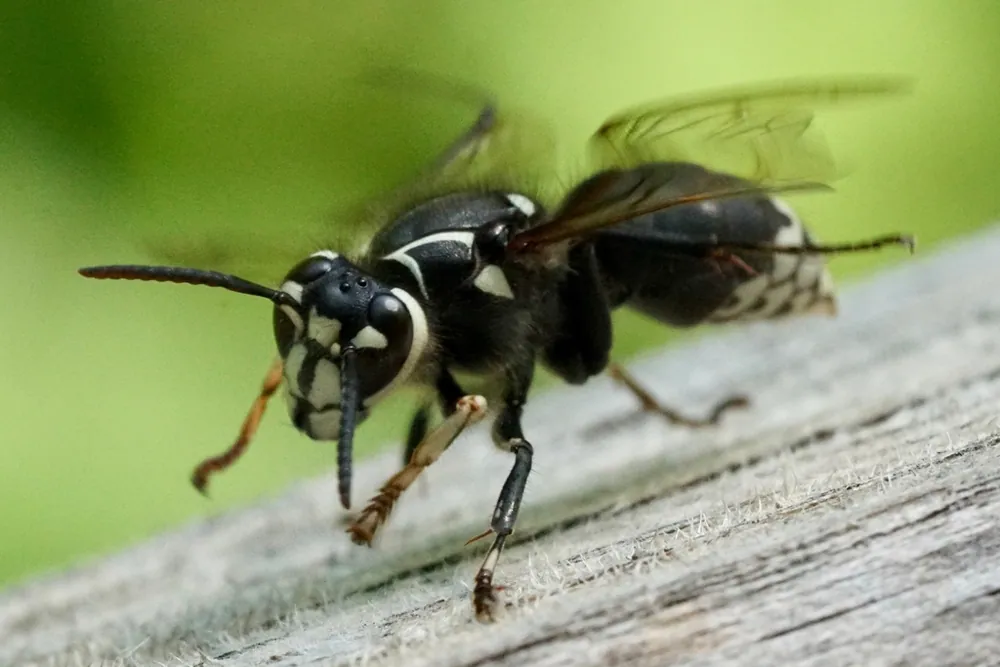
The bald-faced hornet is a wasp with a striking black and white body and a white face. It builds large, hanging paper nests in trees and bushes across North America. Its workers will defend the nest by stinging repeatedly, so it is important to keep well away from its nests.1



 Ndenge ya koyeba yango
- Black and white colouring, unlike other yellowjackets of its genus, which are mostly black and yellow1
- A white or "bald" face1
- Three white stripes at the end of the body1
- Adults average about 19 mm long, larger than other Dolichovespula species1
- A large, egg-shaped, grey paper nest that hangs from trees or bushes, up to 58 cm long1
Bakosanaka yango mbala mingi na: Other Dolichovespula wasps are mostly black and yellow. The bald-faced hornet's black and white colouring and white face set it apart. It is not one of the true hornets, which belong to the genus Vespa.1
Makasi ya venin
Venin ebimaka na nzela ya nsende ya kotuba.
Venin na yango esalaka nini?
Workers can squirt venom from the stinger into the eyes of animals that intrude on the nest. The venom makes the eyes water immediately and causes temporary blindness.1
Likama na yango mpo na bato ezali boni?
Likama mpo na bato: Epesaka pasiEkoki kopesa pasi mingi, kasi pene na ntango nyonso ezalaka likambo monene te.It is aggressive when defending its nest. Workers sting repeatedly, and colonies can have 400 to 700 workers. The risk is highest when people walk too close to a nest or when a nest is built near homes.1
Esalaka nini ntango ebangi?
Workers defend the nest by stinging repeatedly and can squirt venom into the eyes of intruders.1
 Soki etubi
- Longola nsende ya nzoi na kokokola yango, mpe pesa malili na esika yango.
- Soki moto azali na mpasi ya kopema, elongi to kingo evimbi, to ayoki lokola azali kobunga makanisi, ezali likama ya allergie: benga nimero ya urgence na yo mpe salela stylo na ye ya adrénaline (auto-injecteur) soki azali na yango.
Benga ntango nyonso nimero ya urgence liboso (112, 000, 911). Oyo ezali toli ya lisalisi ya liboso, ezali toli ya monganga te. Makambo ya moboko ya lisalisi ya liboso
 Zala na libateli
- Ata mokolo moko te, simba, kanga to silikisa nyama ya zamba te, ata ya moke, mpe ata soki emonani lokola elali to ekufi.
- Tika yango esika. Soki okutani na moko, zala kimia, zonga sima malembe mpe tika ekende nzela na yango.
- Soki moko etubi yo: zala kimia, ningana te, benga nimero ya urgence na yo (112, 000, 911) to kende na lopitalo noki. Kanisa ndenge ezalaki, foto esalisaka.
Ezali koluka yo te. Esalelaka venin na yango mpo na kokanga bilei to komibatela, mpe elingaka mingi kobombama. Makambo mosusu mpo na komibatela
Monene na yango boni?
Molai na yango boni?
 mokuse koleka mosapi na yo ya moke
 ekoki kopumbwa kokatisa terrain mobimba ya football na sekonde 15
Bald-faced hornet azali monene boni soki tokokanisi na YO?
Kaka ba calcul na navigateur na yo. Eloko moko te ebombamaka to etindamaka esika moko.
Mbangu na yango boni?


Makambo ya solo
It can spray venom from its stinger into the eyes of nest intruders, causing temporary blindness.1
Its colony can have 400 to 700 workers, the largest recorded colony size in its genus, Dolichovespula.1
Female bee moths can lay eggs in its nests, and the hatched larvae feed on the eggs, larvae and pupae inside, sometimes destroying large parts of the nest.1
Its nests are made from chewed wood fibres mixed with saliva, which dries into a papery structure.1
A colony lasts about 4 months in Washington, from mid-May to mid-September. Colonies in lower latitudes last longer.1
Solo to lokuta?
Lokuta: It is a true hornet.
Solo: It is a yellowjacket wasp. True hornets belong to the genus Vespa.1
Mpo na ba expert ya venin
- Kombo ya siansi
- Dolichovespula maculata
- Ebota
- Nzoi, ba guêpe & ba frelon
- Libota
- Vespidae2
- Molongo
- Hymenoptera
- Bakontina
- Amerika ya Nord
- Bana
- A single queen starts each new nest in spring, laying eggs that hatch into workers, and later lays eggs that become males and new queens.1
- Likama mpo na bato
- 2 / 5: Epesaka pasi3
Esika makambo euti
- Dolichovespula maculata (Wikipedia (CC BY-SA 4.0))
- Dolichovespula maculata (iNaturalist): bankombo mpe classification.
- Venom Wiki: niveau ya likama, monene ya momesano mpe kokanisa ya mbangu ezali ya biso moko. Tala ndenge tolukaka yango: Ndenge tomekaka likama.
Likambo nyonso na lokasa oyo ezali na nimero oyo elakisi source na yango. Soki tosali libunga, limbisa biso, tozali bato oyo balingaka banyama, zulunale ya siansi te. Yebisa biso na [email protected] mpe tokobongisa yango.
 Scorpion azali na nzala! Venom Wiki ezali mosala ya moto moko: ya ofele, pibilisite te mpe trackers te. Mwa mbongo moke ya kosalisa esalisaka mpo ete etikala na internet.Pesa scorpion bilei
Mosusu ya ebota moko: Nzoi, ba guêpe & ba frelon
 Tarantula hawkNzoi, ba guêpe & ba frelonEpesaka kaka pasi
 Executioner waspNzoi, ba guêpe & ba frelonEsengeli monganga
 Warrior waspNzoi, ba guêpe & ba frelonEsengeli monganga
 Cow killer velvet antNzoi, ba guêpe & ba frelonEpesaka kaka pasi
 Eastern cicada killerNzoi, ba guêpe & ba frelonEzangi likama
 Aerial yellowjacketNzoi, ba guêpe & ba frelonEpesaka kaka pasi
Ezalaka mpe na: Amerika ya Nord
 TerciopeloBa vipère à fossettesEkoki koboma
 Eastern coral snakeBanyoka corailEkoki koboma
 Eastern diamondback rattlesnakeBanyoka ya sonnetteEkoki koboma
 Eyelash viperBa vipère à fossettesEkoki koboma
 Timber rattlesnakeBanyoka ya sonnetteEkoki koboma
 Western diamondback rattlesnakeBanyoka ya sonnetteEkoki koboma