
 Afrika
 Azia
Azia Erópa
Erópa Amerika ya Sude
 Australia & Océanie
 Antarctique
 Océan Pacifique
 Océan Atlantique
 Océan Indien
 Océan Arctique
 Mer Méditerranée
 Mer Rouge
 Mer des Caraïbes
 Mer de Corail
 Mer de Chine méridionale
 Mer des Philippines
 Mer d'Andaman
 Mer du Nord
 Mer de Timor & Mer d'Arafura
 Golfe du Bengale
 Golfe de Californie
Mojave rattlesnake
 Kosua
KosuaThe Mojave rattlesnake is a venomous pit viper that lives in the deserts of the southwestern United States and northern Mexico. Its venom is among the most studied of any rattlesnake, and it varies a lot from one population to another. Knowing how to recognise it helps people in its range stay safe.1


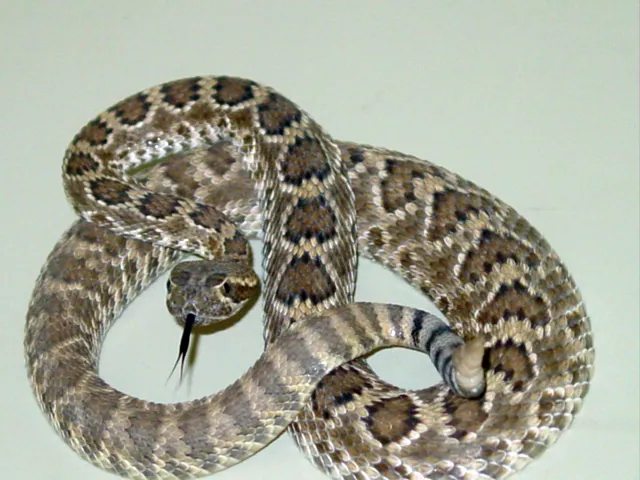
 Ndenge ya koyeba yango
- Has a row of large diamond-shaped blotches along the back, without the dark speckling found on the Western Diamond-backed Rattlesnake.1
- The diamonds usually lack the white edges seen on most Western Diamond-backed Rattlesnakes.1
- The tail has pale and dark rings, and the dark rings are often narrower than the pale ones.1
- The rattle is usually yellow and black, or entirely yellow.1
- Its back colour ranges from green to brown, grey or yellowish, so colour alone is not a reliable guide.1
Bakosanaka yango mbala mingi na: It closely resembles the Western Diamond-backed Rattlesnake, which lives in the same areas. The Mojave rattlesnake has no dark speckling on its back, usually lacks white edges on the diamonds, has a facial stripe that bends toward the neck rather than meeting the mouth, and usually has a yellow or bicoloured rattle rather than a black one. No single trait reliably separates the two.1
Makasi ya venin
Venin ebimaka na nzela ya mino na yango ntango esui.
Venin na yango esalaka nini?
Its venom comes in two main types. Venom A contains Mojave toxin, a neurotoxic venom that attacks the nerves and can cause delayed respiratory paralysis, meaning the muscles used for breathing fail, with little or no local tissue damage. Venom B has no Mojave toxin and instead contains tissue-destroying enzymes called metalloproteinases.1
Likama na yango mpo na bato ezali boni?
Likama mpo na bato: Likama mingiEkoki koboma moto oyo azwi bosalisi te.For decades this snake has been described as one of the deadliest rattlesnakes, and some sources call it the most dangerous snake in the United States. The danger depends on the population, because the neurotoxic venom is not found everywhere in its range. Some animals in between produce a mix of both venom types.1
Esalaka nini ntango ebangi?
It is shy and tends to avoid confrontation, but it will strike and bite vigorously when disturbed, especially if surprised or if there is no nearby vegetation or burrow to escape into.1
 Soki esui
- Tika moto aningana te mpe azala kimia, tika lokolo to loboko oyo esui na niveau ya motema, longola ba bague mpe biloko oyo ekangi makasi, mpe kende na lopitalo noki.
Benga ntango nyonso nimero ya urgence liboso (112, 000, 911). Oyo ezali toli ya lisalisi ya liboso, ezali toli ya monganga te. Makambo ya moboko ya lisalisi ya liboso
 Zala na libateli
- Ata mokolo moko te, simba, kanga to silikisa nyama ya zamba te, ata ya moke, mpe ata soki emonani lokola elali to ekufi.
- Tika yango esika. Soki okutani na moko, zala kimia, zonga sima malembe mpe tika ekende nzela na yango.
- Soki moko esui yo: zala kimia, ningana te, benga nimero ya urgence na yo (112, 000, 911) to kende na lopitalo noki. Kanisa ndenge ezalaki, foto esalisaka.
Ezali koluka yo te. Esalelaka venin na yango mpo na kokanga bilei to komibatela, mpe elingaka mingi kobombama. Makambo mosusu mpo na komibatela
Monene na yango boni?
Molai na yango boni?
 molai lokola ba pusu ya ndako 2,5, zolo kino mokila
 molai lokola bitabe 7 oyo etiami moko na sima ya mosusu
 ekoki kopota metre 100 na sekonde 97 (moto ya mbangu koleka asengaka 9,6)
Mojave rattlesnake azali monene boni soki tokokanisi na YO?
Kaka ba calcul na navigateur na yo. Eloko moko te ebombamaka to etindamaka esika moko.
Mbangu na yango boni?


Makambo ya solo
Solo to lokuta?
Lokuta: Every Mojave rattlesnake bite is extraordinarily deadly.
Solo: The reputation for deadliness comes mainly from the neurotoxic venom, which is found in most populations but not all. Venom from some populations is non-neurotoxic and mainly destroys tissue.1
Mpo na ba expert ya venin
- Kombo ya siansi
- Crotalus scutulatus
- Ebota
- Banyoka ya sonnette
- Libota
- Viperidae2
- Molongo
- Squamata
- Bakontina
- Amerika ya Nord
- Bana
- It bears live young, usually between 2 and 17 (average about eight), from July through September.1
- Ndenge ezali kobika na zamba
- Least Concern (IUCN Red List)1
- Likama mpo na bato
- 4 / 5: Likama mingi3
Esika makambo euti
- Crotalus scutulatus (Wikipedia (CC BY-SA 4.0))
- Crotalus scutulatus (iNaturalist): bankombo mpe classification.
- Venom Wiki: niveau ya likama, monene ya momesano mpe kokanisa ya mbangu ezali ya biso moko. Tala ndenge tolukaka yango: Ndenge tomekaka likama.
Likambo nyonso na lokasa oyo ezali na nimero oyo elakisi source na yango. Soki tosali libunga, limbisa biso, tozali bato oyo balingaka banyama, zulunale ya siansi te. Yebisa biso na [email protected] mpe tokobongisa yango.
 Scorpion azali na nzala! Venom Wiki ezali mosala ya moto moko: ya ofele, pibilisite te mpe trackers te. Mwa mbongo moke ya kosalisa esalisaka mpo ete etikala na internet.Pesa scorpion bilei
Mosusu ya ebota moko: Banyoka ya sonnette
 Eastern diamondback rattlesnakeBanyoka ya sonnetteEkoki koboma
 Timber rattlesnakeBanyoka ya sonnetteEkoki koboma
 Western diamondback rattlesnakeBanyoka ya sonnetteEkoki koboma
 SidewinderBanyoka ya sonnetteEsengeli monganga
 Aruba rattlesnakeBanyoka ya sonnetteEsengeli monganga
 Black-tailed rattlesnakeBanyoka ya sonnetteEsengeli monganga
Ezalaka mpe na: Amerika ya Nord
 TerciopeloBa vipère à fossettesEkoki koboma
 Eastern coral snakeBanyoka corailEkoki koboma
 Eyelash viperBa vipère à fossettesEkoki koboma
 Arizona bark scorpionBa scorpionEsengeli monganga
 Brown recluseBa tandambulaEsengeli monganga
 Cane toadBa grenouille ya poison, ba crapaud & ba tritonEsengeli mongangaKosimba te