
 Afrika
 Azija
Azija Europa
 Pietų Amerika
 Australija ir Okeanija
 Antarktida
 Ramusis vandenynas
 Atlanto vandenynas
 Indijos vandenynas
 Arkties vandenynas
 Viduržemio jūra
 Raudonoji jūra
 Karibų jūra
 Koralų jūra
 Pietų Kinijos jūra
 Filipinų jūra
 Andamanų jūra
 Šiaurės jūra
 Timoro ir Arafūros jūros
 Bengalijos įlanka
 Kalifornijos įlanka
Black-banded jumper ant
 Įgėlimai
The black-banded jumper ant is a large ant that can leap up to 10 centimetres, which is far above its own body length. It lives in eastern Australia, including suburbs of Sydney and Brisbane. Its sting is painful and can cause serious allergic reactions in some people, so it is worth knowing how to recognise it.1



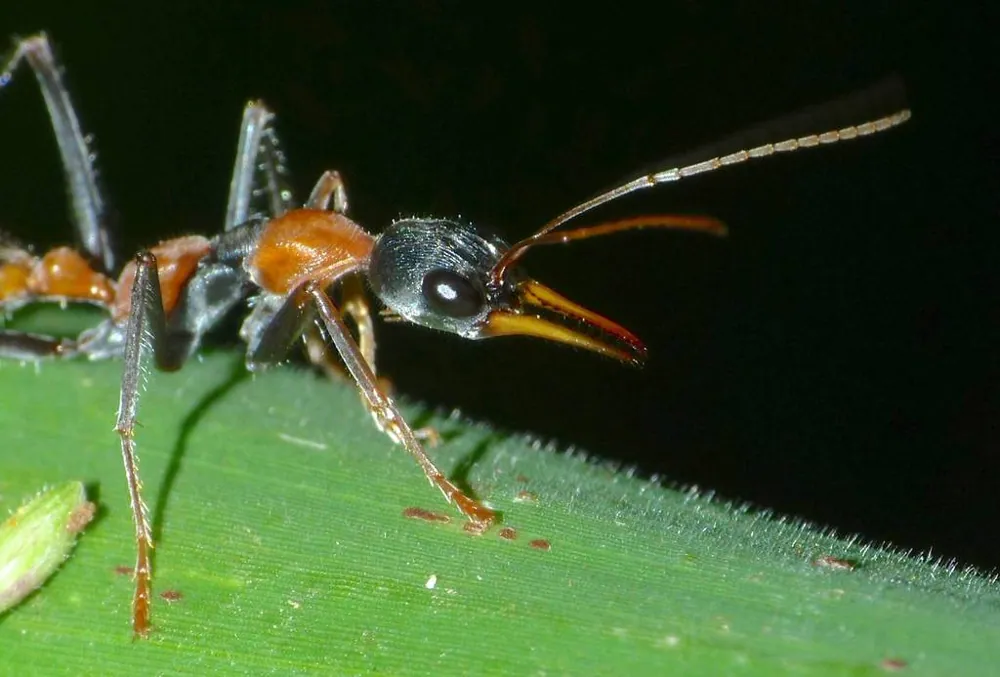
 Kaip jį atpažinti
- Mostly black and orange-red in colour.1
- The gaster (rear body), head, legs and mesonotum (middle back) are black, while the pronotum, propodeum, petiole and post-petiole are red.1
- Mandibles (jaws) are either black or yellow, depending on where the ant lives.1
- Workers are 13 to 15 mm long, males 16 to 17 mm, and queens 17 to 19 mm.1
- It can leap 76 to 102 mm by suddenly extending its middle and hind legs.1
Dažnai painiojamas su: It is often confused with other Myrmecia species. It can be told apart by its bi-coloured thorax and post-petiole, which are yellowish-red and black, and by its yellowish-red node.1
Nuodų galia
Nuodai išeina per geluonį.
Ką daro jo nuodai?
Its sting is highly venomous and causes intense burning pain. The burning can last for many days, and the sting itches. If the sting is left untreated, it may develop into an ulcer (an open sore). The venom of a close relative, M. pilosula, is among the strongest of all ants and contains acids, enzymes and phospholipases.1
Koks jis pavojingas žmonėms?
Pavojus žmonėms: SkausmingasGali labai skaudėti, bet beveik niekada nebūna rimta.A 2011 study of Australian ant allergies found that 265 of 376 participants reacted to the stings of several Myrmecia species, which can cause anaphylaxis (a severe, whole-body allergic reaction). Of these, 15 reacted to this species, while 176 reacted to M. pilosula. The study concluded that Myrmecia species were among four main groups of Australian ants responsible for anaphylaxis.1
Ką jis daro, kai išsigąsta?
When threatened, workers and scouts quickly defend the nest and may react aggressively even to a shadow crossing it, bursting out in short hops to attack.1
 Jei jis įgelia
- Nuplauk ir atvėsink įgėlimus.
- Jei žmogui sunku kvėpuoti, tinsta veidas ar gerklė arba jis jaučiasi lyg tuoj nualps, tai skubi alerginė būklė: skambink pagalbos numeriu.
Visada pirmiausia skambink pagalbos numeriu (112, 000, 911). Tai bendri pirmosios pagalbos patarimai, o ne medicininė konsultacija. Pirmosios pagalbos pagrindai
 Būk saugus
- Niekada neliesk, negaudyk ir neerzink laukinio gyvūno, net mažo, ir net jei jis atrodo miegantis ar negyvas.
- Palik jam vietos. Jei tokį sutiksi, išlik ramus, lėtai atsitrauk ir leisk jam eiti savo keliu.
- Jei toks tau įgėlė: išlik ramus, nejudėk, skambink pagalbos numeriu (112, 000, 911) arba greitai vyk į ligoninę. Įsimink, kaip jis atrodė, nuotrauka padeda.
Jis nesiruošia tavęs medžioti. Nuodus jis naudoja maistui sugauti arba apsiginti ir daug mieliau pasislėptų. Daugiau apie saugumą
Koks jis didelis?
Koks jis ilgas?
 trumpesnis už tavo mažąjį pirštelį
Koks didelis Black-banded jumper ant, palyginti su TAVIMI?
Tik matematika tavo naršyklėje. Niekas neišsaugoma ir niekur nesiunčiama.
Koks jis greitas?


Faktai
It can jump between 76 and 102 mm, which is far more than its own body length.1
Colonies can continue without a queen, because workers can lay fertile eggs.1
It often forages in trees, where it visits the flowers of some eucalyptus and senna plants and may help pollinate them.1
A worker can live for over a year, with a maximum of about 1.3 years.1
Its nests are camouflaged with twigs, leaves, gravel and other plant material.1
Nuodų ekspertams
- Mokslinis pavadinimas
- Myrmecia nigrocincta
- Grupė
- Skruzdėlės
- Šeima
- Formicidae2
- Tvarka
- Hymenoptera
- Žemynai
- Australija ir Okeanija
- Mažyliai
- Worker-laid eggs can be reared into males in colonies with no queen. Colonies typically have between 400 and 1200 individuals.1
- Gyvenimo trukmė
- apie 1,3 metų1
- Pavojus žmonėms
- 2 / 5: Skausmingas3
Iš kur faktai
- Myrmecia nigrocincta (Wikipedia (CC BY-SA 4.0))
- Myrmecia nigrocincta (iNaturalist): pavadinimai ir klasifikacija.
- Venom Wiki: pavojaus lygis, tipiškas dydis ir greičio spėjimas yra mūsų pačių. Pažiūrėk, kaip juos apskaičiuojame: Kaip vertiname pavojų.
Kiekvienas faktas šiame puslapyje turi numerį, rodantį į jo šaltinį. Jei kažką supainiojome, atsiprašome, mes gyvūnų gerbėjai, o ne mokslo žurnalas. Parašyk mums [email protected] ir mes ištaisysime.
 Skorpionas alkanas! Venom Wiki yra vieno žmogaus projektas: nemokamas, be reklamų ir be sekiklių. Maži arbatpinigiai padeda jam išlikti internete.Pamaitink skorpioną
 Bulldog ant
 Jack jumper ant
 Green weaver ant
 Giant bull ant
 Green-head ant
 Inchman ant
 Pakrančių taipanas
 Paprastoji mirtinoji angis
 Rytinė rudoji gyvatė
 Vidurinis taipanas
 Sidnėjaus piltuvinis voras
 Tigrinė gyvatė