
 Afrika
 Azija
Azija Europa
 Pietų Amerika
 Australija ir Okeanija
 Antarktida
 Ramusis vandenynas
 Atlanto vandenynas
 Indijos vandenynas
 Arkties vandenynas
 Viduržemio jūra
 Raudonoji jūra
 Karibų jūra
 Koralų jūra
 Pietų Kinijos jūra
 Filipinų jūra
 Andamanų jūra
 Šiaurės jūra
 Timoro ir Arafūros jūros
 Bengalijos įlanka
 Kalifornijos įlanka
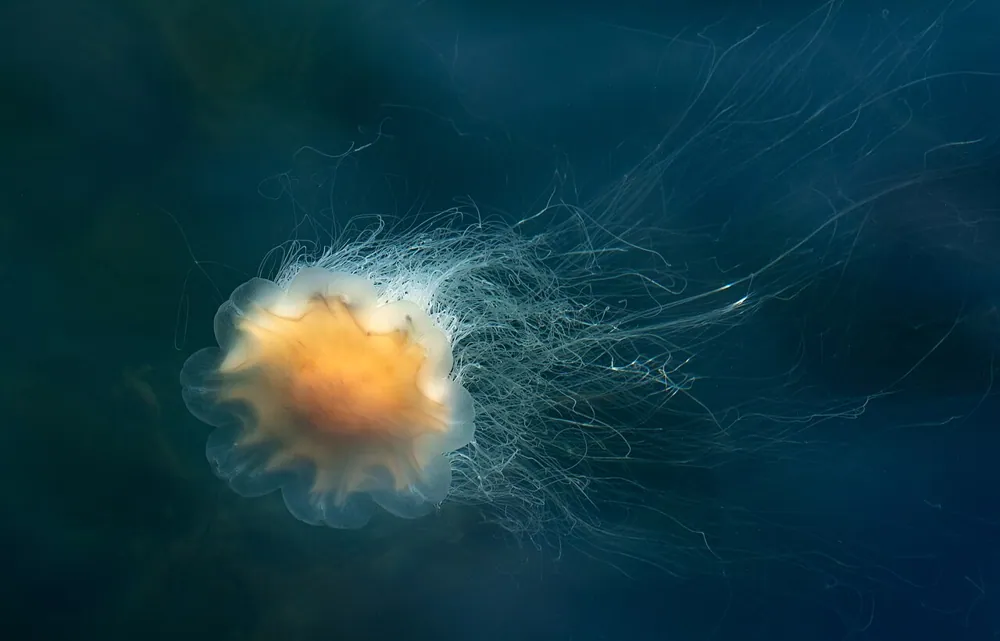
Lion's mane jellyfish
 Geliantys čiuptuvai
The lion's mane jellyfish is one of the largest jellyfish known, and its bell can be over 2 m across in the far north. It lives in cold northern seas, including the English Channel, the North Sea and the Irish Sea. Its long, trailing stinging tentacles can wash up on beaches in late summer and autumn.1



 Kaip jį atpažinti
- Bell is divided into eight lobes, giving it the look of an eight-point star1
- Young ones are light orange or tan, darkening to red and purple as they grow1
- Long, thin, trailing tentacles, with many more tentacles around the mouth1
- Bell is often about 50 cm across in lower latitudes, and much larger in the far north1
- Usually found alone, rarely in groups1
Dažnai painiojamas su: The blue jellyfish (Cyanea lamarckii) is sometimes found in the same waters. It is blue rather than red, and smaller, with a bell of about 10 to 20 cm across.1
Nuodų galia
Tūkstančiai mažyčių geliančių ląstelių iššauna, kai kas nors jas paliečia.
Ką daro jo nuodai?
Its tentacles carry stinging cells, called nematocysts, which inject a sting when touched. The sting is very painful and feels like intense itching or burning, and it can cause temporary pain and redness where the skin was touched. Stings across large parts of the body can cause whole-body (systemic) effects, and medical attention is recommended in that case.1
Koks jis pavojingas žmonėms?
Pavojus žmonėms: SkausmingasGali labai skaudėti, bet beveik niekada nebūna rimta.Stings are not known to be fatal in healthy people, and there is normally no real danger, though people with special allergies may be at risk. Rare severe stings in deep water can cause panic, which may lead to drowning. In July 2010, about 150 beachgoers were stung by the remains of one broken-up jellyfish on a beach in New Hampshire, US.1
 Jei jis įgelia
- Vinegar can be used to deactivate the stinging cells. If you have touched a large number of tentacles, get medical attention after exposure.1
- Išlipk iš vandens ir nurink visus čiuptuvus (pirštinėmis arba audiniu).
- Tropinėms kubomedūzoms: pilk actą ant įgėlimų bent 30 sekundžių, kviesk pagalbą ir būk pasiruošęs daryti gaivinimą (ŠPG). Fizalijoms ir daugumai kitų: nuskalauk jūros vandeniu, tada karštu vandeniu nuo skausmo.
Visada pirmiausia skambink pagalbos numeriu (112, 000, 911). Tai bendri pirmosios pagalbos patarimai, o ne medicininė konsultacija. Pirmosios pagalbos pagrindai
 Būk saugus
- Niekada neliesk, negaudyk ir neerzink laukinio gyvūno, net mažo, ir net jei jis atrodo miegantis ar negyvas.
- Palik jam vietos. Jei tokį sutiksi, išlik ramus, lėtai atsitrauk ir leisk jam eiti savo keliu.
- Jei toks tau įgėlė: išlik ramus, nejudėk, skambink pagalbos numeriu (112, 000, 911) arba greitai vyk į ligoninę. Įsimink, kaip jis atrodė, nuotrauka padeda.
Jis nesiruošia tavęs medžioti. Nuodus jis naudoja maistui sugauti arba apsiginti ir daug mieliau pasislėptų. Daugiau apie saugumą
Kur pasaulyje?
Koks jis didelis?
Koks jis ilgas?
 ilgas kaip 4 naminės katės nuo nosies iki uodegos
 ilgas kaip 12 bananai, sudėti vienas po kito
 galėtų nuplaukti didelio baseino ilgį (50 m) per 140 sekundžių
Koks didelis Lion's mane jellyfish, palyginti su TAVIMI?
Tik matematika tavo naršyklėje. Niekas neišsaugoma ir niekur nesiunčiama.
Koks jis greitas?

Faktai
The longest recorded tentacles were 36.6 m long, longer than a blue whale.1
Its tentacles can still sting for up to 25 days after they have detached from the jellyfish.1
Each of the eight lobes of its bell has about 70 to 150 tentacles, and it has around 1,200 tentacles near its mouth.1
The leatherback sea turtle feeds almost exclusively on lion's mane jellyfish in large numbers during summer around Eastern Canada.1
Unlike most jellyfish that drift in groups, the lion's mane is completely solitary.1
Mitų griovėjas
Mitas: The lion's mane jellyfish is the longest animal in the world.
Tiesa: This claim was made on a TV show, but it was corrected. A bootlace worm reported in 1864 was said to be over 55 m long, and that report is doubted because bootlace worms can stretch well beyond their natural length. If that report is wrong, the lion's mane would be the longest animal.1
Nuodų ekspertams
- Mokslinis pavadinimas
- Cyanea capillata
- Grupė
- Medūzos ir geliantys jūrų gyvūnai
- Šeima
- Cyaneidae2
- Tvarka
- Semaeostomeae
- Žemynai
- Arkties vandenynas, Atlanto vandenynas, Ramusis vandenynas, Šiaurės jūra, Vandenynai
- Mažyliai
- The female carries fertilised eggs in a tentacle, and they grow into larvae that settle on a hard surface and become polyps, which then produce young jellyfish called ephyrae.1
- Gyvenimo trukmė
- apie 1 metų1
- Pavojus žmonėms
- 2 / 5: Skausmingas3
Iš kur faktai
- Lion's mane jellyfish (Wikipedia (CC BY-SA 4.0))
- Cyanea capillata (iNaturalist): pavadinimai ir klasifikacija.
- Venom Wiki: pavojaus lygis, tipiškas dydis ir greičio spėjimas yra mūsų pačių. Pažiūrėk, kaip juos apskaičiuojame: Kaip vertiname pavojų.
Kiekvienas faktas šiame puslapyje turi numerį, rodantį į jo šaltinį. Jei kažką supainiojome, atsiprašome, mes gyvūnų gerbėjai, o ne mokslo žurnalas. Parašyk mums [email protected] ir mes ištaisysime.
 Skorpionas alkanas! Venom Wiki yra vieno žmogaus projektas: nemokamas, be reklamų ir be sekiklių. Maži arbatpinigiai padeda jam išlikti internete.Pamaitink skorpioną
Daugiau iš tos pačios grupės: Medūzos ir geliantys jūrų gyvūnai
 Australinė kubomedūzaMedūzos ir geliantys jūrų gyvūnaiMirtinasNeliesti
 Irukandji jellyfishMedūzos ir geliantys jūrų gyvūnaiGali nužudytiNeliesti
 Portuguese man o' warMedūzos ir geliantys jūrų gyvūnaiReikia gydytojoNeliesti
 Moon jellyfishMedūzos ir geliantys jūrų gyvūnaiNekenksmingas
 Common kingslayerMedūzos ir geliantys jūrų gyvūnaiGali nužudytiNeliesti
 Hell's fire anemoneMedūzos ir geliantys jūrų gyvūnaiReikia gydytojoNeliesti
 Greenland shark
 Spiny dogfish
 Bootlace worm