
 Afrika
 Asia
Asia Eropah
 Amerika Selatan
 Australia & Oceania
 Antartika
 Lautan Pasifik
 Lautan Atlantik
 Lautan Hindi
 Lautan Artik
 Laut Mediterranean
 Laut Merah
 Laut Caribbean
 Laut Karang
 Laut China Selatan
 Laut Filipina
 Laut Andaman
 Laut Utara
 Laut Timor & Laut Arafura
 Teluk Benggala
 Teluk California
Bald-faced hornet
 Sengatan
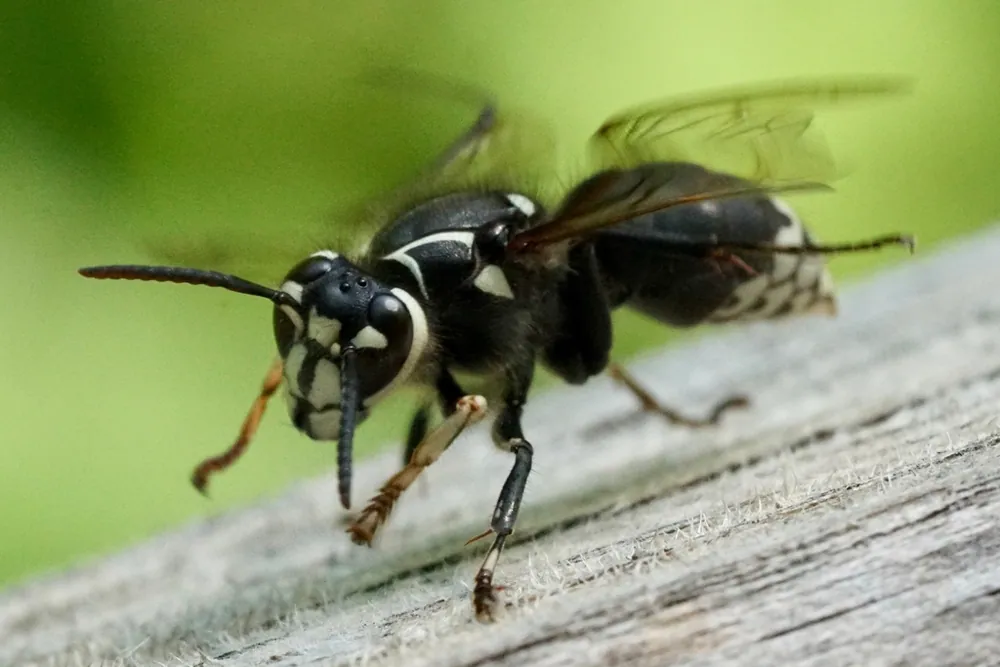
The bald-faced hornet is a wasp with a striking black and white body and a white face. It builds large, hanging paper nests in trees and bushes across North America. Its workers will defend the nest by stinging repeatedly, so it is important to keep well away from its nests.1



 Cara mengenalinya
- Black and white colouring, unlike other yellowjackets of its genus, which are mostly black and yellow1
- A white or "bald" face1
- Three white stripes at the end of the body1
- Adults average about 19 mm long, larger than other Dolichovespula species1
- A large, egg-shaped, grey paper nest that hangs from trees or bushes, up to 58 cm long1
Sering dikelirukan dengan: Other Dolichovespula wasps are mostly black and yellow. The bald-faced hornet's black and white colouring and white face set it apart. It is not one of the true hornets, which belong to the genus Vespa.1
Kuasa bisa
Bisa keluar melalui penyengat.
Apa kesan bisanya?
Workers can squirt venom from the stinger into the eyes of animals that intrude on the nest. The venom makes the eyes water immediately and causes temporary blindness.1
Berapa bahaya ia kepada manusia?
Bahaya kepada manusia: MenyakitkanIa boleh jadi sangat sakit, tetapi hampir tidak pernah serius.It is aggressive when defending its nest. Workers sting repeatedly, and colonies can have 400 to 700 workers. The risk is highest when people walk too close to a nest or when a nest is built near homes.1
Apa yang ia buat apabila takut?
Workers defend the nest by stinging repeatedly and can squirt venom into the eyes of intruders.1
 Jika ia menyengat
- Kikis keluar sengat lebah dan sejukkan tempat itu.
- Jika orang itu sukar bernafas, muka atau tekak membengkak, atau rasa nak pengsan, ini kecemasan alahan: hubungi nombor kecemasan dan guna pen adrenalinanya jika dia ada.
Sentiasa hubungi nombor kecemasan dahulu (112, 000, 911). Ini panduan pertolongan cemas umum, bukan nasihat perubatan. Asas pertolongan cemas
 Kekal selamat
- Jangan sesekali sentuh, tangkap atau usik haiwan liar, walaupun yang kecil, dan walaupun ia nampak tidur atau mati.
- Beri ia ruang. Jika kamu terjumpa, bertenang, undur perlahan-lahan dan biarkan ia pergi.
- Jika ia menyengat kamu: bertenang, jangan bergerak, hubungi nombor kecemasan (112, 000, 911) atau pergi ke hospital dengan segera. Ingat rupanya, gambar boleh membantu.
Ia bukan mahu memburu kamu. Ia guna bisanya untuk menangkap makanan atau melindungi diri, dan ia lebih suka bersembunyi. Lagi tentang keselamatan
Di mana di dunia?
Berapa besar ia?
Berapa panjang ia?
 lebih pendek daripada jari kelingking kamu
 boleh terbang merentasi seluruh padang bola sepak dalam 15 saat
Berapa besar Bald-faced hornet berbanding KAMU?
Hanya matematik dalam pelayar kamu. Tiada apa yang disimpan atau dihantar ke mana-mana.
Berapa laju ia?


Fakta
It can spray venom from its stinger into the eyes of nest intruders, causing temporary blindness.1
Its colony can have 400 to 700 workers, the largest recorded colony size in its genus, Dolichovespula.1
Female bee moths can lay eggs in its nests, and the hatched larvae feed on the eggs, larvae and pupae inside, sometimes destroying large parts of the nest.1
Its nests are made from chewed wood fibres mixed with saliva, which dries into a papery structure.1
A colony lasts about 4 months in Washington, from mid-May to mid-September. Colonies in lower latitudes last longer.1
Pemecah mitos
Mitos: It is a true hornet.
Hakikat: It is a yellowjacket wasp. True hornets belong to the genus Vespa.1
Untuk pakar bisa
- Nama saintifik
- Dolichovespula maculata
- Kumpulan
- Lebah, penyengat & tebuan
- Keluarga
- Vespidae2
- Susunan
- Hymenoptera
- Benua-benua
- Amerika Utara
- Anak
- A single queen starts each new nest in spring, laying eggs that hatch into workers, and later lays eggs that become males and new queens.1
- Bahaya kepada manusia
- 2 / 5: Menyakitkan3
Dari mana fakta datang
- Dolichovespula maculata (Wikipedia (CC BY-SA 4.0))
- Dolichovespula maculata (iNaturalist): nama dan pengelasan.
- Venom Wiki: tahap bahaya, saiz biasa dan anggaran kelajuan adalah penilaian kami sendiri. Lihat cara kami mengiranya: Cara kami menilai bahaya.
Setiap fakta di halaman ini ada nombor yang menunjuk kepada sumbernya. Jika kami tersilap, maaf, kami peminat haiwan, bukan jurnal sains. Beritahu kami di [email protected] dan kami akan betulkan.
 Kala jengking lapar! Venom Wiki ialah projek seorang lelaki: percuma, tanpa iklan dan tanpa penjejak. Sedikit sumbangan membantu memastikannya terus dalam talian.Beri kala jengking makan
Lagi dari kumpulan yang sama: Lebah, penyengat & tebuan
 Tarantula hawkLebah, penyengat & tebuanSakit sahaja
 Executioner waspLebah, penyengat & tebuanPerlu jumpa doktor
 Warrior waspLebah, penyengat & tebuanPerlu jumpa doktor
 Cow killer velvet antLebah, penyengat & tebuanSakit sahaja
 Eastern cicada killerLebah, penyengat & tebuanTidak berbahaya
 Aerial yellowjacketLebah, penyengat & tebuanSakit sahaja
 Ular terciopelo
 Eastern coral snake
 Eastern diamondback rattlesnake
 Eyelash viper
 Timber rattlesnake
 Western diamondback rattlesnake