
 Afrika
 Asia
Asia Eropah
 Amerika Selatan
 Australia & Oceania
 Antartika
 Lautan Pasifik
 Lautan Atlantik
 Lautan Hindi
 Lautan Artik
 Laut Mediterranean
 Laut Merah
 Laut Caribbean
 Laut Karang
 Laut China Selatan
 Laut Filipina
 Laut Andaman
 Laut Utara
 Laut Timor & Laut Arafura
 Teluk Benggala
 Teluk California
Mojave rattlesnake
 Gigitan
The Mojave rattlesnake is a venomous pit viper that lives in the deserts of the southwestern United States and northern Mexico. Its venom is among the most studied of any rattlesnake, and it varies a lot from one population to another. Knowing how to recognise it helps people in its range stay safe.1


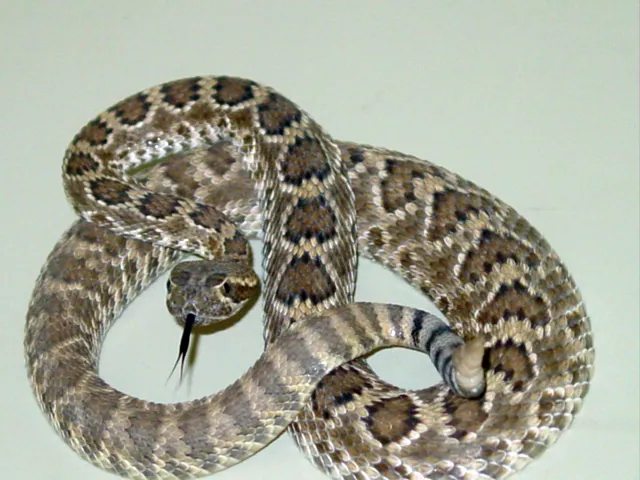
 Cara mengenalinya
- Has a row of large diamond-shaped blotches along the back, without the dark speckling found on the Western Diamond-backed Rattlesnake.1
- The diamonds usually lack the white edges seen on most Western Diamond-backed Rattlesnakes.1
- The tail has pale and dark rings, and the dark rings are often narrower than the pale ones.1
- The rattle is usually yellow and black, or entirely yellow.1
- Its back colour ranges from green to brown, grey or yellowish, so colour alone is not a reliable guide.1
Sering dikelirukan dengan: It closely resembles the Western Diamond-backed Rattlesnake, which lives in the same areas. The Mojave rattlesnake has no dark speckling on its back, usually lacks white edges on the diamonds, has a facial stripe that bends toward the neck rather than meeting the mouth, and usually has a yellow or bicoloured rattle rather than a black one. No single trait reliably separates the two.1
Kuasa bisa
Bisa keluar melalui taring atau giginya apabila ia menggigit.
Apa kesan bisanya?
Its venom comes in two main types. Venom A contains Mojave toxin, a neurotoxic venom that attacks the nerves and can cause delayed respiratory paralysis, meaning the muscles used for breathing fail, with little or no local tissue damage. Venom B has no Mojave toxin and instead contains tissue-destroying enzymes called metalloproteinases.1
Berapa bahaya ia kepada manusia?
Bahaya kepada manusia: Sangat berbahayaIa boleh membunuh orang yang tidak mendapat rawatan.For decades this snake has been described as one of the deadliest rattlesnakes, and some sources call it the most dangerous snake in the United States. The danger depends on the population, because the neurotoxic venom is not found everywhere in its range. Some animals in between produce a mix of both venom types.1
Apa yang ia buat apabila takut?
It is shy and tends to avoid confrontation, but it will strike and bite vigorously when disturbed, especially if surprised or if there is no nearby vegetation or burrow to escape into.1
 Jika ia menggigit
- Pastikan orang itu tidak bergerak dan tenang, letakkan anggota yang digigit pada paras jantung, tanggalkan cincin dan barang yang ketat, dan pergi ke hospital dengan segera.
Sentiasa hubungi nombor kecemasan dahulu (112, 000, 911). Ini panduan pertolongan cemas umum, bukan nasihat perubatan. Asas pertolongan cemas
 Kekal selamat
- Jangan sesekali sentuh, tangkap atau usik haiwan liar, walaupun yang kecil, dan walaupun ia nampak tidur atau mati.
- Beri ia ruang. Jika kamu terjumpa, bertenang, undur perlahan-lahan dan biarkan ia pergi.
- Jika ia menggigit kamu: bertenang, jangan bergerak, hubungi nombor kecemasan (112, 000, 911) atau pergi ke hospital dengan segera. Ingat rupanya, gambar boleh membantu.
Ia bukan mahu memburu kamu. Ia guna bisanya untuk menangkap makanan atau melindungi diri, dan ia lebih suka bersembunyi. Lagi tentang keselamatan
Di mana di dunia?
Berapa besar ia?
Berapa panjang ia?
 sepanjang 2.5 ekor kucing rumah dari hidung ke ekor
 sepanjang 7 biji pisang disusun hujung ke hujung
 boleh melepasi 100 meter dalam 97 saat (manusia paling laju perlukan 9.6)
Berapa besar Mojave rattlesnake berbanding KAMU?
Hanya matematik dalam pelayar kamu. Tiada apa yang disimpan atau dihantar ke mana-mana.
Berapa laju ia?


Fakta
Pemecah mitos
Mitos: Every Mojave rattlesnake bite is extraordinarily deadly.
Hakikat: The reputation for deadliness comes mainly from the neurotoxic venom, which is found in most populations but not all. Venom from some populations is non-neurotoxic and mainly destroys tissue.1
Untuk pakar bisa
- Nama saintifik
- Crotalus scutulatus
- Kumpulan
- Ular orok-orok
- Keluarga
- Viperidae2
- Susunan
- Squamata
- Benua-benua
- Amerika Utara
- Anak
- It bears live young, usually between 2 and 17 (average about eight), from July through September.1
- Keadaannya di alam liar
- Least Concern (IUCN Red List)1
- Bahaya kepada manusia
- 4 / 5: Sangat berbahaya3
Dari mana fakta datang
- Crotalus scutulatus (Wikipedia (CC BY-SA 4.0))
- Crotalus scutulatus (iNaturalist): nama dan pengelasan.
- Venom Wiki: tahap bahaya, saiz biasa dan anggaran kelajuan adalah penilaian kami sendiri. Lihat cara kami mengiranya: Cara kami menilai bahaya.
Setiap fakta di halaman ini ada nombor yang menunjuk kepada sumbernya. Jika kami tersilap, maaf, kami peminat haiwan, bukan jurnal sains. Beritahu kami di [email protected] dan kami akan betulkan.
 Kala jengking lapar! Venom Wiki ialah projek seorang lelaki: percuma, tanpa iklan dan tanpa penjejak. Sedikit sumbangan membantu memastikannya terus dalam talian.Beri kala jengking makan
Lagi dari kumpulan yang sama: Ular orok-orok
 Eastern diamondback rattlesnakeUlar orok-orokBoleh membunuh
 Timber rattlesnakeUlar orok-orokBoleh membunuh
 Western diamondback rattlesnakeUlar orok-orokBoleh membunuh
 SidewinderUlar orok-orokPerlu jumpa doktor
 Aruba rattlesnakeUlar orok-orokPerlu jumpa doktor
 Black-tailed rattlesnakeUlar orok-orokPerlu jumpa doktor
 Ular terciopelo
 Eastern coral snake
 Eyelash viper
 Arizona bark scorpion
 Brown recluse
 Cane toad