
 Afrika
 Azië
Azië Europa
 Zuid-Amerika
 Australië & Oceanië
 Antarctica
 Grote Oceaan
 Atlantische Oceaan
 Indische Oceaan
 Noordelijke IJszee
 Middellandse Zee
 Rode Zee
 Caribische Zee
 Koraalzee
 Zuid-Chinese Zee
 Filipijnenzee
 Andamanse Zee
 Noordzee
 Timorzee & Arafurazee
 Golf van Bengalen
 Golf van Californië
African crested rat
 Gif in de huid
The African crested rat is a large, nocturnal rodent with long hair and a bushy tail. It looks a little like a porcupine. It lives in East Africa, where it is the world's only known poisonous rodent, coating itself in plant toxins to keep predators away.1



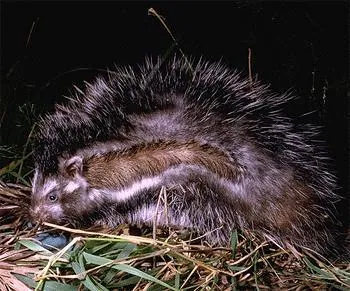
 Zo herken je het
- Large, nocturnal rodent with long, silver and black-tipped guard hairs over a woolly grey and white undercoat1
- A mane of longer black-and-white banded hairs runs from the top of the head to just beyond the base of the tail1
- A broad, white-bordered strip of glandular skin sits beside the mane, and it becomes visible when the animal is threatened1
- Bushy tail and short black fur on the face and limbs1
- Superficially resembles a porcupine1
Gifkracht
Zijn huid is giftig. Het is gevaarlijk om aan te raken, te likken of op te eten.
Wat doet zijn gif als je het aanraakt of opeet?
This animal is poisonous rather than venomous, so it does not bite or sting to inject poison. It smears poison from the bark of the poison arrow tree onto the hairs of its glandular skin patch. A predator that bites it can be sickened or even killed by this poison.1
Hoe gevaarlijk is het voor mensen?
Gevaar voor mensen: ErnstigAls iemand het aanraakt of opeet, moet die naar de dokter. Sterfgevallen zijn heel zeldzaam.Its poison is a risk to predators that try to bite it. The rat itself is not harmed by the toxins it stores.1
Wat doet het als het bang is?
When threatened or excited, the mane stands up and the glandular strip parts, exposing the skin that carries the poison.1
 Als iemand het heeft aangeraakt of gegeten
- Als iemand het heeft gegeten of klachten heeft na het eten: bel meteen je alarmnummer of het vergiftigingencentrum.
Bel altijd eerst je alarmnummer (112, 000, 911). Dit is algemene EHBO-informatie, geen medisch advies. EHBO-basis
 Blijf veilig
- Raak een wild dier nooit aan, vang het niet en pest het niet, ook geen kleintje, en ook niet als het lijkt te slapen of dood lijkt.
- Geef het de ruimte. Kom je er een tegen, blijf rustig, stap langzaam achteruit en laat het zijn eigen weg gaan.
- Als je het hebt aangeraakt of gegeten: wrijf niet in je ogen of aan je mond, was je handen en haal medische hulp.
Het is niet op jou uit. Zijn gif is er alleen zodat niets het opeet. Meer over veilig blijven
Waar ter wereld?
Hoe groot is het?
Hoe lang is het?
Hoe zwaar is het?

 zo lang als 10 speelgoedbouwsteentjes op een rij
 zou 100 meter kunnen afleggen in 72 seconden (de snelste mens doet er 9,6 over)
Hoe groot is African crested rat vergeleken met JOU?
Alleen rekenwerk in je browser. Er wordt niets opgeslagen of verstuurd.
Hoe snel is het?


Feiten
It is the world's only known poisonous rodent.1
It is the only rodent known to use and store toxins from a different species in nature to protect itself, and it suffers no known harm from them.1
Its stomach has five anatomically distinct sections, a feature found in very few rodents.1
The skull is covered with small bony projections that give it a pebbled look.1
Its large size may allow microbes in its foregut to break down cellulose from plants by fermentation.1
Fabeltjes-checker
Fabel: The maned rat was believed to be solitary.
Waarheid: It is now known to be somewhat sociable. Several animals are found in the same territory, and they purr and groom one another, so they may form family groups of a male, a female and their young.1
Voor gifexperts
- Wetenschappelijke naam
- Lophiomys imhausi
- Groep
- Andere passief giftige dieren
- Familie
- Muridae2
- Orde
- Rodentia
- Continenten
- Afrika
- Baby's
- Litters have 1 to 3 young. The young are slightly haired at birth, their eyes open by day 13, and they are weaned by day 40.1
- Hoe het in het wild gaat
- Least Concern1
- Gevaar voor mensen
- 3 / 5: Ernstig3
Waar de feiten vandaan komen
- Maned rat (Wikipedia (CC BY-SA 4.0))
- Lophiomys imhausi (iNaturalist): namen en indeling.
- Venom Wiki: het gevarenniveau, de typische grootte en de geschatte snelheid zijn van onszelf. Zo berekenen we ze: Hoe we gevaar beoordelen.
Elk feit op deze pagina heeft een nummer dat naar de bron wijst. Hebben we iets fout? Sorry, we zijn dierenfans, geen wetenschappelijk tijdschrift. Laat het ons weten via [email protected] en we passen het aan.
 De schorpioen heeft honger! Venom Wiki is een eenmansproject: gratis, zonder reclame en zonder trackers. Een kleine fooi helpt om het online te houden.Voer de schorpioen
Meer uit dezelfde groep: Andere passief giftige dieren
 Common quailAndere passief giftige dierenDoet alleen pijn
 Spur-winged gooseAndere passief giftige dierenDoet alleen pijn
 Fahaka pufferfishAndere passief giftige dierenKan doden
 Red-striped oil beetleAndere passief giftige dierenDoet alleen pijnNiet aanraken
 Japanse kogelvisAndere passief giftige dierenDodelijk
 Hawksbill sea turtleAndere passief giftige dierenKan doden
 Zwarte mamba
 Deathstalker
 Egyptische cobra
 Pofadder
 Boomslang
 Fat-tailed scorpion