
 Afrika
 Azië
Azië Europa
 Zuid-Amerika
 Australië & Oceanië
 Antarctica
 Grote Oceaan
 Atlantische Oceaan
 Indische Oceaan
 Noordelijke IJszee
 Middellandse Zee
 Rode Zee
 Caribische Zee
 Koraalzee
 Zuid-Chinese Zee
 Filipijnenzee
 Andamanse Zee
 Noordzee
 Timorzee & Arafurazee
 Golf van Bengalen
 Golf van Californië
Asian hornet
 Steken
The Asian hornet is a hornet from Southeast Asia that has spread to many other countries, including most of Europe, where it is an invasive species. It is a concern because it hunts honeybees and its stings can be serious for people.1


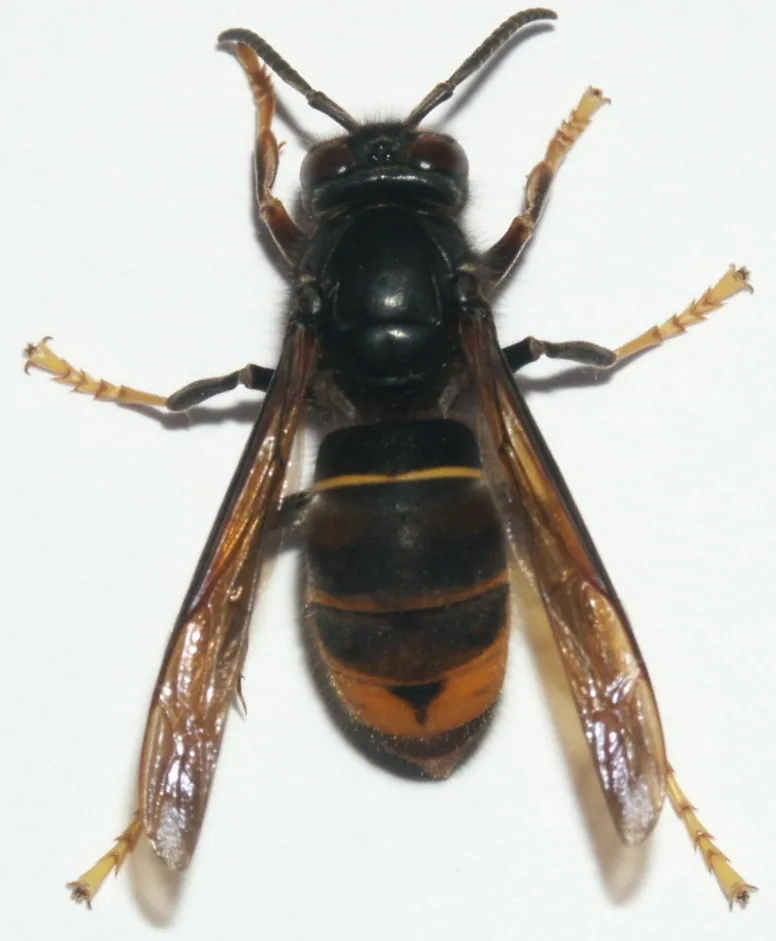
 Zo herken je het
- Queens are about 3 cm long, males about 2.4 cm and workers about 2 cm, so it is significantly smaller than the European hornet.1
- Its legs (tarsi) are yellow, which gives it the name yellow-legged hornet.1
- The thorax is velvety brown or black, with a brown abdomen.1
- Each abdominal segment has a narrow yellow border at the back, except the fourth segment, which is orange.1
- The head is black and the face is yellow.1
Vaak verward met: It looks like the European hornet (V. crabro), which is much larger. Its nest exit is usually on the side rather than at the bottom.1
Gifkracht
Het gif komt naar buiten via een angel.
Wat doet zijn gif als het bijt of steekt?
Multiple stings have caused anaphylactic shock, a severe allergic reaction, in people who were hospitalised in France.1
Hoe gevaarlijk is het voor mensen?
Gevaar voor mensen: PijnlijkHet kan echt pijn doen, maar het is bijna nooit ernstig.Although the species is not aggressive, people have been attacked after disturbing nests. A man in Galicia, Spain, was killed in 2017 after being stung over 20 times while pruning an apple tree. Several people have died in south west France, including in 2019 and 2020. Because of its larger size, its stings are more serious than those of western honeybees.1
Wat doet het als het bang is?
When it feels its nest is threatened, it charges in a group.1
 Als het steekt
- Schraap een bijenangel eruit en koel de plek.
- Als de persoon moeite heeft met ademen, een opgezwollen gezicht of keel heeft, of zich flauw voelt, is het een allergisch noodgeval: bel je alarmnummer en gebruik de adrenaline-auto-injector (adrenalinepen) van de persoon als die er een heeft.
Bel altijd eerst je alarmnummer (112, 000, 911). Dit is algemene EHBO-informatie, geen medisch advies. EHBO-basis
 Blijf veilig
- Raak een wild dier nooit aan, vang het niet en pest het niet, ook geen kleintje, en ook niet als het lijkt te slapen of dood lijkt.
- Geef het de ruimte. Kom je er een tegen, blijf rustig, stap langzaam achteruit en laat het zijn eigen weg gaan.
- Als er een je steekt: blijf rustig, beweeg niet, bel je alarmnummer (112, 000, 911) of ga snel naar een ziekenhuis. Onthoud hoe het eruitzag, een foto helpt.
Het is niet op jou uit. Het gebruikt zijn gif om voedsel te vangen of zichzelf te beschermen, en verstopt zich veel liever. Meer over veilig blijven
Waar ter wereld?
Hoe groot is het?
Hoe lang is het?
 ongeveer zo lang als een paperclip
 zou in 13 seconden over een heel voetbalveld kunnen vliegen
Hoe groot is Asian hornet vergeleken met JOU?
Alleen rekenwerk in je browser. Er wordt niets opgeslagen of verstuurd.
Hoe snel is het?


Feiten
In its native range, its main prey is the eastern honeybee, which defends the hive by balling hornets and raising the temperature inside the ball to a level that kills the hornet.1
A hornet hunting honeybees holds a territory of about 0.5 m² above a beehive and catches bees as they return to the hive.1
It is believed to have reached France in boxes of pottery from China in 2004.1
A colony often starts a nest in a low shrub, then abandons it after some months and builds a new one high in a tree, possibly to avoid parasites.1
Young queens leave the colony in late autumn and hibernate over winter.1
Fabeltjes-checker
Fabel: Asian hornets are aggressive and will attack anyone who comes near.
Waarheid: The species is not aggressive, but it will charge in a group when it feels its nest is threatened.1
Waar de feiten vandaan komen
- Asian hornet (Wikipedia (CC BY-SA 4.0))
- Vespa velutina (iNaturalist): namen en indeling.
- Venom Wiki: het gevarenniveau, de typische grootte en de geschatte snelheid zijn van onszelf. Zo berekenen we ze: Hoe we gevaar beoordelen.
Elk feit op deze pagina heeft een nummer dat naar de bron wijst. Hebben we iets fout? Sorry, we zijn dierenfans, geen wetenschappelijk tijdschrift. Laat het ons weten via [email protected] en we passen het aan.
 De schorpioen heeft honger! Venom Wiki is een eenmansproject: gratis, zonder reclame en zonder trackers. Een kleine fooi helpt om het online te houden.Voer de schorpioen
Meer uit dezelfde groep: Bijen, wespen & hoornaars
 Asian giant hornetBijen, wespen & hoornaarsKan doden
 Common waspBijen, wespen & hoornaarsDoet alleen pijn
 European hornetBijen, wespen & hoornaarsDoet alleen pijn
 Western honey beeBijen, wespen & hoornaarsDoet alleen pijn
 Giant honey beeBijen, wespen & hoornaarsMoet naar de dokter
 European paper waspBijen, wespen & hoornaarsDoet alleen pijn
 Deathstalker
 Brilslang
 Indische zaagschubadder
 Koningscobra
 Pofadder
 Russells adder