
 Afrika
 Azië
Azië Europa
 Zuid-Amerika
 Australië & Oceanië
 Antarctica
 Grote Oceaan
 Atlantische Oceaan
 Indische Oceaan
 Noordelijke IJszee
 Middellandse Zee
 Rode Zee
 Caribische Zee
 Koraalzee
 Zuid-Chinese Zee
 Filipijnenzee
 Andamanse Zee
 Noordzee
 Timorzee & Arafurazee
 Golf van Bengalen
 Golf van Californië
Cinnabar moth
 Giftig om te eten
The cinnabar moth is a brightly coloured day-flying moth with red and black wings. It is native to Europe and parts of Asia, and it has been introduced to New Zealand, Australia and North America. Its bright colours warn predators that it is poisonous.1


 Zo herken je het
- Predominantly black wings with red patches1
- Adults are about 2 cm long, with a wingspan of 3.4 to 4.6 cm1
- Often seen flying in daylight, though it is also active at night1
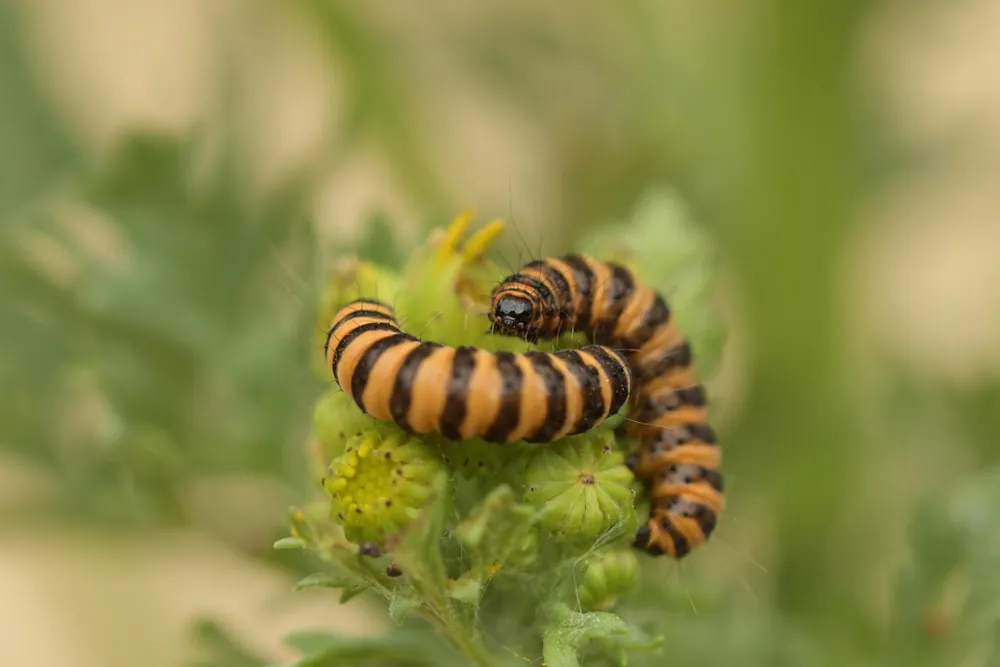
- Young caterpillars are pale yellow; later caterpillars are jet-black with orange or yellow stripes1
- Rarely, the red can be yellow, the forewing can be all red with a black border, or the wings can be completely black1
Gifkracht
Het is alleen schadelijk als iets het opeet.
Hoe gevaarlijk is het voor mensen?
Gevaar voor mensen: MildZoals een bijensteek of minder. Eigenlijk ongevaarlijk voor mensen.Wat doet het als het bang is?
Its bright red and black colours warn predators that it is unpalatable, and predators seldom eat it.1
 Als iemand het heeft aangeraakt of gegeten
- Als iemand het heeft gegeten of klachten heeft na het eten: bel meteen je alarmnummer of het vergiftigingencentrum.
Bel altijd eerst je alarmnummer (112, 000, 911). Dit is algemene EHBO-informatie, geen medisch advies. EHBO-basis
 Blijf veilig
- Raak een wild dier nooit aan, vang het niet en pest het niet, ook geen kleintje, en ook niet als het lijkt te slapen of dood lijkt.
- Geef het de ruimte. Kom je er een tegen, blijf rustig, stap langzaam achteruit en laat het zijn eigen weg gaan.
- Als je het hebt aangeraakt of gegeten: wrijf niet in je ogen of aan je mond, was je handen en haal medische hulp.
Het is niet op jou uit. Zijn gif is er alleen zodat niets het opeet. Meer over veilig blijven
Waar ter wereld?
Hoe groot is het?
Hoe lang is het?
 ongeveer zo lang als een paperclip
 zou in 42 seconden over een heel voetbalveld kunnen vliegen
Hoe groot is Cinnabar moth vergeleken met JOU?
Alleen rekenwerk in je browser. Er wordt niets opgeslagen of verstuurd.
Hoe snel is het?


Feiten
The caterpillars can turn cannibalistic, mainly when food is short, and will eat other cinnabar caterpillars.1
Cuckoos are an exception to the moth's protection, as some species eat its hairy, poisonous caterpillars.1
The moth was used as a biocontrol agent against ragwort, working alongside the Tansy ragwort flea beetle in the western United States.1
Very few caterpillars usually survive to the pupal stage, because they can eat their food plant bare before they mature.1
Evidence suggests the Brown long-eared bat preys on this moth.1
The caterpillars overwinter as cocoons on the ground.1
Waar de feiten vandaan komen
- Cinnabar moth (Wikipedia (CC BY-SA 4.0))
- Tyria jacobaeae (iNaturalist): namen en indeling.
- Venom Wiki: het gevarenniveau, de typische grootte en de geschatte snelheid zijn van onszelf. Zo berekenen we ze: Hoe we gevaar beoordelen.
Elk feit op deze pagina heeft een nummer dat naar de bron wijst. Hebben we iets fout? Sorry, we zijn dierenfans, geen wetenschappelijk tijdschrift. Laat het ons weten via [email protected] en we passen het aan.
 De schorpioen heeft honger! Venom Wiki is een eenmansproject: gratis, zonder reclame en zonder trackers. Een kleine fooi helpt om het online te houden.Voer de schorpioen
Meer uit dezelfde groep: Andere passief giftige dieren
 Spanish flyAndere passief giftige dierenMoet naar de dokterNiet aanraken
 Green spotted pufferAndere passief giftige dierenMoet naar de dokter
 Common quailAndere passief giftige dierenDoet alleen pijn
 Black oil beetleAndere passief giftige dierenDoet alleen pijnNiet aanraken
 Red-striped oil beetleAndere passief giftige dierenDoet alleen pijnNiet aanraken
 Six-spot burnetAndere passief giftige dierenOngevaarlijk
Leeft ook in: Europa
 Common European adderAddersMoet naar de dokter
 Common waspBijen, wespen & hoornaarsDoet alleen pijn
 European hornetBijen, wespen & hoornaarsDoet alleen pijn
 Fire salamanderPijlgifkikkers, padden & salamandersDoet alleen pijnNiet aanraken
 Western honey beeBijen, wespen & hoornaarsDoet alleen pijn
 Blunt-nosed viperAddersKan doden