
 Afrika
 Azië
Azië Europa
 Zuid-Amerika
 Australië & Oceanië
 Antarctica
 Grote Oceaan
 Atlantische Oceaan
 Indische Oceaan
 Noordelijke IJszee
 Middellandse Zee
 Rode Zee
 Caribische Zee
 Koraalzee
 Zuid-Chinese Zee
 Filipijnenzee
 Andamanse Zee
 Noordzee
 Timorzee & Arafurazee
 Golf van Bengalen
 Golf van Californië
Climbing mantella
 Gif in de huid
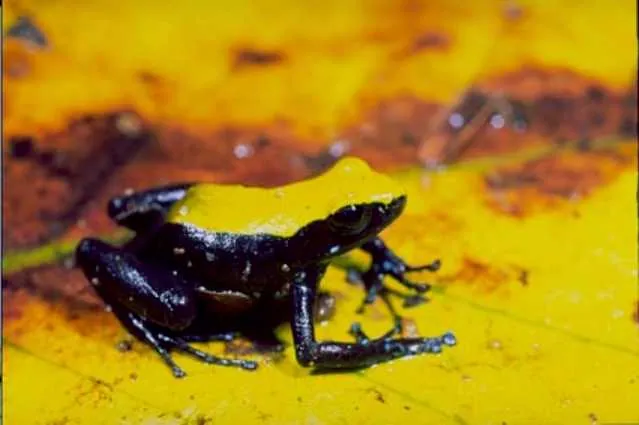
The climbing mantella is a small, brightly coloured frog that lives in the lowland rainforests of northeast Madagascar. It is a poison frog, so its skin holds chemicals that can harm predators. It is special because it is one of the few frogs whose parents care for their tadpoles by feeding them eggs.1



 Zo herken je het
- Adults are 24–30 mm long and weigh 1.2–2.0 g1
- Front of the back is bright yellow or pale green1
- Arms, legs, belly and rear are black, with blue spots on the limbs1
- Eyes are completely black1
- Has discs at the tips of its fingers and toes, and the toes are webbed1
Vaak verward met: M. betsileo, M. viridis and M. expectata look similar but are differently coloured. They often have blue spots on the throat rather than the limbs, and they have a faint line along the upper lip, which the climbing mantella lacks.1
Gifkracht
Zijn huid is giftig. Het is gevaarlijk om aan te raken, te likken of op te eten.
Wat doet zijn gif als je het aanraakt of opeet?
This frog is poisonous rather than venomous. Its skin glands contain lipophilic alkaloids, the chemicals that make up its poison, which it gets from the arthropods it eats. Researchers have found 41 different potent alkaloids in its skin. Captive frogs lose their toxicity over time.1
Hoe gevaarlijk is het voor mensen?
Gevaar voor mensen: MildZoals een bijensteek of minder. Eigenlijk ongevaarlijk voor mensen.Wat doet het als het bang is?
Its bright colours warn predators that its skin is toxic.1
 Als iemand het heeft aangeraakt of gegeten
- Als iemand er een heeft aangeraakt: was de handen goed en raak de ogen of mond niet aan. Als een kind of huisdier er een heeft gelikt of opgegeten: bel het vergiftigingencentrum of je alarmnummer.
Bel altijd eerst je alarmnummer (112, 000, 911). Dit is algemene EHBO-informatie, geen medisch advies. EHBO-basis
 Blijf veilig
- Raak een wild dier nooit aan, vang het niet en pest het niet, ook geen kleintje, en ook niet als het lijkt te slapen of dood lijkt.
- Geef het de ruimte. Kom je er een tegen, blijf rustig, stap langzaam achteruit en laat het zijn eigen weg gaan.
- Als je het hebt aangeraakt of gegeten: wrijf niet in je ogen of aan je mond, was je handen en haal medische hulp.
Het is niet op jou uit. Zijn gif is er alleen zodat niets het opeet. Meer over veilig blijven
Waar ter wereld?
Hoe groot is het?
Hoe lang is het?
Hoe zwaar is het?
 ongeveer zo lang als een paperclip
 zo licht dat je het niet zou voelen op je hand
 zou 100 meter kunnen afleggen in 100 seconden (de snelste mens doet er 9,6 over)
Hoe groot is Climbing mantella vergeleken met JOU?
Alleen rekenwerk in je browser. Er wordt niets opgeslagen of verstuurd.
Hoe snel is het?


Feiten
Its tadpoles eat only the eggs of their own species, and the parents feed them unfertilized eggs.1
Males defend territories of about 2 square metres and fight by wrestling, chasing and leaping, sometimes for over 1.5 hours.1
Female frogs choose a mate based on the quality of the male's well, not on his call.1
The climbing mantella is the only member of the Mantella genus that breeds in water-filled wells in trees, tree holes or broken bamboo stalks.1
Its chemical defence has developed in a similar way to that of the dart frogs of Dendrobatidae, although the two families are only distantly related.1
Voor gifexperts
- Wetenschappelijke naam
- Mantella laevigata
- Groep
- Pijlgifkikkers, padden & salamanders
- Familie
- Mantellidae2
- Orde
- Anura
- Continenten
- Afrika
- Baby's
- Usually lays only one large egg, 3–3.5 mm across, at the side of a water-filled well or above the water line. The parents feed tadpoles unfertilized eggs.1
- Hoe het in het wild gaat
- Least Concern (IUCN Red List, 2016), though its population is suspected to be decreasing1
- Gevaar voor mensen
- 1 / 5: Mild3
Waar de feiten vandaan komen
- Climbing mantella (Wikipedia (CC BY-SA 4.0))
- Mantella laevigata (iNaturalist): namen en indeling.
- Venom Wiki: het gevarenniveau, de typische grootte en de geschatte snelheid zijn van onszelf. Zo berekenen we ze: Hoe we gevaar beoordelen.
Elk feit op deze pagina heeft een nummer dat naar de bron wijst. Hebben we iets fout? Sorry, we zijn dierenfans, geen wetenschappelijk tijdschrift. Laat het ons weten via [email protected] en we passen het aan.
 De schorpioen heeft honger! Venom Wiki is een eenmansproject: gratis, zonder reclame en zonder trackers. Een kleine fooi helpt om het online te houden.Voer de schorpioen
Meer uit dezelfde groep: Pijlgifkikkers, padden & salamanders
 Golden mantellaPijlgifkikkers, padden & salamandersOngevaarlijk
 Iberian ribbed newtPijlgifkikkers, padden & salamandersOngevaarlijk
 Tomato frogPijlgifkikkers, padden & salamandersOngevaarlijk
 African common toadPijlgifkikkers, padden & salamandersDoet alleen pijnNiet aanraken
 Baron's mantellaPijlgifkikkers, padden & salamandersOngevaarlijk
 Blue-legged mantellaPijlgifkikkers, padden & salamandersOngevaarlijk
 Zwarte mamba
 Deathstalker
 Egyptische cobra
 Pofadder
 Boomslang
 Fat-tailed scorpion