
 Afrika
 Azië
Azië Europa
 Zuid-Amerika
 Australië & Oceanië
 Antarctica
 Grote Oceaan
 Atlantische Oceaan
 Indische Oceaan
 Noordelijke IJszee
 Middellandse Zee
 Rode Zee
 Caribische Zee
 Koraalzee
 Zuid-Chinese Zee
 Filipijnenzee
 Andamanse Zee
 Noordzee
 Timorzee & Arafurazee
 Golf van Bengalen
 Golf van Californië
Daddy long-legs spider
 Beten
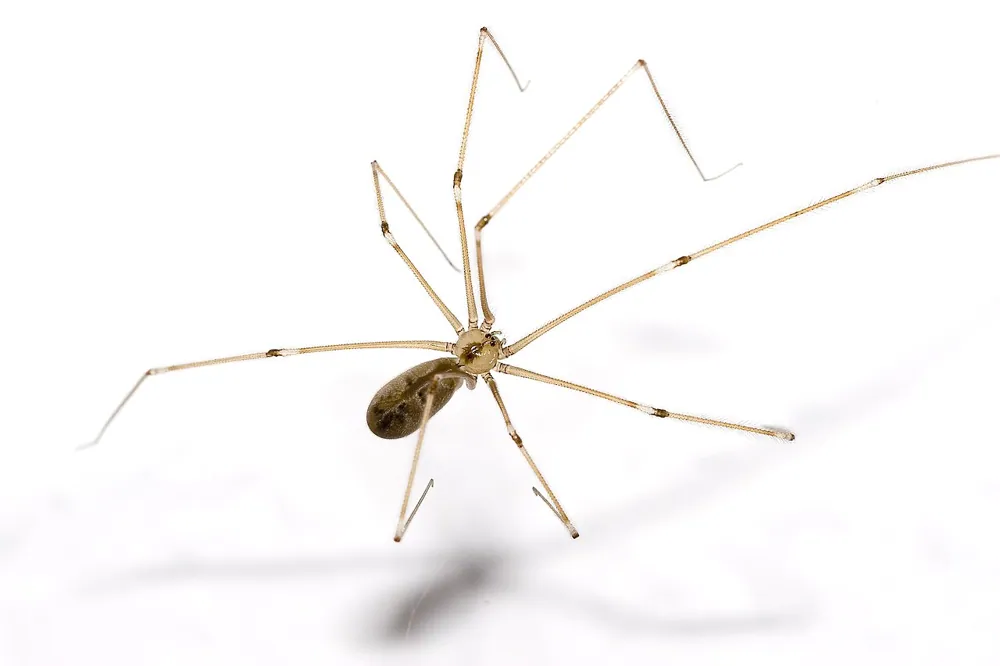
BetenThe daddy long-legs spider is a small spider with very long, thin legs. It lives indoors in quiet, dim corners of homes, cellars and garages, and it is found in most temperate countries on every continent. It is valued because it hunts other spiders, including the dangerous redback spider.1


 Zo herken je het
- Small body, about 6 to 10 mm long in males and 7 to 8 mm on average in females, not counting the legs.1
- Eight very long, thin legs covered in fine grey bristles. The legs are about 5 to 6 times the length of the body.1
- Translucent grey or pale brown body, with a dark spot on the back of the front body part and dark, blurred spots on the top of the rear body part.1
- Eight eyes: a pair of small dark eyes at the front, followed by three rows of pairs of larger eyes.1
- Loose, horizontal webs with many irregularities, often tangled with the webs of other spiders.1
Vaak verward met: It is often called 'daddy long-legs', a name also used for crane flies and harvestmen. Crane flies are insects, and harvestmen belong to a different group of arachnids (the order Opiliones), so they are not spiders.1
Gifkracht
Het gif komt naar buiten via de giftanden of tanden als het bijt.
Wat doet zijn gif als het bijt of steekt?
Its venom is used to subdue prey, and it can bite. According to researchers, its venom has negligible effects on humans and other mammals. A bite causes a mild stinging sensation with no long-term health effects.1
Hoe gevaarlijk is het voor mensen?
Gevaar voor mensen: MildZoals een bijensteek of minder. Eigenlijk ongevaarlijk voor mensen.It is considered harmless to humans. Bites are hardly ever reported, and a bite causes only mild stinging.1
Wat doet het als het bang is?
When it senses danger, it swings its body round in a circle repeatedly while its legs stay fixed on the web, a movement called whirling.1
 Als het bijt
- Was de beet en leg er een coldpack op tegen de pijn. Haal medische hulp als de pijn hevig is, zich verspreidt of de persoon zich niet goed voelt.
Bel altijd eerst je alarmnummer (112, 000, 911). Dit is algemene EHBO-informatie, geen medisch advies. EHBO-basis
 Blijf veilig
- Raak een wild dier nooit aan, vang het niet en pest het niet, ook geen kleintje, en ook niet als het lijkt te slapen of dood lijkt.
- Geef het de ruimte. Kom je er een tegen, blijf rustig, stap langzaam achteruit en laat het zijn eigen weg gaan.
- Als er een je bijt: blijf rustig, beweeg niet, bel je alarmnummer (112, 000, 911) of ga snel naar een ziekenhuis. Onthoud hoe het eruitzag, een foto helpt.
Het is niet op jou uit. Het gebruikt zijn gif om voedsel te vangen of zichzelf te beschermen, en verstopt zich veel liever. Meer over veilig blijven
Waar ter wereld?
Hoe groot is het?
Hoe lang is het?
 zo lang als 2 speelgoedbouwsteentjes op een rij
 zou 100 meter kunnen afleggen in 280 seconden (de snelste mens doet er 9,6 over)
Hoe groot is Daddy long-legs spider vergeleken met JOU?
Alleen rekenwerk in je browser. Er wordt niets opgeslagen of verstuurd.
Hoe snel is het?


Feiten
It hunts redback spiders, which are among the most venomous spiders in the world.1
It fakes the vibrations of a trapped insect in its web, then waits on its long legs until the prey touches one of them before attacking.1
Its whirling defence can last several hours or even days when it is threatened by jumping spiders.1
Its silk has been reported to have potential medicinal uses.1
Fabeltjes-checker
Fabel: Daddy long-legs spiders cannot bite humans because their fangs cannot get through human skin.
Waarheid: Their fangs are about 0.25 mm long, and human skin is about 0.1 mm thick, so they can bite. Bites are very rarely reported, and they cause only mild stinging.1
Waar de feiten vandaan komen
- Pholcus phalangioides (Wikipedia (CC BY-SA 4.0))
- Pholcus phalangioides (iNaturalist): namen en indeling.
- Venom Wiki: het gevarenniveau, de typische grootte en de geschatte snelheid zijn van onszelf. Zo berekenen we ze: Hoe we gevaar beoordelen.
Elk feit op deze pagina heeft een nummer dat naar de bron wijst. Hebben we iets fout? Sorry, we zijn dierenfans, geen wetenschappelijk tijdschrift. Laat het ons weten via [email protected] en we passen het aan.
 De schorpioen heeft honger! Venom Wiki is een eenmansproject: gratis, zonder reclame en zonder trackers. Een kleine fooi helpt om het online te houden.Voer de schorpioen
Meer uit dezelfde groep: Spinnen
 Mediterranean black widow
 Diving bell spider
 European yellow sac spider
 Noble false widow
 Tarantula wolf spider
 European garden spider
Leeft ook in: Europa
 Common European adderAddersMoet naar de dokter
 Spanish flyAndere passief giftige dierenMoet naar de dokterNiet aanraken
 Common waspBijen, wespen & hoornaarsDoet alleen pijn
 European hornetBijen, wespen & hoornaarsDoet alleen pijn
 Fire salamanderPijlgifkikkers, padden & salamandersDoet alleen pijnNiet aanraken
 Western honey beeBijen, wespen & hoornaarsDoet alleen pijn