
 Afrika
 Azië
Azië Europa
 Zuid-Amerika
 Australië & Oceanië
 Antarctica
 Grote Oceaan
 Atlantische Oceaan
 Indische Oceaan
 Noordelijke IJszee
 Middellandse Zee
 Rode Zee
 Caribische Zee
 Koraalzee
 Zuid-Chinese Zee
 Filipijnenzee
 Andamanse Zee
 Noordzee
 Timorzee & Arafurazee
 Golf van Bengalen
 Golf van Californië
Kokoe poison frog
 Gif in de huid
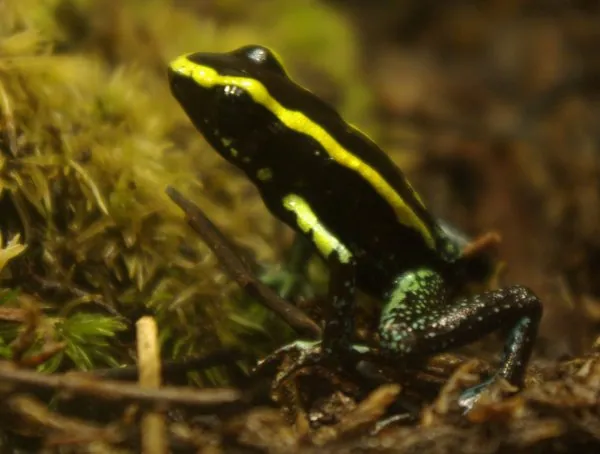
The Kokoe poison frog is a small, brightly striped frog that lives on the forest floor of western Colombia. It is one of the most poisonous frogs in the world. Its skin holds a toxin that can be deadly, so it should never be handled.1



 Zo herken je het
- Black back, sometimes with orange patches.1
- Green, yellow, orange or brownish gold stripes along each side of the body.1
- Black belly with blue or green dots.1
- The smallest of the poison dart frogs in its genus, Phyllobates.1
- Two forms exist: a smaller form with large stripes and a larger form with small stripes.1
Gifkracht
Zijn huid is giftig. Het is gevaarlijk om aan te raken, te likken of op te eten.
Wat doet zijn gif als je het aanraakt of opeet?
This frog is poisonous rather than venomous, because its toxin is held in its skin and does not come from a bite or sting. The toxin, batrachotoxin, is a steroidal alkaloid. It keeps the sodium channels in nerve and muscle cells permanently open, which stops the cells from resetting. The result is paralysis, and often death, as affected muscles stay locked in a contracted state.1
Hoe gevaarlijk is het voor mensen?
Gevaar voor mensen: Heel gevaarlijkHet kan iemand doden die geen behandeling krijgt.Wild frogs are extremely deadly to humans, and the toxin can be fatal in doses as small as 100 μg. Frogs raised in captivity are generally non-toxic.1
Wat doet het als het bang is?
It releases its toxin from skin glands only when under stress.1
 Als iemand het heeft aangeraakt of gegeten
- Als iemand er een heeft aangeraakt: was de handen goed en raak de ogen of mond niet aan. Als een kind of huisdier er een heeft gelikt of opgegeten: bel het vergiftigingencentrum of je alarmnummer.
Bel altijd eerst je alarmnummer (112, 000, 911). Dit is algemene EHBO-informatie, geen medisch advies. EHBO-basis
 Blijf veilig
- Raak een wild dier nooit aan, vang het niet en pest het niet, ook geen kleintje, en ook niet als het lijkt te slapen of dood lijkt.
- Geef het de ruimte. Kom je er een tegen, blijf rustig, stap langzaam achteruit en laat het zijn eigen weg gaan.
- Als je het hebt aangeraakt of gegeten: wrijf niet in je ogen of aan je mond, was je handen en haal medische hulp.
Het is niet op jou uit. Zijn gif is er alleen zodat niets het opeet. Meer over veilig blijven
Waar ter wereld?
Hoe groot is het?
Hoe lang is het?
 ongeveer zo lang als een paperclip
 zou 100 meter kunnen afleggen in 100 seconden (de snelste mens doet er 9,6 over)
Hoe groot is Kokoe poison frog vergeleken met JOU?
Alleen rekenwerk in je browser. Er wordt niets opgeslagen of verstuurd.
Hoe snel is het?


Feiten
It is known as the third most poisonous frog in the world.1
Indigenous peoples of Colombia have used its poison on hunting darts.1
Unlike many other dart frogs, males do not wrestle. Rivals face off and call loudly until one backs down.1
Its mating calls are a loud, bird-like whirring twitter, which can last up to 45 seconds.1
Unlike other Phyllobates species, it does not breed in coconut shells. It lays its eggs in narrow tubes on the ground instead.1
Fabeltjes-checker
Fabel: All poison frogs make their own poison.
Waarheid: These frogs probably do not make batrachotoxin themselves. They take it in from their diet of beetles, millipedes and flies, and from the leaf litter. That is why captive frogs are generally non-toxic.1
Voor gifexperts
- Wetenschappelijke naam
- Phyllobates aurotaenia
- Groep
- Pijlgifkikkers, padden & salamanders
- Familie
- Dendrobatidae2
- Orde
- Anura
- Continenten
- Zuid-Amerika
- Baby's
- The female lays a clutch of eggs in leaf litter, averaging 15 to 20. After the eggs hatch, the male carries the tadpoles to slow-flowing water.1
- Hoe het in het wild gaat
- Least Concern (IUCN), although its numbers and range are declining, mainly due to habitat loss1
- Gevaar voor mensen
- 4 / 5: Heel gevaarlijk3
Waar de feiten vandaan komen
- Phyllobates aurotaenia (Wikipedia (CC BY-SA 4.0))
- Phyllobates aurotaenia (iNaturalist): namen en indeling.
- Venom Wiki: het gevarenniveau, de typische grootte en de geschatte snelheid zijn van onszelf. Zo berekenen we ze: Hoe we gevaar beoordelen.
Elk feit op deze pagina heeft een nummer dat naar de bron wijst. Hebben we iets fout? Sorry, we zijn dierenfans, geen wetenschappelijk tijdschrift. Laat het ons weten via [email protected] en we passen het aan.
 De schorpioen heeft honger! Venom Wiki is een eenmansproject: gratis, zonder reclame en zonder trackers. Een kleine fooi helpt om het online te houden.Voer de schorpioen
Meer uit dezelfde groep: Pijlgifkikkers, padden & salamanders
 Gouden pijlgifkikkerPijlgifkikkers, padden & salamandersDodelijkNiet aanraken
 Cane toadPijlgifkikkers, padden & salamandersMoet naar de dokterNiet aanraken
 Dyeing poison dart frogPijlgifkikkers, padden & salamandersDoet alleen pijnNiet aanraken
 Black-legged poison frogPijlgifkikkers, padden & salamandersKan dodenNiet aanraken
 Bruno's casque-headed frogPijlgifkikkers, padden & salamandersMoet naar de dokterNiet aanraken
 Harlequin poison frogPijlgifkikkers, padden & salamandersMoet naar de dokterNiet aanraken
 Terciopelo
 Brazilian wandering spider
 Eyelash viper
 Golden lancehead
 South American bushmaster
 Peruvian giant centipede