
 Afrika
 Azië
Azië Europa
 Zuid-Amerika
 Australië & Oceanië
 Antarctica
 Grote Oceaan
 Atlantische Oceaan
 Indische Oceaan
 Noordelijke IJszee
 Middellandse Zee
 Rode Zee
 Caribische Zee
 Koraalzee
 Zuid-Chinese Zee
 Filipijnenzee
 Andamanse Zee
 Noordzee
 Timorzee & Arafurazee
 Golf van Bengalen
 Golf van Californië
Philippine slow loris
 Beten
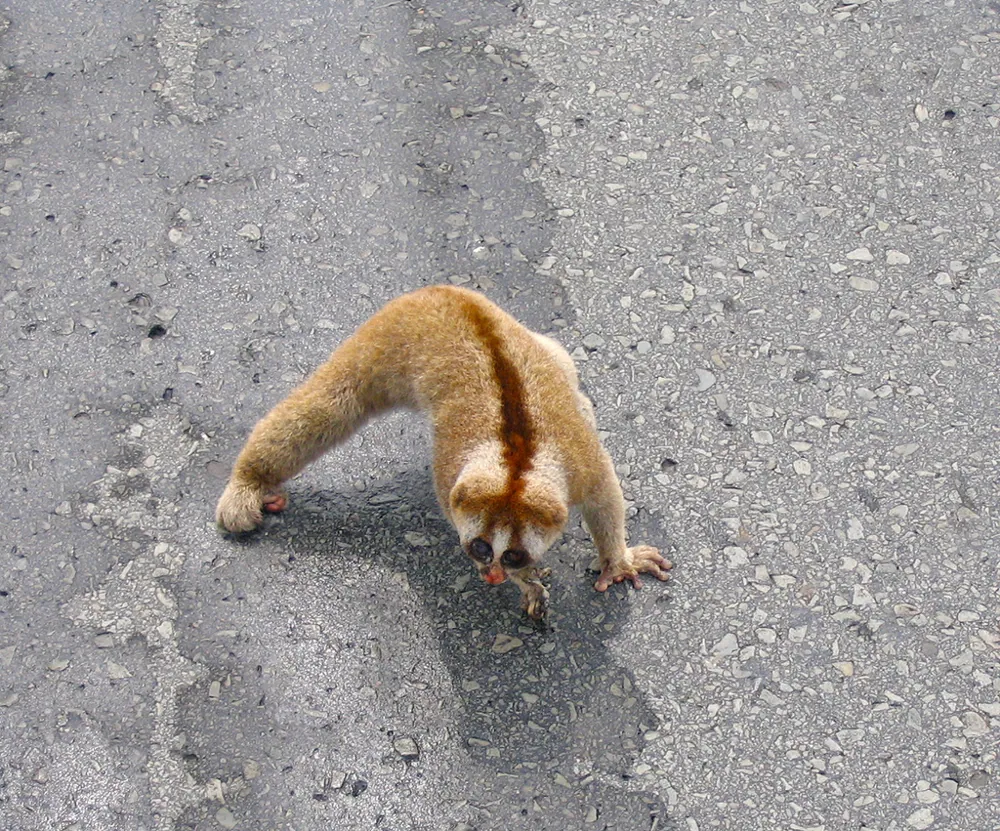
BetenThe Philippine slow loris is a small primate with pale golden to red fur and large eyes. It lives in lowland forests, gardens and plantations on the north and east coasts of Borneo and in the Sulu Archipelago of the Philippines. It is special because it is one of the smallest slow lorises and one of the hardest to find in the wild.1

 Zo herken je het
- Pale golden to red fur1
- Low-contrast markings on the face and head, with no strong dark face mask1
- Short, unfluffed body hair1
- Consistently lacks a second upper incisor (front tooth)1
- Small body, with a vestigial tail, round head and short ears; it is nocturnal and moves through the trees1
Vaak verward met: It is often confused with other slow lorises. The Bornean kayan slow loris (N. kayan) also has pale body colour, but it has a dark, high-contrast face mask and longer, fluffier fur. Its face markings are much fainter than those of N. kayan.1
Gifkracht
Het gif komt naar buiten via de giftanden of tanden als het bijt.
Wat doet zijn gif als het bijt of steekt?
This animal has a gland on the inside of its elbow that makes a pungent, clear, oily toxin. It spreads the toxin on its toothcomb (a set of lower front teeth) and uses it for defence.1
Hoe gevaarlijk is het voor mensen?
Gevaar voor mensen: PijnlijkHet kan echt pijn doen, maar het is bijna nooit ernstig.Wat doet het als het bang is?
When threatened, it wipes toxin from its elbow gland onto its toothcomb.1
 Als het bijt
- Was de wond goed en haal medische hulp.
Bel altijd eerst je alarmnummer (112, 000, 911). Dit is algemene EHBO-informatie, geen medisch advies. EHBO-basis
 Blijf veilig
- Raak een wild dier nooit aan, vang het niet en pest het niet, ook geen kleintje, en ook niet als het lijkt te slapen of dood lijkt.
- Geef het de ruimte. Kom je er een tegen, blijf rustig, stap langzaam achteruit en laat het zijn eigen weg gaan.
- Als er een je bijt: blijf rustig, beweeg niet, bel je alarmnummer (112, 000, 911) of ga snel naar een ziekenhuis. Onthoud hoe het eruitzag, een foto helpt.
Het is niet op jou uit. Het gebruikt zijn gif om voedsel te vangen of zichzelf te beschermen, en verstopt zich veel liever. Meer over veilig blijven
Waar ter wereld?
Hoe groot is het?
Hoe lang is het?
Hoe zwaar is het?

 zo lang als 9 speelgoedbouwsteentjes op een rij
 zou 100 meter kunnen afleggen in 180 seconden (de snelste mens doet er 9,6 over)
Hoe groot is Philippine slow loris vergeleken met JOU?
Alleen rekenwerk in je browser. Er wordt niets opgeslagen of verstuurd.
Hoe snel is het?


Feiten
It is so rare and hard to find that in one 75-day field study at Sabangau National Park, researchers recorded only 12 sightings.1
It has a curved grooming claw on its second hind toe, which it uses for scratching and grooming.1
Fossils of this species have been found in the Late Pleistocene site of Niah in Sarawak.1
It is one of the smallest slow lorises, and it is the least studied of Indonesia's slow lorises.1
Waar de feiten vandaan komen
- Philippine slow loris (Wikipedia (CC BY-SA 4.0))
- Nycticebus menagensis (iNaturalist): namen en indeling.
- Venom Wiki: het gevarenniveau, de typische grootte en de geschatte snelheid zijn van onszelf. Zo berekenen we ze: Hoe we gevaar beoordelen.
Elk feit op deze pagina heeft een nummer dat naar de bron wijst. Hebben we iets fout? Sorry, we zijn dierenfans, geen wetenschappelijk tijdschrift. Laat het ons weten via [email protected] en we passen het aan.
 De schorpioen heeft honger! Venom Wiki is een eenmansproject: gratis, zonder reclame en zonder trackers. Een kleine fooi helpt om het online te houden.Voer de schorpioen
Meer uit dezelfde groep: Giftige zoogdieren
 Bengal slow lorisGiftige zoogdierenDoet alleen pijn
 Javan slow lorisGiftige zoogdierenDoet alleen pijn
 Pygmy slow lorisGiftige zoogdierenDoet alleen pijn
 Sunda slow lorisGiftige zoogdierenDoet alleen pijn
 Kayan River slow lorisGiftige zoogdierenDoet alleen pijn
 Eurasian water shrewGiftige zoogdierenOngevaarlijk
 Deathstalker
 Brilslang
 Indische zaagschubadder
 Koningscobra
 Pofadder
 Russells adder