
 Afrika
 Azië
Azië Europa
 Zuid-Amerika
 Australië & Oceanië
 Antarctica
 Grote Oceaan
 Atlantische Oceaan
 Indische Oceaan
 Noordelijke IJszee
 Middellandse Zee
 Rode Zee
 Caribische Zee
 Koraalzee
 Zuid-Chinese Zee
 Filipijnenzee
 Andamanse Zee
 Noordzee
 Timorzee & Arafurazee
 Golf van Bengalen
 Golf van Californië
Pumpkin toadlet
 Gif in de huid
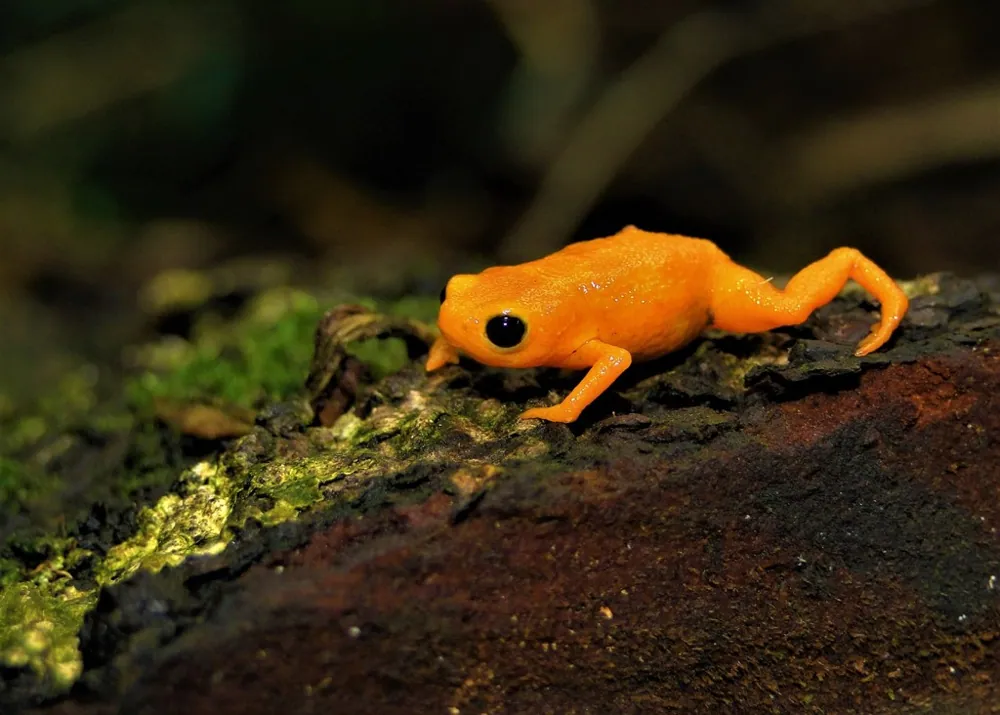
The pumpkin toadlet is a tiny, brightly coloured frog that lives in the leaf litter of the Atlantic rainforests of southeastern Brazil. Adults are bright yellow-orange, a warning sign that their skin and body carry a strong toxin. Scientists have found that the head and back of this frog glow under ultraviolet light.1
 Zo herken je het
- Adults are bright yellow-orange.1
- Newly hatched young are brown and well camouflaged.1
- It is very small, with adults measuring 12.5 to 19.7 mm from snout to vent.1
- Females tend to be larger than males.1
Vaak verward met: It is closely related to the red pumpkin toadlet (B. pitanga), which also glows under ultraviolet light and shares its inability to hear its own call.1
Gifkracht
Zijn huid is giftig. Het is gevaarlijk om aan te raken, te likken of op te eten.
Wat doet zijn gif als je het aanraakt of opeet?
This frog is poisonous rather than venomous, so it does not inject venom. Its main toxin is 11-oxotetrodotoxin, which is extremely rare in animals, even marine ones, and is four to five times more potent than tetrodotoxin. The toxins are found in the skin and ovaries but are mostly concentrated in the liver.1
Hoe gevaarlijk is het voor mensen?
Gevaar voor mensen: PijnlijkHet kan echt pijn doen, maar het is bijna nooit ernstig.Wat doet het als het bang is?
Its bright yellow-orange colour is a warning display (aposematism) that tells predators it is toxic.1
 Als iemand het heeft aangeraakt of gegeten
- Als iemand er een heeft aangeraakt: was de handen goed en raak de ogen of mond niet aan. Als een kind of huisdier er een heeft gelikt of opgegeten: bel het vergiftigingencentrum of je alarmnummer.
Bel altijd eerst je alarmnummer (112, 000, 911). Dit is algemene EHBO-informatie, geen medisch advies. EHBO-basis
 Blijf veilig
- Raak een wild dier nooit aan, vang het niet en pest het niet, ook geen kleintje, en ook niet als het lijkt te slapen of dood lijkt.
- Geef het de ruimte. Kom je er een tegen, blijf rustig, stap langzaam achteruit en laat het zijn eigen weg gaan.
- Als je het hebt aangeraakt of gegeten: wrijf niet in je ogen of aan je mond, was je handen en haal medische hulp.
Het is niet op jou uit. Zijn gif is er alleen zodat niets het opeet. Meer over veilig blijven
Waar ter wereld?
Hoe groot is het?
Hoe lang is het?
 korter dan je pinkje
 zou 100 meter kunnen afleggen in 180 seconden (de snelste mens doet er 9,6 over)
Hoe groot is Pumpkin toadlet vergeleken met JOU?
Alleen rekenwerk in je browser. Er wordt niets opgeslagen of verstuurd.
Hoe snel is het?


Feiten
In 2019, scientists found that the head and back of this frog glow under ultraviolet light because of fluorescent skeletons. Young frogs that have gained adult colours still do not glow.1
Adults cannot hear the frequency of their own calls because their ears are underdeveloped. They communicate with movements such as inflating the vocal sac, gaping the mouth and waving their arms.1
Its main toxin, 11-oxotetrodotoxin, is extremely rare in animals, even in marine species.1
Its young hatch directly into tiny toadlets, skipping the tadpole stage.1
It is among the largest frogs in its genus, Brachycephalus.1
Fabeltjes-checker
Fabel: Its glow under ultraviolet light is a warning signal to predators.
Waarheid: Studies suggest this is unlikely. Predators attack the frogs at the same rate whether or not they glow.1
Voor gifexperts
- Wetenschappelijke naam
- Brachycephalus ephippium
- Groep
- Pijlgifkikkers, padden & salamanders
- Familie
- Brachycephalidae2
- Orde
- Anura
- Continenten
- Zuid-Amerika
- Baby's
- It breeds by direct development. The female lays a few eggs on land, which hatch into young toadlets with no tadpole stage.1
- Hoe het in het wild gaat
- Not considered threatened1
- Gevaar voor mensen
- 2 / 5: Pijnlijk3
Waar de feiten vandaan komen
- Pumpkin toadlet (Wikipedia (CC BY-SA 4.0))
- Brachycephalus ephippium (iNaturalist): namen en indeling.
- Venom Wiki: het gevarenniveau, de typische grootte en de geschatte snelheid zijn van onszelf. Zo berekenen we ze: Hoe we gevaar beoordelen.
Elk feit op deze pagina heeft een nummer dat naar de bron wijst. Hebben we iets fout? Sorry, we zijn dierenfans, geen wetenschappelijk tijdschrift. Laat het ons weten via [email protected] en we passen het aan.
 De schorpioen heeft honger! Venom Wiki is een eenmansproject: gratis, zonder reclame en zonder trackers. Een kleine fooi helpt om het online te houden.Voer de schorpioen
Meer uit dezelfde groep: Pijlgifkikkers, padden & salamanders
 Golden poison frogPijlgifkikkers, padden & salamandersDodelijkNiet aanraken
 Cane toadPijlgifkikkers, padden & salamandersMoet naar de dokterNiet aanraken
 Dyeing poison dart frogPijlgifkikkers, padden & salamandersDoet alleen pijnNiet aanraken
 Black-legged poison frogPijlgifkikkers, padden & salamandersKan dodenNiet aanraken
 Bruno's casque-headed frogPijlgifkikkers, padden & salamandersMoet naar de dokterNiet aanraken
 Harlequin poison frogPijlgifkikkers, padden & salamandersMoet naar de dokterNiet aanraken
 Terciopelo
 Brazilian wandering spider
 Eyelash viper
 Golden lancehead
 South American bushmaster
 Peruvian giant centipede