
 Afrika
 Azië
Azië Europa
 Zuid-Amerika
 Australië & Oceanië
 Antarctica
 Grote Oceaan
 Atlantische Oceaan
 Indische Oceaan
 Noordelijke IJszee
 Middellandse Zee
 Rode Zee
 Caribische Zee
 Koraalzee
 Zuid-Chinese Zee
 Filipijnenzee
 Andamanse Zee
 Noordzee
 Timorzee & Arafurazee
 Golf van Bengalen
 Golf van Californië
Red-naped snake
 Beten
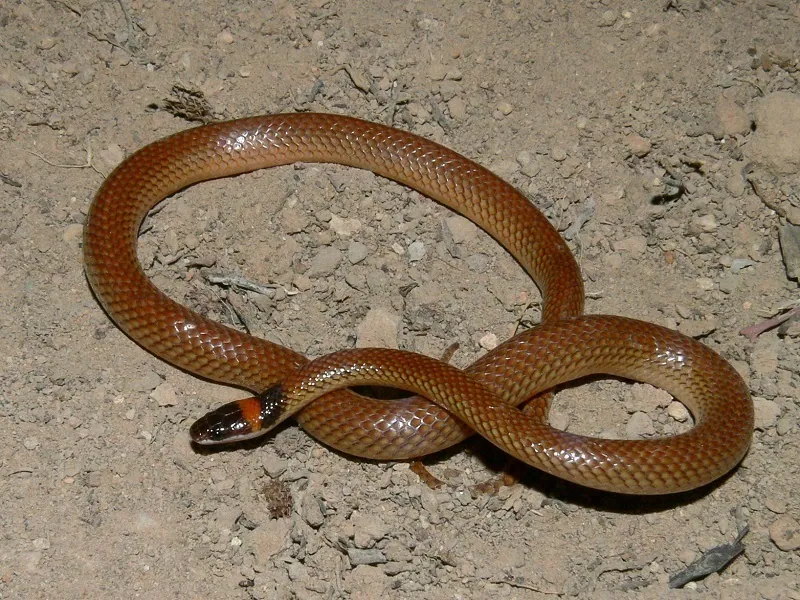
BetenThe red-naped snake is a small venomous snake with a bright red or orange patch on the back of its neck. It lives in many parts of eastern and central Australia, mostly hunting at night. It is special because it looks very like the young eastern brown snake, which is far more dangerous.1

 Zo herken je het
- Small, slim snake, reaching a maximum length of about 45 cm1
- Shiny black head and neck, with small black eyes and a head that looks partly flattened1
- A white streak on the upper lip1
- A well-defined orange or red patch on the back of the neck, shaped like a diamond, crescent or oval1
- Red-brown body with dark edges to the scales, so the pattern looks like a net; the belly is cream or white1
Vaak verward met: The red-naped snake looks similar to the juvenile eastern brown snake. The eastern brown snake has a lighter band between its dark head and neck. Behaviour is the easiest difference: the eastern brown snake is active in the day, while the red-naped snake is nocturnal and is rarely seen unless its shelter is disturbed.1
Gifkracht
Het gif komt naar buiten via de giftanden of tanden als het bijt.
Hoe gevaarlijk is het voor mensen?
Gevaar voor mensen: MildZoals een bijensteek of minder. Eigenlijk ongevaarlijk voor mensen.The red-naped snake is venomous, but it is considered harmless to humans. It can bite, and will do so if it is provoked enough.1
Wat doet het als het bang is?
When threatened, it strikes out several times with the front of its body raised off the ground, usually with its mouth closed.1
 Als het bijt
- Drukimmobilisatie: wikkel een stevig elastisch verband over de beet en daarna omhoog over de hele arm of het hele been, leg een spalk aan en houd de persoon helemaal stil tot er hulp komt.
- Was de beet niet: in het ziekenhuis kunnen ze het gif dat op de huid achterblijft testen om het juiste tegengif (antiserum) te kiezen.
Bel altijd eerst je alarmnummer (112, 000, 911). Dit is algemene EHBO-informatie, geen medisch advies. EHBO-basis
 Blijf veilig
- Raak een wild dier nooit aan, vang het niet en pest het niet, ook geen kleintje, en ook niet als het lijkt te slapen of dood lijkt.
- Geef het de ruimte. Kom je er een tegen, blijf rustig, stap langzaam achteruit en laat het zijn eigen weg gaan.
- Als er een je bijt: blijf rustig, beweeg niet, bel je alarmnummer (112, 000, 911) of ga snel naar een ziekenhuis. Onthoud hoe het eruitzag, een foto helpt.
Het is niet op jou uit. Het gebruikt zijn gif om voedsel te vangen of zichzelf te beschermen, en verstopt zich veel liever. Meer over veilig blijven
Waar ter wereld?
Hoe groot is het?
Hoe lang is het?
 zo lang als 2,5 bananen achter elkaar
 zo lang als 14 speelgoedbouwsteentjes op een rij
 zou 100 meter kunnen afleggen in 61 seconden (de snelste mens doet er 9,6 over)
Hoe groot is Red-naped snake vergeleken met JOU?
Alleen rekenwerk in je browser. Er wordt niets opgeslagen of verstuurd.
Hoe snel is het?


Feiten
It kills its prey with both venom and constriction, squeezing the prey in its coils.1
Its look is so close to the young eastern brown snake that behaviour is often the only way to tell them apart.1
Its neck patch is one of its clearest markings: an orange or red shape on an otherwise black head and neck.1
It is nocturnal, so it is rarely seen unless its hiding place is disturbed.1
Voor gifexperts
- Wetenschappelijke naam
- Furina diadema
- Groep
- Australische slangen
- Familie
- Elapidae2
- Orde
- Squamata
- Continenten
- Australië & Oceanië
- Baby's
- It lays eggs. Recorded clutches range from 1 to 10 eggs, with an average of 3. Young hatch in January, or February in cooler regions, and become adults within a year.1
- Hoe het in het wild gaat
- Threatened (listed in Victoria)1
- Gevaar voor mensen
- 1 / 5: Mild3
Waar de feiten vandaan komen
- Red-naped snake (Wikipedia (CC BY-SA 4.0))
- Furina diadema (iNaturalist): namen en indeling.
- Venom Wiki: het gevarenniveau, de typische grootte en de geschatte snelheid zijn van onszelf. Zo berekenen we ze: Hoe we gevaar beoordelen.
Elk feit op deze pagina heeft een nummer dat naar de bron wijst. Hebben we iets fout? Sorry, we zijn dierenfans, geen wetenschappelijk tijdschrift. Laat het ons weten via [email protected] en we passen het aan.
 De schorpioen heeft honger! Venom Wiki is een eenmansproject: gratis, zonder reclame en zonder trackers. Een kleine fooi helpt om het online te houden.Voer de schorpioen
Meer uit dezelfde groep: Australische slangen
 Kusttaipan
 Gewone doodsadder
 Oostelijke bruine slang
 Inlandtaipan
 Tijgerslang
 Collett's snake
Leeft ook in: Australië & Oceanië
 SydneytrechterspinVogelspinnen & trechterwebspinnenDodelijk
 Redback spiderSpinnenMoet naar de dokter
 Brown tree snakeAchtertandslangenDoet alleen pijn
 Hooded pitohuiAndere passief giftige dierenDoet alleen pijnNiet aanraken
 PlatypusGiftige zoogdierenDoet alleen pijn
 Northern tree-dwelling funnel-web spiderVogelspinnen & trechterwebspinnenDodelijk