
 Afrikaa
 Eeshiyaa
 Awurooppaa
 Ameerikaa Kibbaa
 Awustiraaliyaa fi Oshiyaaniyaa
 Antaarkitikaa
 Garba Paasifikii
 Garba Atlaantikii
 Garba Hindii
 Garba Arkitikii
 Galaana Meditiraaniyaa
 Galaana Diimaa
 Galaana Kaariibiyaan
 Galaana Kooraal
 Galaana Chaayinaa Kibbaa
 Galaana Filippiinsii
 Galaana Andamaan
 Galaana Kaabaa
 Galaana Timoor fi Araafuuraa
 Galaana Bengaal
 Galaana Kaaliforniyaa
Chinese cobra
 Ciniinnaa
The Chinese cobra is a venomous snake from southern China and a few neighbouring countries and islands. It is one of the most common venomous snakes in China, and it has caused many snakebites there.1
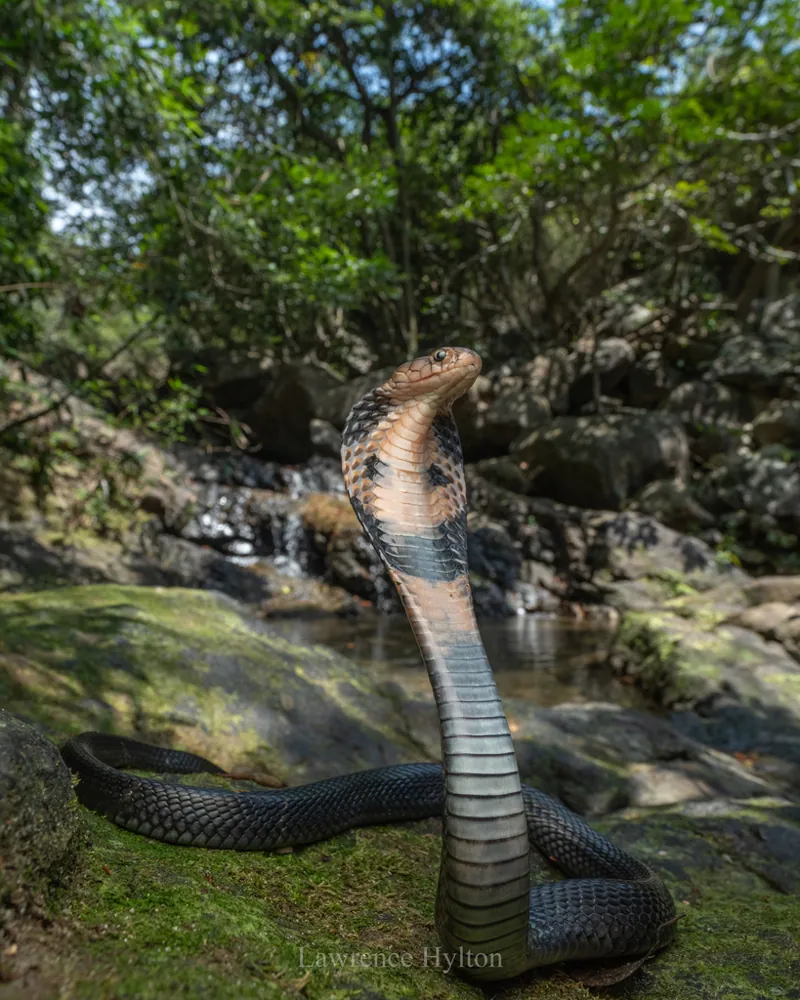
 Akkaataa itti beekamu
- The hood marking varies. It can look like spectacles, a mask, a horseshoe or the letter O, and it is often linked to a pale throat area on at least one side.1
- The body is iridescent black, with widely spaced yellow double lines running across it.1
- The underside is pearl or slate-coloured. The upper colour is usually brown, grey or black, sometimes with narrow pale lines, which are especially clear in young snakes.1
- Typical adults are 1.2 to 1.5 metres long.1
Yeroo baay'ee kan itti wal fakkeessan: It is sometimes confused with the monocled cobra (Naja kaouthia). The Chinese cobra has lower counts of ventral and subcaudal scales, which are the belly and tail scales. Sex should be taken into account when comparing these counts.1
Humna summii
Summiin yeroo ciniinu ilkaan summii ykn ilkaan isaa keessaan ba'a.
Summiin isaa (ciniinnaa ykn iddiin) maal godha?
The Chinese cobra is a highly venomous member of the true cobras. Local symptoms at the bite include darkening of the wound, redness, swelling, pain and numbness, and blisters and necrosis (death of tissue) almost always follow. Necrosis can last for years after the person has otherwise recovered. Whole-body symptoms can include chest discomfort, fever, sore throat, difficulty swallowing, loss of voice, weak limbs, unsteady walking, lockjaw and difficulty breathing.1
Namootaaf hammam balaa qaba?
Balaa namootaaf: Baay'ee balaa qabaNama yaalii hin arganne ajjeesuu danda'a.It is one of the most common venomous snakes in China and has caused many snakebite incidents there. Deaths occasionally occur, but they are much rarer than they used to be.1
 Oduu gaarii: doktoroonni qoricha (qoricha farra summii, antivenom) ykn yaalii kanaaf qabu.1
Yeroo sodaatu maal godha?
Adults can be aggressive, and young snakes are more nervous and more likely to be aggressive, but it usually escapes to avoid a confrontation.1
 Yoo ciniine
- Namicha sochii malee fi tasgabbaa'aa tursiisi, qubeelaa fi waan cimee hidhu baasi, dafii hospitaala geessi: yaaliin isaa qoricha farra summii (antivenom) dha.
- Yoo summiin ija keessatti tufame, battaluma bishaan qulqulluu baay'eedhaan dhiqi.
Yeroo hunda dursa lakkoofsa balaa tasaa kee bilbili (112, 000, 911). Kun qajeelfama gargaarsa jalqabaa waliigalaa ti, gorsa yaalaa miti. Bu'uura gargaarsa jalqabaa
 Nageenyaan turi
- Bineensa bosonaa gonkumaa hin tuqin, hin qabin, hin tuttuqin, xiqqaa ta'us, rafe ykn du'e fakkaatus.
- Iddoo itti kenni. Yoo tokko wajjin wal argite, tasgabbaa'i, suuta duubatti deebi'iitii karaa isaa akka deemu dhiisi.
- Yoo tokko si ciniine: tasgabbaa'i, sochii malee turi, lakkoofsa balaa tasaa kee (112, 000, 911) bilbili ykn dafii hospitaala ga'i. Maal akka fakkaatu yaadadhu, suuraan ni gargaara.
Si miidhuuf si hin barbaadu. Summii isaa nyaata qabachuuf ykn of eeguuf fayyadama, dhokachuu immoo baay'ee filata. Waa'ee nageenyaa dabalataan
Addunyaa keessaa eessatti?
Hammam guddaa dha?
Dheerinni isaa hammam?
 akka adurree manaa 4 funyaan hanga eegeetti dheerata
 akka muuzii 11 walitti aananii tarreeffamanii dheerata
 meetira 100 sekoondii 48 keessatti fiiguu danda'a (namni hundaa caalaa ariifatu 9,6 barbaada)
Chinese cobra SI wajjin yoo wal bira qabamu hammam guddaa dha?
Herrega qofa barsiisaa kee keessatti. Homtuu hin olkaa'amu, eessayyuu hin ergamu.
Hammam ariifata?


Dhugaawwan
Necrosis from a bite can continue for many years after the victim has recovered in general.1
A snake kept at a snake farm gave an average venom yield of about 250.8 mg, of which about 80 mg was dry weight.1
Its fangs are always erect and sit at the front of the upper jaw, as in other elapid snakes.1
Dhugaawwan eessaa dhufu
- Chinese cobra (Wikipedia (CC BY-SA 4.0))
- Naja atra (iNaturalist): maqaa fi ramaddii.
- Venom Wiki: sadarkaan balaa, guddinni idilee fi tilmaamni ariitii kan keenya. Akkamitti akka hojjennu ilaali: Balaa akkamitti madaalla.
Dhugaan fuula kana irra jiru hundi lakkoofsa madda isaatti si qajeelchu qaba. Yoo waan tokko dogoggorre, dhiifama, nuti jaallattoota bineensotaa ti malee joornaalii saayinsii miti. [email protected] irratti nutti himi, ni sirreessina.
 Iskoorpiyooniin beela'eera! Venom Wiki pirojektii nama tokkoo ti: bilisa, beeksisa fi hordoftuu malee. Gumaachi xiqqaan interneetii irratti akka turu gargaara.Iskoorpiyoonii nyaachisi
Garee wal fakkaataa irraa dabalataan: Kobraa, mambaa fi kiraayitii
 Indian cobraKobraa, mambaa fi kiraayitiiNama ajjeesa
 King cobraKobraa, mambaa fi kiraayitiiNama ajjeesa
 Caspian cobraKobraa, mambaa fi kiraayitiiNama ajjeesa
 Common kraitKobraa, mambaa fi kiraayitiiNama ajjeesa
 Malayan kraitKobraa, mambaa fi kiraayitiiNama ajjeesa
 Many-banded kraitKobraa, mambaa fi kiraayitiiNama ajjeesa
Akkasumas kan jiraatu: Eeshiyaa
 DeathstalkerIskoorpiyoonotaNama ajjeesa
 Indian saw-scaled viperBofoota viper fi adderNama ajjeesa
 Puff adderBofoota viper fi adderNama ajjeesa
 Bufaa RaaselBofoota viper fi adderNama ajjeesa
 Asian giant hornetKanniisa fi hurrii (wasp fi hornet)Ni ajjeesuu danda'a
 Komodo dragonArgiinsota summii qabanNi ajjeesuu danda'a