
 África
 Ásia
Ásia Europa
 América do Sul
 Austrália e Oceania
 Antártida
 Oceano Pacífico
 Oceano Atlântico
 Oceano Índico
 Oceano Ártico
 Mar Mediterrâneo
 Mar Vermelho
 Mar do Caribe
 Mar de Coral
 Mar do Sul da China
 Mar das Filipinas
 Mar de Andamão
 Mar do Norte
 Mar de Timor e de Arafura
 Golfo de Bengala
 Golfo da Califórnia
African crested rat
 Veneno na pele
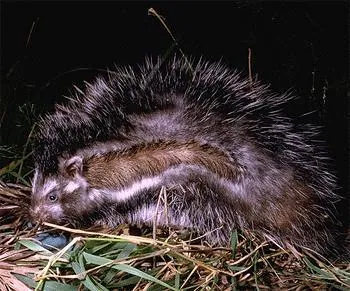
The African crested rat is a large, nocturnal rodent with long hair and a bushy tail. It looks a little like a porcupine. It lives in East Africa, where it is the world's only known poisonous rodent, coating itself in plant toxins to keep predators away.1



 Como reconhecer
- Large, nocturnal rodent with long, silver and black-tipped guard hairs over a woolly grey and white undercoat1
- A mane of longer black-and-white banded hairs runs from the top of the head to just beyond the base of the tail1
- A broad, white-bordered strip of glandular skin sits beside the mane, and it becomes visible when the animal is threatened1
- Bushy tail and short black fur on the face and limbs1
- Superficially resembles a porcupine1
Poder venenoso
A pele dele é venenosa. É perigoso tocar, lamber ou comer.
O que o veneno dele faz se você tocar ou comer?
This animal is poisonous rather than venomous, so it does not bite or sting to inject poison. It smears poison from the bark of the poison arrow tree onto the hairs of its glandular skin patch. A predator that bites it can be sickened or even killed by this poison.1
Qual é o perigo para as pessoas?
Perigo para as pessoas: GraveSe alguém tocar nele ou comer, é preciso ir ao médico. Mortes são muito raras.Its poison is a risk to predators that try to bite it. The rat itself is not harmed by the toxins it stores.1
O que ele faz quando está com medo?
When threatened or excited, the mane stands up and the glandular strip parts, exposing the skin that carries the poison.1
 Se alguém tocou ou comeu
- Se alguém comeu ou tem sintomas depois de comer: ligue já para o número de emergência ou para o centro de informação toxicológica.
Sempre ligue primeiro para o número de emergência (112, 000, 911). Estas são orientações gerais de primeiros socorros, não um conselho médico. Primeiros socorros básicos
 Fique em segurança
- Nunca toque, pegue ou provoque um animal selvagem, mesmo que seja pequeno, e mesmo que pareça estar dormindo ou morto.
- Dê espaço a ele. Se encontrar um, fique calmo, dê alguns passos para trás devagar e deixe que ele siga o caminho dele.
- Se você tocou ou comeu: não esfregue os olhos nem a boca, lave as mãos e procure ajuda médica.
Ele não está atrás de você. O veneno dele só existe para que ninguém o coma. Mais sobre como ficar em segurança
Em que lugar do mundo?
Qual é o tamanho dele?
Qual é o comprimento dele?
Quanto ele pesa?

 tem o comprimento de 10 blocos de montar em fila
 poderia percorrer 100 metros em 72 segundos (o humano mais rápido precisa de 9,6)
Qual é o tamanho de African crested rat comparado com VOCÊ?
Só contas no seu navegador. Nada é salvo nem enviado para lugar nenhum.
Quão rápido ele é?


Informações
It is the world's only known poisonous rodent.1
It is the only rodent known to use and store toxins from a different species in nature to protect itself, and it suffers no known harm from them.1
Its stomach has five anatomically distinct sections, a feature found in very few rodents.1
The skull is covered with small bony projections that give it a pebbled look.1
Its large size may allow microbes in its foregut to break down cellulose from plants by fermentation.1
Caça-mitos
Mito: The maned rat was believed to be solitary.
Verdade: It is now known to be somewhat sociable. Several animals are found in the same territory, and they purr and groom one another, so they may form family groups of a male, a female and their young.1
Para especialistas em veneno
- Nome científico
- Lophiomys imhausi
- Grupo
- Outros animais venenosos
- Família
- Muridae2
- Ordem
- Rodentia
- Continentes
- África
- Filhotes
- Litters have 1 to 3 young. The young are slightly haired at birth, their eyes open by day 13, and they are weaned by day 40.1
- Como ele está na natureza
- Least Concern1
- Perigo para as pessoas
- 3 / 5: Grave3
De onde vêm as informações
- Maned rat (Wikipedia (CC BY-SA 4.0))
- Lophiomys imhausi (iNaturalist): nomes e classificação.
- Venom Wiki: o nível de perigo, o tamanho típico e o palpite de velocidade são nossos. Veja como calculamos: Como avaliamos o perigo.
Cada informação desta página tem um número que leva à fonte. Se a gente errou alguma coisa, desculpe, somos fãs de animais, não uma revista científica. Avise a gente em [email protected] e nós corrigimos.
 O escorpião está com fome! O Venom Wiki é um projeto de uma pessoa só: grátis, sem anúncios e sem rastreadores. Uma pequena contribuição ajuda a manter o site no ar.Alimente o escorpião
 Common quail
 Spur-winged goose
 Fahaka pufferfish
 Red-striped oil beetle
 Baiacu-japonês
 Hawksbill sea turtle
 Mamba-negra
 Escorpião-amarelo-palestino
 Naja-egípcia
 Víbora-bufadora
 Boomslang
 Fat-tailed scorpion