
 África
 Ásia
Ásia Europa
 América do Sul
 Austrália e Oceania
 Antártida
 Oceano Pacífico
 Oceano Atlântico
 Oceano Índico
 Oceano Ártico
 Mar Mediterrâneo
 Mar Vermelho
 Mar do Caribe
 Mar de Coral
 Mar do Sul da China
 Mar das Filipinas
 Mar de Andamão
 Mar do Norte
 Mar de Timor e de Arafura
 Golfo de Bengala
 Golfo da Califórnia
Asian hornet
 Picadas
The Asian hornet is a hornet from Southeast Asia that has spread to many other countries, including most of Europe, where it is an invasive species. It is a concern because it hunts honeybees and its stings can be serious for people.1


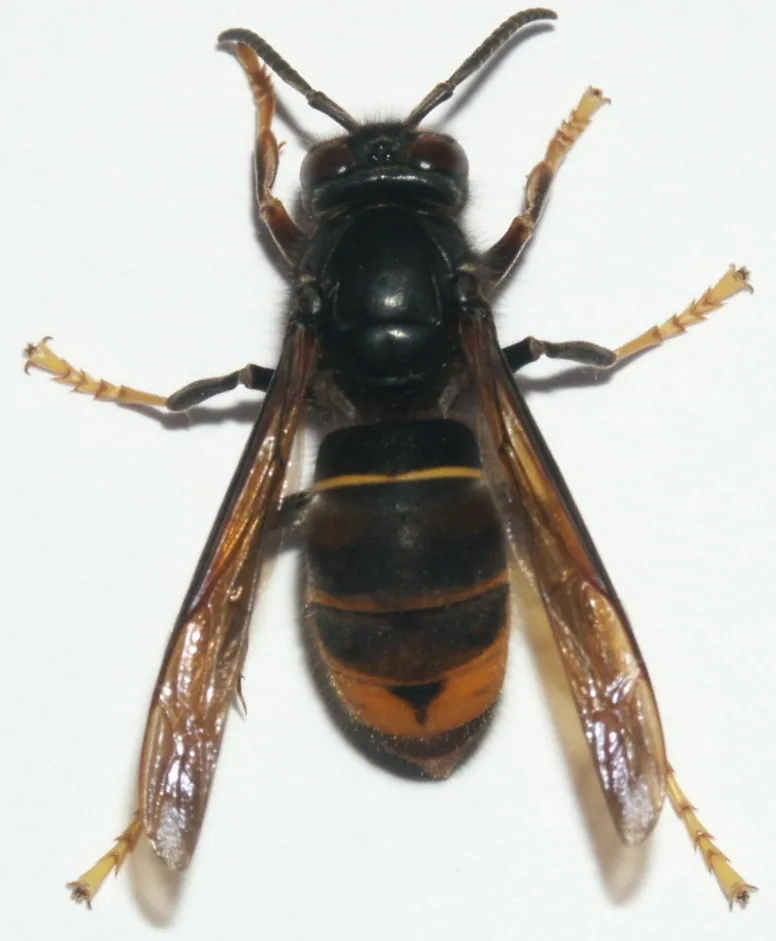
 Como reconhecer
- Queens are about 3 cm long, males about 2.4 cm and workers about 2 cm, so it is significantly smaller than the European hornet.1
- Its legs (tarsi) are yellow, which gives it the name yellow-legged hornet.1
- The thorax is velvety brown or black, with a brown abdomen.1
- Each abdominal segment has a narrow yellow border at the back, except the fourth segment, which is orange.1
- The head is black and the face is yellow.1
Muitas vezes confundido com: It looks like the European hornet (V. crabro), which is much larger. Its nest exit is usually on the side rather than at the bottom.1
Poder do veneno
O veneno sai por um ferrão.
O que o veneno dele faz?
Multiple stings have caused anaphylactic shock, a severe allergic reaction, in people who were hospitalised in France.1
Qual é o perigo para as pessoas?
Perigo para as pessoas: DolorosoPode doer bastante, mas quase nunca é grave.Although the species is not aggressive, people have been attacked after disturbing nests. A man in Galicia, Spain, was killed in 2017 after being stung over 20 times while pruning an apple tree. Several people have died in south west France, including in 2019 and 2020. Because of its larger size, its stings are more serious than those of western honeybees.1
O que ele faz quando está com medo?
When it feels its nest is threatened, it charges in a group.1
 Se ele picar
- Raspe o ferrão da abelha para tirar e esfrie o local.
- Se a pessoa tem dificuldade para respirar, inchaço no rosto ou na garganta, ou se sente desmaiar, é uma emergência alérgica: ligue para o número de emergência e use a caneta de adrenalina dela, se ela tiver uma.
Sempre ligue primeiro para o número de emergência (112, 000, 911). Estas são orientações gerais de primeiros socorros, não um conselho médico. Primeiros socorros básicos
 Fique em segurança
- Nunca toque, pegue ou provoque um animal selvagem, mesmo que seja pequeno, e mesmo que pareça estar dormindo ou morto.
- Dê espaço a ele. Se encontrar um, fique calmo, dê alguns passos para trás devagar e deixe que ele siga o caminho dele.
- Se um deles picar você: fique calmo, fique parado, ligue para o número de emergência (112, 000, 911) ou vá rápido para um hospital. Lembre como ele era, uma foto ajuda.
Ele não está atrás de você. Usa o veneno para pegar comida ou se proteger, e prefere muito mais se esconder. Mais sobre como ficar em segurança
Em que lugar do mundo?
Qual é o tamanho dele?
Qual é o comprimento dele?
 mais ou menos o comprimento de um clipe de papel
 poderia atravessar voando um campo de futebol inteiro em 13 segundos
Qual é o tamanho de Asian hornet comparado com VOCÊ?
Só contas no seu navegador. Nada é salvo nem enviado para lugar nenhum.
Quão rápido ele é?


Informações
In its native range, its main prey is the eastern honeybee, which defends the hive by balling hornets and raising the temperature inside the ball to a level that kills the hornet.1
A hornet hunting honeybees holds a territory of about 0.5 m² above a beehive and catches bees as they return to the hive.1
It is believed to have reached France in boxes of pottery from China in 2004.1
A colony often starts a nest in a low shrub, then abandons it after some months and builds a new one high in a tree, possibly to avoid parasites.1
Young queens leave the colony in late autumn and hibernate over winter.1
Caça-mitos
Mito: Asian hornets are aggressive and will attack anyone who comes near.
Verdade: The species is not aggressive, but it will charge in a group when it feels its nest is threatened.1
De onde vêm as informações
- Asian hornet (Wikipedia (CC BY-SA 4.0))
- Vespa velutina (iNaturalist): nomes e classificação.
- Venom Wiki: o nível de perigo, o tamanho típico e o palpite de velocidade são nossos. Veja como calculamos: Como avaliamos o perigo.
Cada informação desta página tem um número que leva à fonte. Se a gente errou alguma coisa, desculpe, somos fãs de animais, não uma revista científica. Avise a gente em [email protected] e nós corrigimos.
 O escorpião está com fome! O Venom Wiki é um projeto de uma pessoa só: grátis, sem anúncios e sem rastreadores. Uma pequena contribuição ajuda a manter o site no ar.Alimente o escorpião
 Asian giant hornet
 Common wasp
 European hornet
 Western honey bee
 Giant honey bee
 European paper wasp
 Escorpião-amarelo-palestino
 Naja-indiana
 Víbora-serrilhada-indiana
 Naja-real
 Víbora-bufadora
 Víbora-de-russell