
 África
 Ásia
Ásia Europa
 América do Sul
 Austrália e Oceania
 Antártida
 Oceano Pacífico
 Oceano Atlântico
 Oceano Índico
 Oceano Ártico
 Mar Mediterrâneo
 Mar Vermelho
 Mar do Caribe
 Mar de Coral
 Mar do Sul da China
 Mar das Filipinas
 Mar de Andamão
 Mar do Norte
 Mar de Timor e de Arafura
 Golfo de Bengala
 Golfo da Califórnia
Baron's mantella
 Veneno na pele
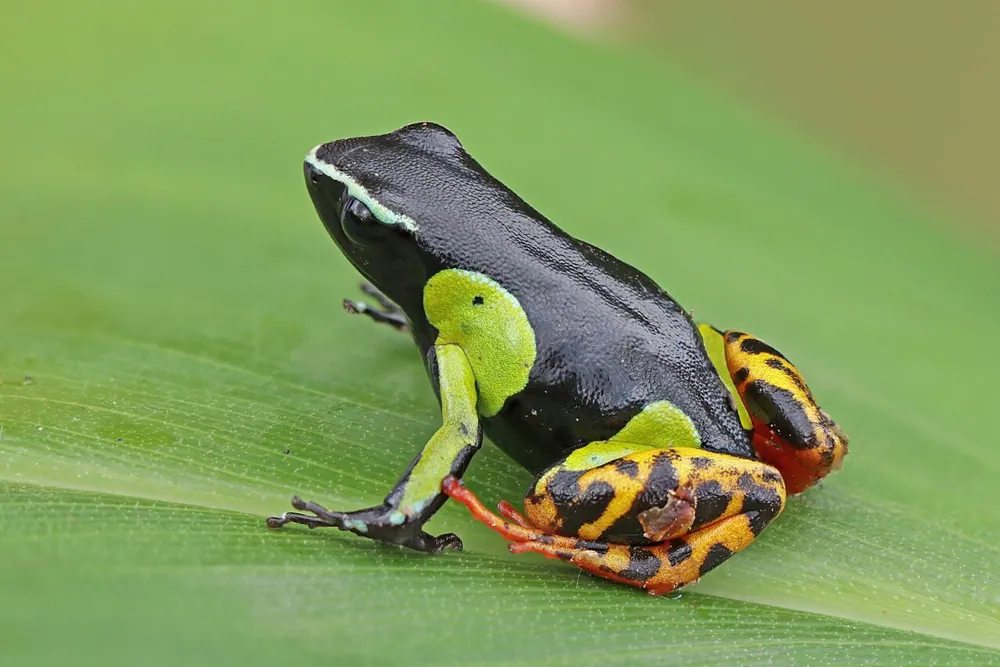
Baron's mantella is a small, brightly coloured frog that lives only on the island of Madagascar. Its skin contains toxic chemicals that make it harmful to predators, and its bright colours warn them to stay away.1



 Como reconhecer
- Has a light line above the eyes, called a rostral line.1
- Hind limbs are orange with irregular black stripes, giving a tiger-like pattern.1
- Front limbs range from light green to bright orange or yellow, with a large rounded flank blotch.1
- Adults are 2.4 to 3.2 cm long, and females are slightly larger than males.1
- Males call during the day, and it is an active hunter in daylight.1
Muitas vezes confundido com: It is often confused with the painted mantella (Mantella madagascariensis), which has a similar look. The painted mantella has a sky-blue, horseshoe-shaped marking on its throat. Baron's mantella does not have the flashmarks on its lower hind limbs.1
Poder venenoso
A pele dele é venenosa. É perigoso tocar, lamber ou comer.
O que o veneno dele faz se você tocar ou comer?
It does not inject venom. Its skin contains alkaloids, which are toxic chemicals it gets from eating mites. These make it harmful to predators that eat it, and they can cause sickness. The strength of the toxin varies over time and by location, and frogs in remote populations may be more potent.1
Qual é o perigo para as pessoas?
Perigo para as pessoas: LeveComo uma picada de abelha ou menos. Praticamente inofensivo para as pessoas.Its toxicity can vary, and careless handling is discouraged.1
O que ele faz quando está com medo?
Its bright colours warn predators that eating it could be dangerous and cause sickness.1
 Se alguém tocou ou comeu
- Se alguém tocou em um: lave bem as mãos e não toque nos olhos nem na boca. Se uma criança ou um bichinho de estimação lambeu ou comeu um: ligue para o centro de informação toxicológica ou para o número de emergência.
Sempre ligue primeiro para o número de emergência (112, 000, 911). Estas são orientações gerais de primeiros socorros, não um conselho médico. Primeiros socorros básicos
 Fique em segurança
- Nunca toque, pegue ou provoque um animal selvagem, mesmo que seja pequeno, e mesmo que pareça estar dormindo ou morto.
- Dê espaço a ele. Se encontrar um, fique calmo, dê alguns passos para trás devagar e deixe que ele siga o caminho dele.
- Se você tocou ou comeu: não esfregue os olhos nem a boca, lave as mãos e procure ajuda médica.
Ele não está atrás de você. O veneno dele só existe para que ninguém o coma. Mais sobre como ficar em segurança
Em que lugar do mundo?
Qual é o tamanho dele?
Qual é o comprimento dele?
 mais ou menos o comprimento de um clipe de papel
 poderia percorrer 100 metros em 100 segundos (o humano mais rápido precisa de 9,6)
Qual é o tamanho de Baron's mantella comparado com VOCÊ?
Só contas no seu navegador. Nada é salvo nem enviado para lugar nenhum.
Quão rápido ele é?


Informações
Its toxicity comes from the mites it eats, so its poison depends on its diet.1
Mantella frogs look like poison dart frogs from Latin America, but they are only distant relatives. The likeness is an example of convergent evolution.1
Unlike most frogs, which are active at night, it hunts during the day.1
Its bright colours and its toxins are a warning system, a pattern called aposematism.1
Its family arrived on Madagascar an estimated 76 to 87 million years ago.1
It is one of the largest species in the Mantella genus, with only some Mantella viridis individuals reaching a similar size.1
Caça-mitos
Mito: Baron's mantella is the same as the painted mantella, and is sometimes called a painted mantella.
Verdade: The two are distinct species. They look alike, but the painted mantella has a sky-blue throat marking that Baron's mantella lacks.1
Para especialistas em veneno
- Nome científico
- Mantella baroni
- Grupo
- Rãs venenosas, sapos e tritões
- Família
- Mantellidae2
- Ordem
- Anura
- Continentes
- África
- Filhotes
- Females can lay up to 130 eggs in a single clutch, usually near water. Rain washes the tadpoles into the water.1
- Como ele está na natureza
- Least Concern (IUCN, 2016). It appears in CITES Appendix II.1
- Perigo para as pessoas
- 1 / 5: Leve3
De onde vêm as informações
- Mantella baroni (Wikipedia (CC BY-SA 4.0))
- Mantella baroni (iNaturalist): nomes e classificação.
- Venom Wiki: o nível de perigo, o tamanho típico e o palpite de velocidade são nossos. Veja como calculamos: Como avaliamos o perigo.
Cada informação desta página tem um número que leva à fonte. Se a gente errou alguma coisa, desculpe, somos fãs de animais, não uma revista científica. Avise a gente em [email protected] e nós corrigimos.
 O escorpião está com fome! O Venom Wiki é um projeto de uma pessoa só: grátis, sem anúncios e sem rastreadores. Uma pequena contribuição ajuda a manter o site no ar.Alimente o escorpião
Mais do mesmo grupo: Rãs venenosas, sapos e tritões
 Golden mantellaRãs venenosas, sapos e tritõesInofensivo
 Iberian ribbed newtRãs venenosas, sapos e tritõesInofensivo
 Tomato frogRãs venenosas, sapos e tritõesInofensivo
 African common toadRãs venenosas, sapos e tritõesSó dóiNão toque
 Blue-legged mantellaRãs venenosas, sapos e tritõesInofensivo
 Climbing mantellaRãs venenosas, sapos e tritõesInofensivo
 Mamba-negra
 Escorpião-amarelo-palestino
 Naja-egípcia
 Víbora-bufadora
 Boomslang
 Fat-tailed scorpion
_Ranomafana.jpg)