
 África
 Ásia
Ásia Europa
 América do Sul
 Austrália e Oceania
 Antártida
 Oceano Pacífico
 Oceano Atlântico
 Oceano Índico
 Oceano Ártico
 Mar Mediterrâneo
 Mar Vermelho
 Mar do Caribe
 Mar de Coral
 Mar do Sul da China
 Mar das Filipinas
 Mar de Andamão
 Mar do Norte
 Mar de Timor e de Arafura
 Golfo de Bengala
 Golfo da Califórnia
Bat ray
 Picadas
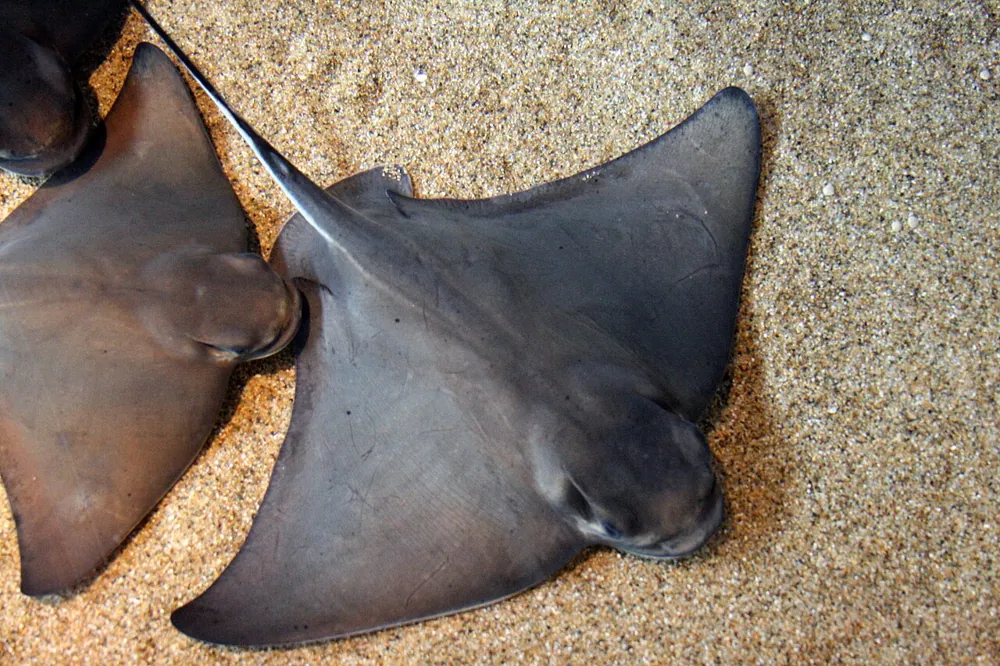
The bat ray is a flat, diamond-shaped fish related to sharks, with wing-like fins that it flaps to swim. It lives in shallow coastal waters from central Oregon in the USA down to the Gulf of California in Mexico, and around the Galápagos Islands. It has a venomous spine near the base of its tail, but it uses it only when it feels threatened.1



 Como reconhecer
- Diamond-shaped body, with wing-like pectoral fins that end in blunt points1
- Broad head raised higher than the fins, with eyes set on the sides of the head1
- Dark back, black or dark brown, with a white underside1
- Whip-like tail with at least one venomous spine at its base1
- Usually two small cephalic horns (projections from the front of the head) used for pushing food into the mouth1
Poder do veneno
O veneno sai por um ferrão.
Qual é o perigo para as pessoas?
Perigo para as pessoas: DolorosoPode doer bastante, mas quase nunca é grave.The bat ray is not considered dangerous to people. It uses its venomous tail spine only when it is attacked or frightened.1
O que ele faz quando está com medo?
The bat ray camouflages itself in the sand and uses its tail spine only when attacked or frightened.1
 Se ele picar
- Coloque o ferimento em água quente, tão quente quanto a pessoa aguentar sem se queimar (teste com a sua própria mão), por 30 a 90 minutos. Procure ajuda médica, principalmente no caso de peixes-pedra e arraias.
Sempre ligue primeiro para o número de emergência (112, 000, 911). Estas são orientações gerais de primeiros socorros, não um conselho médico. Primeiros socorros básicos
 Fique em segurança
- Nunca toque, pegue ou provoque um animal selvagem, mesmo que seja pequeno, e mesmo que pareça estar dormindo ou morto.
- Dê espaço a ele. Se encontrar um, fique calmo, dê alguns passos para trás devagar e deixe que ele siga o caminho dele.
- Se um deles picar você: fique calmo, fique parado, ligue para o número de emergência (112, 000, 911) ou vá rápido para um hospital. Lembre como ele era, uma foto ajuda.
Ele não está atrás de você. Usa o veneno para pegar comida ou se proteger, e prefere muito mais se esconder. Mais sobre como ficar em segurança
Em que lugar do mundo?
Qual é o tamanho dele?
Qual é o comprimento dele?
Quanto ele pesa?

 tem o comprimento de 4 gatos domésticos do focinho à cauda
 tem o comprimento de 10 bananas enfileiradas
 poderia nadar o comprimento de uma piscina grande (50 m) em 8,2 segundos
Qual é o tamanho de Bat ray comparado com VOCÊ?
Só contas no seu navegador. Nada é salvo nem enviado para lugar nenhum.
Quão rápido ele é?


Informações
Bat rays dig pits in the seabed that can be up to 4 m long, and small fish gather to eat the creatures the rays expose.1
The bat ray's young are born with the spine's sheath, which falls off within hours of birth.1
Bat rays can grow to a wingspan of 1.8 m, and the largest individuals weigh about 91 kg.1
Some bat rays live alone, while others form schools of thousands.1
Bat rays have teeth that are replaced continuously, as is the case with all elasmobranchs (sharks, rays and their relatives).1
Caça-mitos
Mito: Bat rays are dangerous to people because of their venomous spine.
Verdade: Bat rays are not considered dangerous. They use the spine only when attacked or frightened, and people can avoid it by shuffling their feet when walking through shallow sand.1
Para especialistas em veneno
- Nome científico
- Myliobatis californica
- Grupo
- Peixes peçonhentos
- Família
- Myliobatidae2
- Ordem
- Myliobatiformes
- Continentes
- Oceano Pacífico, Golfo da Califórnia, Os oceanos
- Filhotes
- Bat rays are ovoviviparous, so the eggs hatch inside the mother and the young are born live. A litter has two to ten pups, which are born tail first with their fins wrapped around their bodies.1
- Tempo de vida
- uns 23 anos1
- Como ele está na natureza
- Least Concern1
- Perigo para as pessoas
- 2 / 5: Doloroso3
De onde vêm as informações
- Bat ray (Wikipedia (CC BY-SA 4.0))
- Myliobatis californica (iNaturalist): nomes e classificação.
- Venom Wiki: o nível de perigo, o tamanho típico e o palpite de velocidade são nossos. Veja como calculamos: Como avaliamos o perigo.
Cada informação desta página tem um número que leva à fonte. Se a gente errou alguma coisa, desculpe, somos fãs de animais, não uma revista científica. Avise a gente em [email protected] e nós corrigimos.
 O escorpião está com fome! O Venom Wiki é um projeto de uma pessoa só: grátis, sem anúncios e sem rastreadores. Uma pequena contribuição ajuda a manter o site no ar.Alimente o escorpião
Mais do mesmo grupo: Peixes peçonhentos
 Reef stonefishPeixes peçonhentosPode matarNão toque
 Red lionfishPeixes peçonhentosPrecisa de médicoNão toque
 Estuarine stonefishPeixes peçonhentosPode matarNão toque
 Short-tail stingrayPeixes peçonhentosPode matar
 Striped eel catfishPeixes peçonhentosPode matarNão toque
 Bluespotted ribbontail rayPeixes peçonhentosPrecisa de médico
Também vive em: Oceano Pacífico
 Australian box jellyfishÁguas-vivas e outros bichos marinhos que queimamMortalNão toque
 Geography coneCaramujos-cone e polvosMortal
 Greater blue-ringed octopusCaramujos-cone e polvosMortal
 Japanese pufferfishOutros animais venenososMortal
 Southern blue-ringed octopusCaramujos-cone e polvosMortal
 Hawksbill sea turtleOutros animais venenososPode matar