
 África
 Ásia
Ásia Europa
 América do Sul
 Austrália e Oceania
 Antártida
 Oceano Pacífico
 Oceano Atlântico
 Oceano Índico
 Oceano Ártico
 Mar Mediterrâneo
 Mar Vermelho
 Mar do Caribe
 Mar de Coral
 Mar do Sul da China
 Mar das Filipinas
 Mar de Andamão
 Mar do Norte
 Mar de Timor e de Arafura
 Golfo de Bengala
 Golfo da Califórnia
Clinging jellyfish
 Tentáculos que queimam
The clinging jellyfish is a small jellyfish, with a bell only 1 to 3 cm across. It lives in shallow coastal waters across much of the Northern Hemisphere. Its sting can be strong in some areas, so it is worth knowing what it looks like.1



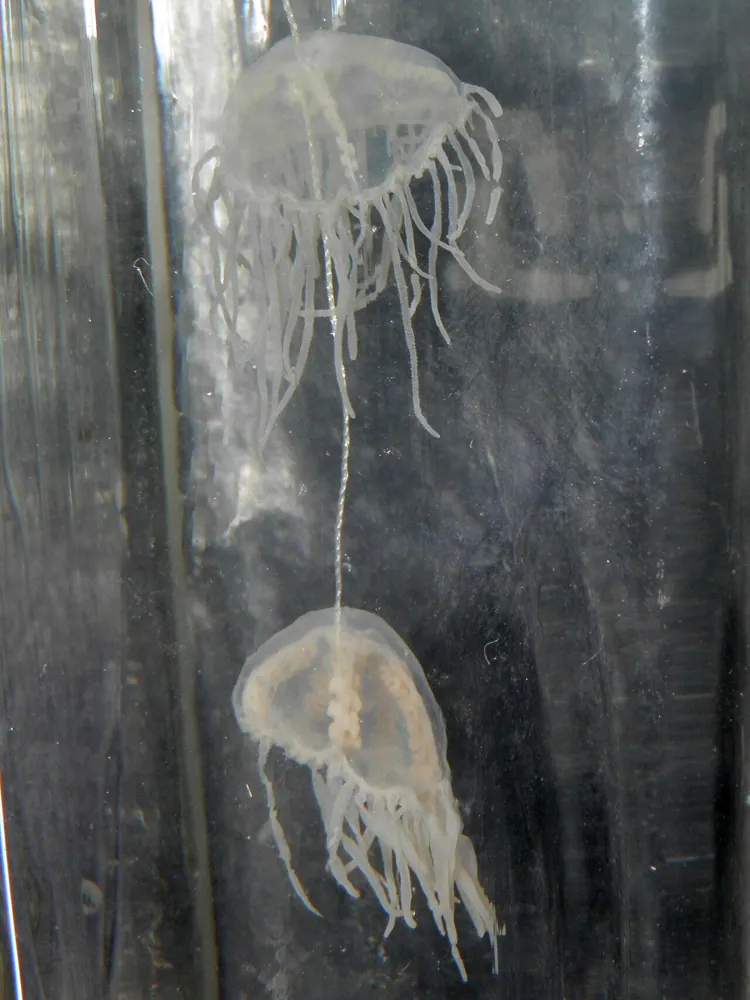
 Como reconhecer
- Has a transparent bell lined with about 60 to 80 tentacles1
- Gonads are orange, red or violet in females and yellow-brown in males1
- The tan manubrium (mouth structure) hangs down in the middle of the bell1
- Bell is usually 1 to 3 cm across; a tentacle can be twice the bell's diameter when fully extended1
Poder do veneno
Milhares de pequenas células que queimam disparam quando algo encosta nelas.
O que o veneno dele faz?
Its sting can cause pain, a swollen throat, chest tightness, muscle cramps, neuropsychiatric changes (effects on mood, thinking or behaviour) and anaphylactic shock, a severe allergic reaction.1
Qual é o perigo para as pessoas?
Perigo para as pessoas: GraveUma picada precisa de médico. Mortes são muito raras.In much of its range the sting is strong enough to cause serious symptoms. Stinging incidents have been reported from East Asia, Europe and the Atlantic coast of the United States. Off North America's northeast Pacific coast, its sting cannot be felt and it is considered harmless to people.1
 Se ele picar
- Saia da água e tire os tentáculos que ficaram (com luvas ou um pano).
- Para cubomedusas tropicais: jogue vinagre nas queimaduras por pelo menos 30 segundos, chame ajuda e esteja pronto para fazer RCP. Para caravelas-portuguesas e a maioria das outras: enxágue com água do mar e depois use água quente para a dor.
Sempre ligue primeiro para o número de emergência (112, 000, 911). Estas são orientações gerais de primeiros socorros, não um conselho médico. Primeiros socorros básicos
 Fique em segurança
- Nunca toque, pegue ou provoque um animal selvagem, mesmo que seja pequeno, e mesmo que pareça estar dormindo ou morto.
- Dê espaço a ele. Se encontrar um, fique calmo, dê alguns passos para trás devagar e deixe que ele siga o caminho dele.
- Se um deles picar você: fique calmo, fique parado, ligue para o número de emergência (112, 000, 911) ou vá rápido para um hospital. Lembre como ele era, uma foto ajuda.
Ele não está atrás de você. Usa o veneno para pegar comida ou se proteger, e prefere muito mais se esconder. Mais sobre como ficar em segurança
Em que lugar do mundo?
Qual é o tamanho dele?
Qual é o comprimento dele?
 mais ou menos o comprimento de um clipe de papel
Qual é o tamanho de Clinging jellyfish comparado com VOCÊ?
Só contas no seu navegador. Nada é salvo nem enviado para lugar nenhum.
Quão rápido ele é?


Informações
Some scientists think the clinging jellyfish may be a group of closely related species, because its sting and body shape vary from place to place.1
The jellyfish appear once the water warms to about 17 to 18 °C, so they follow a yearly pattern and sometimes appear in large numbers at once.1
The medusa (jellyfish) stage usually lasts no more than three months, but the polyp stage can last for years.1
Polyps can split into several new polyps by budding.1
In Europe, the species is non-native and has been found in the Mediterranean and along the Atlantic coast from Portugal to Norway and Sweden.1
Caça-mitos
Mito: The clinging jellyfish is harmless everywhere.
Verdade: Its sting is harmless off the northeast Pacific coast of North America, but it can be strong and dangerous in East Asia, Europe and the Atlantic coast of the United States.1
Para especialistas em veneno
- Nome científico
- Gonionemus vertens
- Grupo
- Águas-vivas e outros bichos marinhos que queimam
- Família
- Olindiidae2
- Ordem
- Limnomedusae
- Continentes
- Oceano Pacífico, Oceano Atlântico, Os oceanos
- Filhotes
- Medusae release tens of thousands of eggs and sperm into the sea. The fertilised young become planula larvae, which settle on the seabed as tiny polyps.1
- Perigo para as pessoas
- 3 / 5: Grave3
De onde vêm as informações
- Gonionemus vertens (Wikipedia (CC BY-SA 4.0))
- Gonionemus vertens (iNaturalist): nomes e classificação.
- Venom Wiki: o nível de perigo, o tamanho típico e o palpite de velocidade são nossos. Veja como calculamos: Como avaliamos o perigo.
Cada informação desta página tem um número que leva à fonte. Se a gente errou alguma coisa, desculpe, somos fãs de animais, não uma revista científica. Avise a gente em [email protected] e nós corrigimos.
 O escorpião está com fome! O Venom Wiki é um projeto de uma pessoa só: grátis, sem anúncios e sem rastreadores. Uma pequena contribuição ajuda a manter o site no ar.Alimente o escorpião
Mais do mesmo grupo: Águas-vivas e outros bichos marinhos que queimam
 Vespa-do-marÁguas-vivas e outros bichos marinhos que queimamMortalNão toque
 Irukandji jellyfishÁguas-vivas e outros bichos marinhos que queimamPode matarNão toque
 Portuguese man o' warÁguas-vivas e outros bichos marinhos que queimamPrecisa de médicoNão toque
 Lion's mane jellyfishÁguas-vivas e outros bichos marinhos que queimamSó dóiNão toque
 Moon jellyfishÁguas-vivas e outros bichos marinhos que queimamInofensivo
 Common kingslayerÁguas-vivas e outros bichos marinhos que queimamPode matarNão toque
Também vive em: Oceano Pacífico
 Cone-geógrafoCaramujos-cone e polvosMortal
 Polvo-de-anéis-azuis-maiorCaramujos-cone e polvosMortal
 Baiacu-japonêsOutros animais venenososMortal
 Polvo-de-anéis-azuis-do-sulCaramujos-cone e polvosMortal
 Hawksbill sea turtleOutros animais venenososPode matar
 Reef stonefishPeixes peçonhentosPode matarNão toque