
 África
 Ásia
Ásia Europa
 América do Sul
 Austrália e Oceania
 Antártida
 Oceano Pacífico
 Oceano Atlântico
 Oceano Índico
 Oceano Ártico
 Mar Mediterrâneo
 Mar Vermelho
 Mar do Caribe
 Mar de Coral
 Mar do Sul da China
 Mar das Filipinas
 Mar de Andamão
 Mar do Norte
 Mar de Timor e de Arafura
 Golfo de Bengala
 Golfo da Califórnia
Dugite
 Mordidas
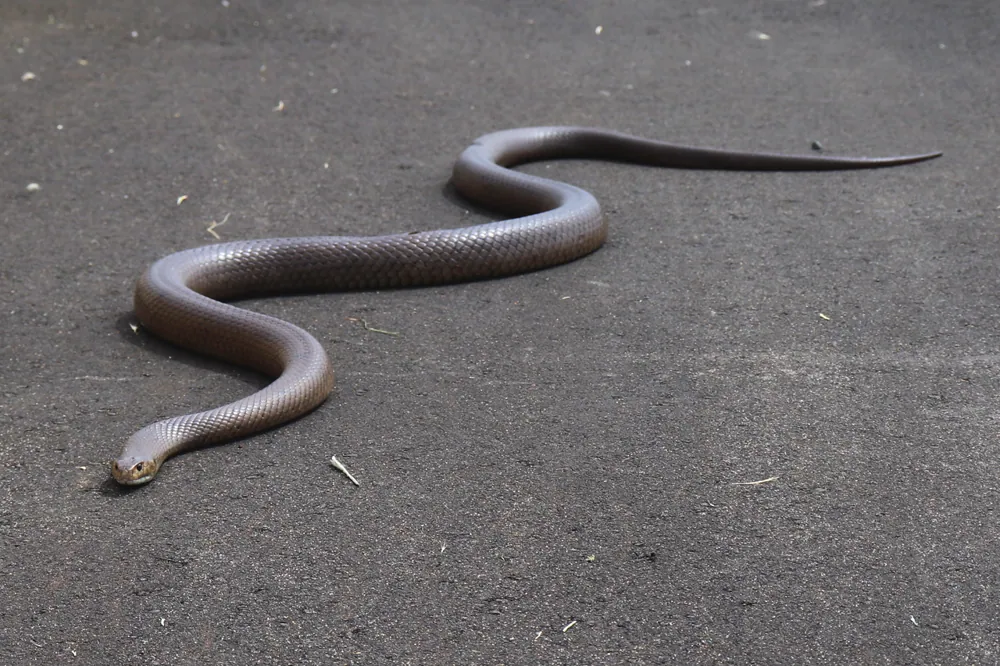
The dugite is a highly venomous snake found in southern Western Australia and in remote coastal parts of western South Australia. Its venom is potentially one of the most lethal in the world, so it is a snake to treat with great respect. It is common in and around Perth, where it often shelters near buildings.1



 Como reconhecer
- Coloured grey, green or brown, but the colours vary widely between individuals, so colour alone is not a reliable guide.1
- Black scales may be scattered over the body.1
- Relatively large scales with a semi-glossy look.1
- The head is rather small and not clearly separate from the neck.1
- Long and slender body, typically about 1.5 metres in total length.1
Poder do veneno
O veneno sai pelas presas ou pelos dentes quando ele morde.
O que o veneno dele faz?
The venom has coagulopathic and procoagulant effects, meaning it disturbs the way blood clots. It is potentially one of the most lethal venoms in the world. In a 2011 case, a boy bitten by a dugite was temporarily paralysed, showing that the venom can affect the nerves and muscles as well as the blood.1
Qual é o perigo para as pessoas?
Perigo para as pessoas: Muito perigosoPode matar uma pessoa que não recebe tratamento.Dugites are potentially lethal. They generally avoid biting people, but the risk of encounters rises during the mating season in October and November. The last recorded human death attributed to a dugite was in August 2015 in South Fremantle. In 2011 a seven-year-old boy was bitten and temporarily paralysed, and he made a full recovery.1
 Boa notícia: os médicos têm um remédio (soro antiveneno) ou um tratamento para isso.1
O que ele faz quando está com medo?
When disturbed they are very shy and often slither away, but they will defend themselves if cornered.1
 Se ele morder
- Prompt medical attention is essential after a bite. In a December 2020 case, a three-year-old girl bitten by a snake believed to be a dugite was quickly immobilised by her grandmother, who wrapped her legs in pressure bandages. She was treated with antivenom in hospital and made a full recovery.1
- Imobilização com pressão: enrole uma atadura elástica firme sobre a mordida e depois pelo membro inteiro, coloque uma tala e mantenha a pessoa completamente parada até a ajuda chegar.
- Não lave a mordida: o hospital pode testar o veneno que ficou na pele para escolher o soro antiveneno certo.
Sempre ligue primeiro para o número de emergência (112, 000, 911). Estas são orientações gerais de primeiros socorros, não um conselho médico. Primeiros socorros básicos
 Fique em segurança
- Nunca toque, pegue ou provoque um animal selvagem, mesmo que seja pequeno, e mesmo que pareça estar dormindo ou morto.
- Dê espaço a ele. Se encontrar um, fique calmo, dê alguns passos para trás devagar e deixe que ele siga o caminho dele.
- Se um deles morder você: fique calmo, fique parado, ligue para o número de emergência (112, 000, 911) ou vá rápido para um hospital. Lembre como ele era, uma foto ajuda.
Ele não está atrás de você. Usa o veneno para pegar comida ou se proteger, e prefere muito mais se esconder. Mais sobre como ficar em segurança
Em que lugar do mundo?
Qual é o tamanho dele?
Qual é o comprimento dele?
 tem o comprimento de 4 gatos domésticos do focinho à cauda
 tem o comprimento de 11 bananas enfileiradas
 poderia percorrer 100 metros em 46 segundos (o humano mais rápido precisa de 9,6)
Qual é o tamanho de Dugite comparado com VOCÊ?
Só contas no seu navegador. Nada é salvo nem enviado para lugar nenhum.
Quão rápido ele é?


Informações
Its venom is potentially one of the most lethal in the world.1
Dugites have become more common because of the house mouse, which is one of their main foods.1
Dugites can lay two clutches of eggs in the same season when conditions are good.1
The Irish activist John Boyle O'Reilly wrote a poem called The Dukite Snake, published in his 1878 collection Songs, Legends and Ballads, based on a bushman's myth.1
In winter, dugites burrow.1
Caça-mitos
Mito: Dugites are aggressive and will chase people.
Verdade: Dugites are very shy and usually slither away when disturbed. They generally avoid biting people, but they will defend themselves if cornered.1
Para especialistas em veneno
- Nome científico
- Pseudonaja affinis
- Grupo
- Cobras australianas
- Família
- Elapidae2
- Ordem
- Squamata
- Continentes
- Austrália e Oceania
- Filhotes
- Dugites lay eggs, typically around 30 at a time, and leave them to hatch on their own after about 65 days. Under good conditions, they can lay two clutches in one season.1
- Perigo para as pessoas
- 4 / 5: Muito perigoso3
De onde vêm as informações
- Dugite (Wikipedia (CC BY-SA 4.0))
- Pseudonaja affinis (iNaturalist): nomes e classificação.
- Venom Wiki: o nível de perigo, o tamanho típico e o palpite de velocidade são nossos. Veja como calculamos: Como avaliamos o perigo.
Cada informação desta página tem um número que leva à fonte. Se a gente errou alguma coisa, desculpe, somos fãs de animais, não uma revista científica. Avise a gente em [email protected] e nós corrigimos.
 O escorpião está com fome! O Venom Wiki é um projeto de uma pessoa só: grátis, sem anúncios e sem rastreadores. Uma pequena contribuição ajuda a manter o site no ar.Alimente o escorpião
Mais do mesmo grupo: Cobras australianas
 Coastal taipan
 Common death adder
 Eastern brown snake
 Taipan-do-interior
 Cobra-tigre
 Collett's snake
.png)
Também vive em: Austrália e Oceania
 Sydney funnel-web spiderCaranguejeiras e aranhas-teia-de-funilMortal
 Redback spiderAranhasPrecisa de médico
 Brown tree snakeCobras com presas no fundo da bocaSó dói
 Hooded pitohuiOutros animais venenososSó dóiNão toque
 PlatypusMamíferos peçonhentosSó dói
 Northern tree-dwelling funnel-web spiderCaranguejeiras e aranhas-teia-de-funilMortal