
 África
 Ásia
Ásia Europa
 América do Sul
 Austrália e Oceania
 Antártida
 Oceano Pacífico
 Oceano Atlântico
 Oceano Índico
 Oceano Ártico
 Mar Mediterrâneo
 Mar Vermelho
 Mar do Caribe
 Mar de Coral
 Mar do Sul da China
 Mar das Filipinas
 Mar de Andamão
 Mar do Norte
 Mar de Timor e de Arafura
 Golfo de Bengala
 Golfo da Califórnia
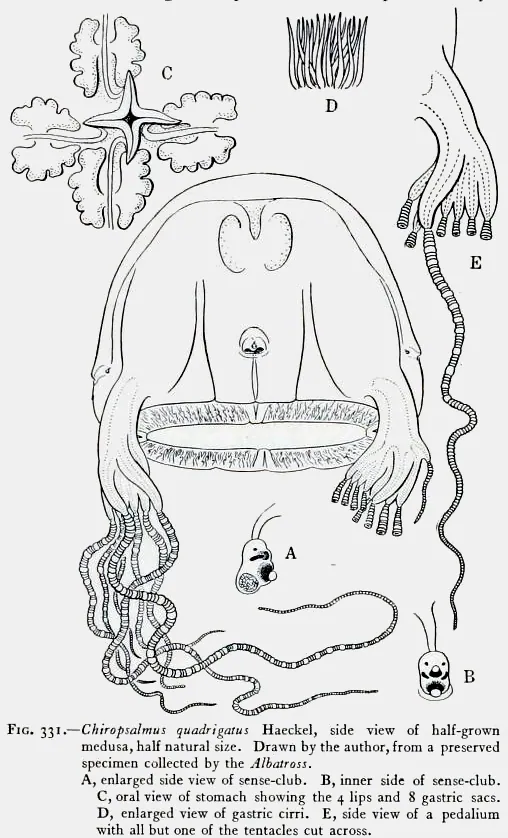
Four-handed box jellyfish
 Tentáculos que queimam
The four-handed box jellyfish is a clear, cube-shaped jellyfish that lives in warm seas. It is found in the western Atlantic, the Gulf of Mexico and parts of the Pacific. Its sting is venomous and can be dangerous to people, especially children.1

 Como reconhecer
Poder do veneno
Milhares de pequenas células que queimam disparam quando algo encosta nelas.
O que o veneno dele faz?
The stinging cells on the tentacles release venom that causes an extremely painful sting. The sting is linear, meaning it leaves a line of marks on the skin. Apart from pain, it can cause heart dysfunction and slowed breathing, which are systemic symptoms that affect the whole body. The rash can last for several months.1
Qual é o perigo para as pessoas?
Perigo para as pessoas: Muito perigosoPode matar uma pessoa que não recebe tratamento.The sting is extremely painful and can be life-threatening. A four-year-old boy in the Gulf of Mexico died within forty minutes of being stung. Off the coast of Brazil, 16 stings over five years were identified as coming from this species. Children are especially at risk.1
 Boa notícia: os médicos têm um remédio (soro antiveneno) ou um tratamento para isso.1
O que ele faz quando está com medo?
Its long, stinging tentacles deter predators.1
 Se ele picar
- Antivenom given within a few hours of the sting relieves the pain somewhat, reduces the severity of the rash and improves other symptoms. In extreme cases, cardiopulmonary resuscitation (CPR) can be effective if started promptly.1
- Saia da água e tire os tentáculos que ficaram (com luvas ou um pano).
- Para cubomedusas tropicais: jogue vinagre nas queimaduras por pelo menos 30 segundos, chame ajuda e esteja pronto para fazer RCP. Para caravelas-portuguesas e a maioria das outras: enxágue com água do mar e depois use água quente para a dor.
Sempre ligue primeiro para o número de emergência (112, 000, 911). Estas são orientações gerais de primeiros socorros, não um conselho médico. Primeiros socorros básicos
 Fique em segurança
- Nunca toque, pegue ou provoque um animal selvagem, mesmo que seja pequeno, e mesmo que pareça estar dormindo ou morto.
- Dê espaço a ele. Se encontrar um, fique calmo, dê alguns passos para trás devagar e deixe que ele siga o caminho dele.
- Se um deles picar você: fique calmo, fique parado, ligue para o número de emergência (112, 000, 911) ou vá rápido para um hospital. Lembre como ele era, uma foto ajuda.
Ele não está atrás de você. Usa o veneno para pegar comida ou se proteger, e prefere muito mais se esconder. Mais sobre como ficar em segurança
Em que lugar do mundo?
Qual é o tamanho dele?
Qual é o comprimento dele?
 tem o comprimento de 4 blocos de montar em fila
 poderia nadar o comprimento de uma piscina grande (50 m) em 36 segundos
Qual é o tamanho de Four-handed box jellyfish comparado com VOCÊ?
Só contas no seu navegador. Nada é salvo nem enviado para lugar nenhum.
Quão rápido ele é?
Informações
Its bell is almost completely transparent, which makes it hard to spot in the water.1
Its tentacles are the longest part of its body, reaching several metres in length.1
Along the Texas Gulf coast in 1955 and 1956, large numbers appeared inshore during drought, when the water was saltier than normal.1
Scientists have done little research on this species, and studies have found that jellyfish from different regions can have different stinging cells.1
Small specimens were often caught in shrimp trawls, while the adults were seldom seen near the surface.1
De onde vêm as informações
- Chiropsalmus quadrumanus (Wikipedia (CC BY-SA 4.0))
- Chiropsalmus quadrumanus (iNaturalist): nomes e classificação.
- Venom Wiki: o nível de perigo, o tamanho típico e o palpite de velocidade são nossos. Veja como calculamos: Como avaliamos o perigo.
Cada informação desta página tem um número que leva à fonte. Se a gente errou alguma coisa, desculpe, somos fãs de animais, não uma revista científica. Avise a gente em [email protected] e nós corrigimos.
 O escorpião está com fome! O Venom Wiki é um projeto de uma pessoa só: grátis, sem anúncios e sem rastreadores. Uma pequena contribuição ajuda a manter o site no ar.Alimente o escorpião
Mais do mesmo grupo: Águas-vivas e outros bichos marinhos que queimam
 Vespa-do-marÁguas-vivas e outros bichos marinhos que queimamMortalNão toque
 Irukandji jellyfishÁguas-vivas e outros bichos marinhos que queimamPode matarNão toque
 Portuguese man o' warÁguas-vivas e outros bichos marinhos que queimamPrecisa de médicoNão toque
 Lion's mane jellyfishÁguas-vivas e outros bichos marinhos que queimamSó dóiNão toque
 Moon jellyfishÁguas-vivas e outros bichos marinhos que queimamInofensivo
 Common kingslayerÁguas-vivas e outros bichos marinhos que queimamPode matarNão toque
 Hawksbill sea turtle
 Blue sea dragon
 Greenland shark
 Common octopus
 Common stingray
 Greater weever