
 África
 Ásia
Ásia Europa
 América do Sul
 Austrália e Oceania
 Antártida
 Oceano Pacífico
 Oceano Atlântico
 Oceano Índico
 Oceano Ártico
 Mar Mediterrâneo
 Mar Vermelho
 Mar do Caribe
 Mar de Coral
 Mar do Sul da China
 Mar das Filipinas
 Mar de Andamão
 Mar do Norte
 Mar de Timor e de Arafura
 Golfo de Bengala
 Golfo da Califórnia
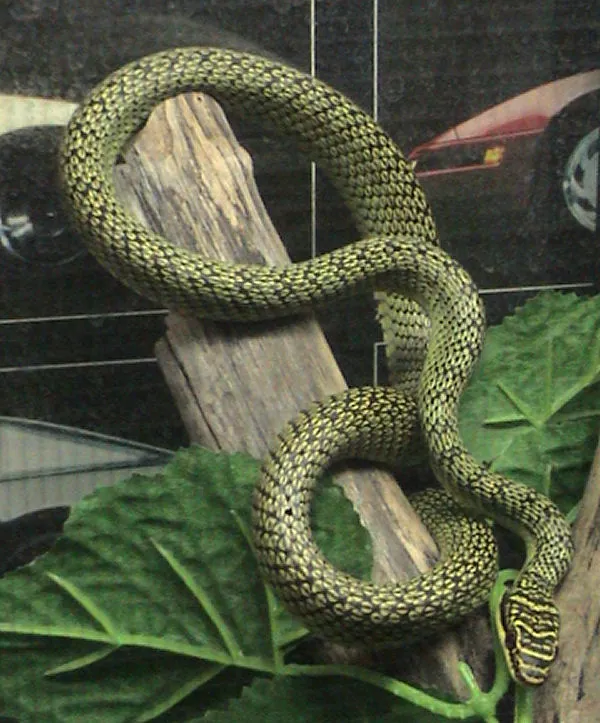
Golden tree snake
 Mordidas
The golden tree snake is a slim, green snake with gold and black markings that lives in trees across South and Southeast Asia. It is famous for its ability to glide from tree to tree, which it does by launching itself into the air and steering with its body. It is mildly venomous, but it is not considered dangerous to people.1



 Como reconhecer
- Usually green, with black cross-hatching and yellow or gold accents1
- Slender body with a flattened head, a blunt nose and large eyes with round pupils1
- In Sri Lanka and southern India it is mainly greenish yellow or pale green, often with reddish or orange flower-shaped spots on its back1
- In Southeast Asia it lacks the reddish spots and has less prominent black crossbars1
- Nervous and fast-moving, it climbs trees and vertical rock faces in graceful curves1
Muitas vezes confundido com: The paradise flying snake (C. paradisi) is a close relative that also glides. Its gliding is more impressive than that of the golden tree snake, which is still able to move easily from tree to tree.1
Poder do veneno
O veneno sai pelas presas ou pelos dentes quando ele morde.
O que o veneno dele faz?
It is mildly venomous. Its two small fangs are at the back of the upper jaw, so it must chew to get venom into prey. The venom is meant to subdue fast-moving tree-living animals and is not considered dangerous to humans.1
Qual é o perigo para as pessoas?
Perigo para as pessoas: LeveComo uma picada de abelha ou menos. Praticamente inofensivo para as pessoas.It is not considered dangerous to humans and is not of medical importance. It generally does not hesitate to bite if handled.1
O que ele faz quando está com medo?
When disturbed it tries to flee, and it can glide away from predators such as birds or other reptiles.1
 Se ele morder
- Lave a mordida, mantenha a pessoa calma e procure ajuda médica. Algumas espécies (como a boomslang) podem ser mortais horas depois.
Sempre ligue primeiro para o número de emergência (112, 000, 911). Estas são orientações gerais de primeiros socorros, não um conselho médico. Primeiros socorros básicos
 Fique em segurança
- Nunca toque, pegue ou provoque um animal selvagem, mesmo que seja pequeno, e mesmo que pareça estar dormindo ou morto.
- Dê espaço a ele. Se encontrar um, fique calmo, dê alguns passos para trás devagar e deixe que ele siga o caminho dele.
- Se um deles morder você: fique calmo, fique parado, ligue para o número de emergência (112, 000, 911) ou vá rápido para um hospital. Lembre como ele era, uma foto ajuda.
Ele não está atrás de você. Usa o veneno para pegar comida ou se proteger, e prefere muito mais se esconder. Mais sobre como ficar em segurança
Em que lugar do mundo?
Qual é o tamanho dele?
Qual é o comprimento dele?
 tem o comprimento de 2,5 gatos domésticos do focinho à cauda
 tem o comprimento de 7 bananas enfileiradas
 poderia percorrer 100 metros em 64 segundos (o humano mais rápido precisa de 9,6)
Qual é o tamanho de Golden tree snake comparado com VOCÊ?
Só contas no seu navegador. Nada é salvo nem enviado para lugar nenhum.
Quão rápido ele é?


Informações
It can glide, or parachute, across distances of as much as 100 m from tree to tree.1
To glide, it curves its belly into a U-shape that acts like a parachute, then undulates through the air like it is swimming.1
It balances in the air by twisting its tail from side to side, with the tail held rigidly upwards.1
Its striking looks and gliding have made it a sought-after choice for captivity, though it often struggles in captivity.1
It is sometimes cooked for food.1
Caça-mitos
Mito: Many locals assume that all snakes are venomous and kill them on sight.
Verdade: The golden tree snake is only mildly venomous and is not considered dangerous to humans.1
Para especialistas em veneno
- Nome científico
- Chrysopelea ornata
- Grupo
- Cobras com presas no fundo da boca
- Família
- Colubridae2
- Ordem
- Squamata
- Continentes
- Ásia
- Filhotes
- It lays eggs. Six to 12 elongated eggs are laid, and hatchlings measure 114–152 mm long.1
- Como ele está na natureza
- Not known to be endangered1
- Perigo para as pessoas
- 1 / 5: Leve3
De onde vêm as informações
- Chrysopelea ornata (Wikipedia (CC BY-SA 4.0))
- Chrysopelea ornata (iNaturalist): nomes e classificação.
- Venom Wiki: o nível de perigo, o tamanho típico e o palpite de velocidade são nossos. Veja como calculamos: Como avaliamos o perigo.
Cada informação desta página tem um número que leva à fonte. Se a gente errou alguma coisa, desculpe, somos fãs de animais, não uma revista científica. Avise a gente em [email protected] e nós corrigimos.
 O escorpião está com fome! O Venom Wiki é um projeto de uma pessoa só: grátis, sem anúncios e sem rastreadores. Uma pequena contribuição ajuda a manter o site no ar.Alimente o escorpião
Mais do mesmo grupo: Cobras com presas no fundo da boca
 Brown tree snakeCobras com presas no fundo da bocaSó dói
 Tiger keelbackCobras com presas no fundo da bocaPode matar
 Red-necked keelbackCobras com presas no fundo da bocaPrecisa de médico
 Green cat snakeCobras com presas no fundo da bocaSó dói
 Mangrove snakeCobras com presas no fundo da bocaSó dói
 Asian vine snakeCobras com presas no fundo da bocaInofensivo
 Escorpião-amarelo-palestino
 Naja-indiana
 Víbora-serrilhada-indiana
 Naja-real
 Víbora-bufadora
 Víbora-de-russell