
 África
 Ásia
Ásia Europa
 América do Sul
 Austrália e Oceania
 Antártida
 Oceano Pacífico
 Oceano Atlântico
 Oceano Índico
 Oceano Ártico
 Mar Mediterrâneo
 Mar Vermelho
 Mar do Caribe
 Mar de Coral
 Mar do Sul da China
 Mar das Filipinas
 Mar de Andamão
 Mar do Norte
 Mar de Timor e de Arafura
 Golfo de Bengala
 Golfo da Califórnia
Masked hunter
 Mordidas
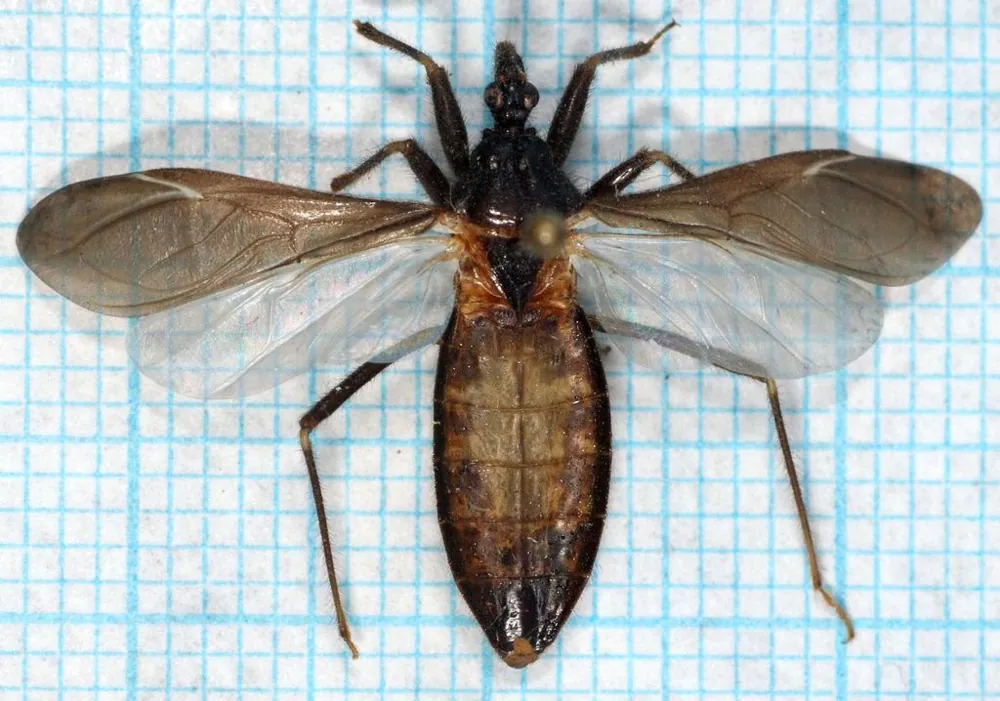
The masked hunter is a dark brown to black insect from the assassin bug family. It hunts small creatures such as bed bugs, woodlice and termites, and it is often found in homes. Its nymphs hide by covering their bodies with dust and debris.1

 Como reconhecer
- Adults are uniformly dark brown to black and measure 17–22 mm in length.1
- The head is elongated, with a short, three-segmented beak and long, slender antennae.1
- The abdomen is wide and extends beyond the wings in the middle, showing the edges of its abdominal segments.1
- Nymphs look like small adults but are often grey or light-coloured, because a sticky body coat collects dust, lint and small particles.1
Muitas vezes confundido com: Masked hunters are sometimes mistaken for the kissing bug. Unlike the kissing bug, masked hunters do not carry Chagas disease.1
Poder do veneno
O veneno sai pelas presas ou pelos dentes quando ele morde.
Qual é o perigo para as pessoas?
Perigo para as pessoas: DolorosoPode doer bastante, mas quase nunca é grave.A handled or trapped masked hunter can deliver a rostral stab, which is painful and comparable to a bee's sting. The swelling can last for about a week. They do not feed on human blood.1
O que ele faz quando está com medo?
When handled or trapped, it defends itself by delivering a stab with its beak.1
 Se ele morder
- Para pelos de lagarta que queimam: tire os pelos com fita adesiva e depois lave a pele. Não esfregue.
- Para mordidas: lave e esfrie. Procure ajuda médica se a pessoa se sentir mal ou sangrar com facilidade.
Sempre ligue primeiro para o número de emergência (112, 000, 911). Estas são orientações gerais de primeiros socorros, não um conselho médico. Primeiros socorros básicos
 Fique em segurança
- Nunca toque, pegue ou provoque um animal selvagem, mesmo que seja pequeno, e mesmo que pareça estar dormindo ou morto.
- Dê espaço a ele. Se encontrar um, fique calmo, dê alguns passos para trás devagar e deixe que ele siga o caminho dele.
- Se um deles morder você: fique calmo, fique parado, ligue para o número de emergência (112, 000, 911) ou vá rápido para um hospital. Lembre como ele era, uma foto ajuda.
Ele não está atrás de você. Usa o veneno para pegar comida ou se proteger, e prefere muito mais se esconder. Mais sobre como ficar em segurança
Em que lugar do mundo?
Qual é o tamanho dele?
Qual é o comprimento dele?
 mais ou menos o comprimento de um clipe de papel
Qual é o tamanho de Masked hunter comparado com VOCÊ?
Só contas no seu navegador. Nada é salvo nem enviado para lugar nenhum.
Quão rápido ele é?


Informações
Nymphs build two layers of camouflage on their bodies, an inner layer of fine particles and an outer layer of coarser ones, using their hind legs and a tarsal fan.1
Their sticky body coat catches dust, lint and other small particles, which hides them from both predators and prey.1
Because they hunt bed bugs, a masked hunter in the home can be a sign of a bed bug problem, and controlling the bed bugs usually deals with the hunters too.1
Masked hunters were probably introduced to North America by accident in the late 1800s to early 1900s. They were first found in Canada in 1905 and in the United States in 1917.1
Caça-mitos
Mito: Masked hunters are kissing bugs and carry Chagas disease.
Verdade: Masked hunters are sometimes mistaken for kissing bugs, but they do not carry Chagas disease. Their stab is painful, but it does not spread that disease.1
De onde vêm as informações
- Reduvius personatus (Wikipedia (CC BY-SA 4.0))
- Reduvius personatus (iNaturalist): nomes e classificação.
- Venom Wiki: o nível de perigo, o tamanho típico e o palpite de velocidade são nossos. Veja como calculamos: Como avaliamos o perigo.
Cada informação desta página tem um número que leva à fonte. Se a gente errou alguma coisa, desculpe, somos fãs de animais, não uma revista científica. Avise a gente em [email protected] e nós corrigimos.
 O escorpião está com fome! O Venom Wiki é um projeto de uma pessoa só: grátis, sem anúncios e sem rastreadores. Uma pequena contribuição ajuda a manter o site no ar.Alimente o escorpião
Mais do mesmo grupo: Lagartas e insetos
 Oak processionaryLagartas e insetosSó dóiNão toque
 Pine processionaryLagartas e insetosSó dóiNão toque
 Common bombardier beetleLagartas e insetosInofensivo
 Asian giant water bugLagartas e insetosSó dói
 Blue-striped nettle grubLagartas e insetosSó dóiNão toque
 Brown-tail mothLagartas e insetosSó dóiNão toque
Também vive em: Europa
 Common European adderVíborasPrecisa de médico
 Spanish flyOutros animais venenososPrecisa de médicoNão toque
 Common waspAbelhas, vespas e vespõesSó dói
 European hornetAbelhas, vespas e vespõesSó dói
 Fire salamanderRãs venenosas, sapos e tritõesSó dóiNão toque
 Western honey beeAbelhas, vespas e vespõesSó dói