
 África
 Ásia
Ásia Europa
 América do Sul
 Austrália e Oceania
 Antártida
 Oceano Pacífico
 Oceano Atlântico
 Oceano Índico
 Oceano Ártico
 Mar Mediterrâneo
 Mar Vermelho
 Mar do Caribe
 Mar de Coral
 Mar do Sul da China
 Mar das Filipinas
 Mar de Andamão
 Mar do Norte
 Mar de Timor e de Arafura
 Golfo de Bengala
 Golfo da Califórnia
Spotted jelly
 Tentáculos que queimam
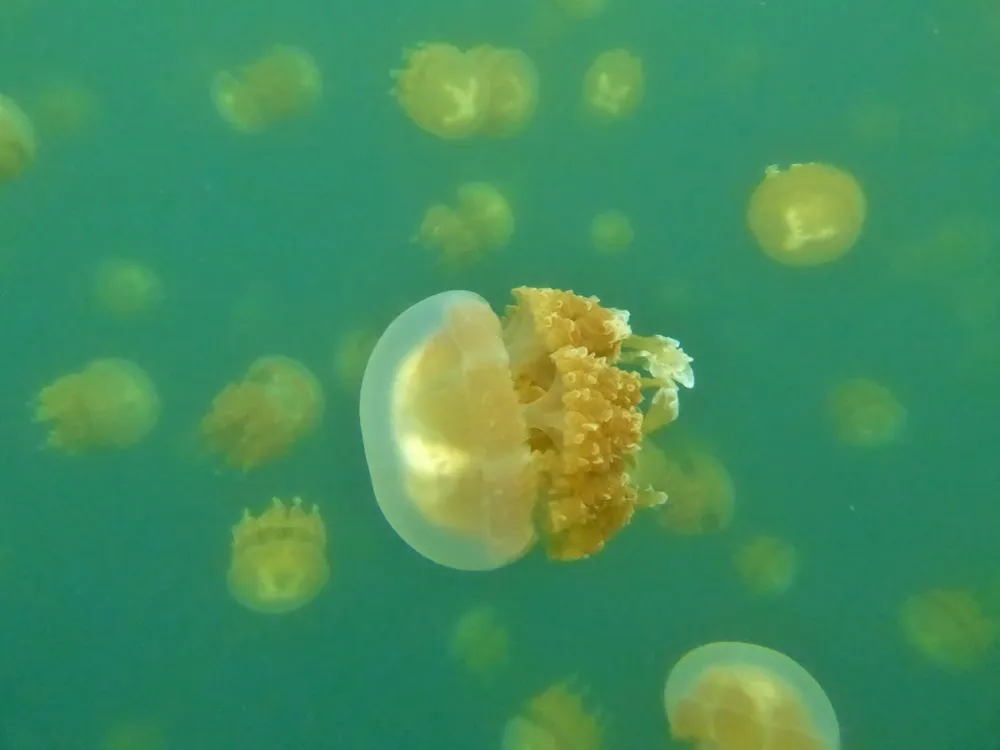
The spotted jelly is a jellyfish with spots on the top of its bell, the rounded body. It lives in the warm Indo-Pacific oceans, and in some saltwater lakes in Palau and Indonesia. Its lake populations are famous because they have lost most of their sting.1


 Como reconhecer
- Distinctive spots on the top of the bell1
- Colour ranges from greenish blue to olive green, from the algae living in its tissues1
- Eight rhopalia (sensory organs) along the edge of the bell1
- Eight frilled oral arms, each ending in a club-like appendage1
- Numerous small mouths along the bottom of the oral arms, unlike many other jellies1
Poder do veneno
Milhares de pequenas células que queimam disparam quando algo encosta nelas.
O que o veneno dele faz?
The venom is protein-based and is delivered by stinging cells called nematocytes (cnidocytes) on the upper surfaces of the oral arms. In jellyfish living in marine lakes, conditions in the lake are thought to break down this venom, so those populations do not sting humans.1
Qual é o perigo para as pessoas?
Perigo para as pessoas: LeveComo uma picada de abelha ou menos. Praticamente inofensivo para as pessoas.Jellyfish in the open ocean have stinging cells on their oral arms. Populations in marine lakes, such as Jellyfish Lake in Palau, do not sting humans.1
 Se ele picar
- Saia da água e tire os tentáculos que ficaram (com luvas ou um pano).
- Para cubomedusas tropicais: jogue vinagre nas queimaduras por pelo menos 30 segundos, chame ajuda e esteja pronto para fazer RCP. Para caravelas-portuguesas e a maioria das outras: enxágue com água do mar e depois use água quente para a dor.
Sempre ligue primeiro para o número de emergência (112, 000, 911). Estas são orientações gerais de primeiros socorros, não um conselho médico. Primeiros socorros básicos
 Fique em segurança
- Nunca toque, pegue ou provoque um animal selvagem, mesmo que seja pequeno, e mesmo que pareça estar dormindo ou morto.
- Dê espaço a ele. Se encontrar um, fique calmo, dê alguns passos para trás devagar e deixe que ele siga o caminho dele.
- Se um deles picar você: fique calmo, fique parado, ligue para o número de emergência (112, 000, 911) ou vá rápido para um hospital. Lembre como ele era, uma foto ajuda.
Ele não está atrás de você. Usa o veneno para pegar comida ou se proteger, e prefere muito mais se esconder. Mais sobre como ficar em segurança
Em que lugar do mundo?
Qual é o tamanho dele?
Qual é o comprimento dele?
 tem o comprimento de 9 blocos de montar em fila
Qual é o tamanho de Spotted jelly comparado com VOCÊ?
Só contas no seu navegador. Nada é salvo nem enviado para lugar nenhum.
Quão rápido ele é?


Informações
Lake populations of spotted jellies have lost most of their ability to sting, probably after being cut off in marine lakes long ago.1
Each day, spotted jellies rise to the surface and follow the sun from east to west, so their algae can photosynthesise.1
Lake jellyfish are over three times wider than ocean ones, yet their tentacles are about the same length.1
Unlike many jellies, spotted jellies have several small mouths along their oral arms.1
A sea anemone called Entacmaea medusivora preys on spotted jellies, catching them in its tentacles.1
At night they stay lower in the water column.1
Caça-mitos
Mito: All spotted jellies sting people.
Verdade: Ocean populations have stinging cells, but the jellyfish in marine lakes such as Jellyfish Lake in Palau do not sting humans.1
De onde vêm as informações
- Spotted jelly (Wikipedia (CC BY-SA 4.0))
- Mastigias papua (iNaturalist): nomes e classificação.
- Venom Wiki: o nível de perigo, o tamanho típico e o palpite de velocidade são nossos. Veja como calculamos: Como avaliamos o perigo.
Cada informação desta página tem um número que leva à fonte. Se a gente errou alguma coisa, desculpe, somos fãs de animais, não uma revista científica. Avise a gente em [email protected] e nós corrigimos.
 O escorpião está com fome! O Venom Wiki é um projeto de uma pessoa só: grátis, sem anúncios e sem rastreadores. Uma pequena contribuição ajuda a manter o site no ar.Alimente o escorpião
Mais do mesmo grupo: Águas-vivas e outros bichos marinhos que queimam
 Vespa-do-marÁguas-vivas e outros bichos marinhos que queimamMortalNão toque
 Irukandji jellyfishÁguas-vivas e outros bichos marinhos que queimamPode matarNão toque
 Portuguese man o' warÁguas-vivas e outros bichos marinhos que queimamPrecisa de médicoNão toque
 Lion's mane jellyfishÁguas-vivas e outros bichos marinhos que queimamSó dóiNão toque
 Moon jellyfishÁguas-vivas e outros bichos marinhos que queimamInofensivo
 Common kingslayerÁguas-vivas e outros bichos marinhos que queimamPode matarNão toque
Também vive em: Oceano Pacífico
 Cone-geógrafoCaramujos-cone e polvosMortal
 Polvo-de-anéis-azuis-maiorCaramujos-cone e polvosMortal
 Baiacu-japonêsOutros animais venenososMortal
 Polvo-de-anéis-azuis-do-sulCaramujos-cone e polvosMortal
 Hawksbill sea turtleOutros animais venenososPode matar
 Reef stonefishPeixes peçonhentosPode matarNão toque