
 África
 Ásia
Ásia Europa
 América do Sul
 Austrália e Oceania
 Antártida
 Oceano Pacífico
 Oceano Atlântico
 Oceano Índico
 Oceano Ártico
 Mar Mediterrâneo
 Mar Vermelho
 Mar do Caribe
 Mar de Coral
 Mar do Sul da China
 Mar das Filipinas
 Mar de Andamão
 Mar do Norte
 Mar de Timor e de Arafura
 Golfo de Bengala
 Golfo da Califórnia
Tiny clinging box jellyfish
 Tentáculos que queimam
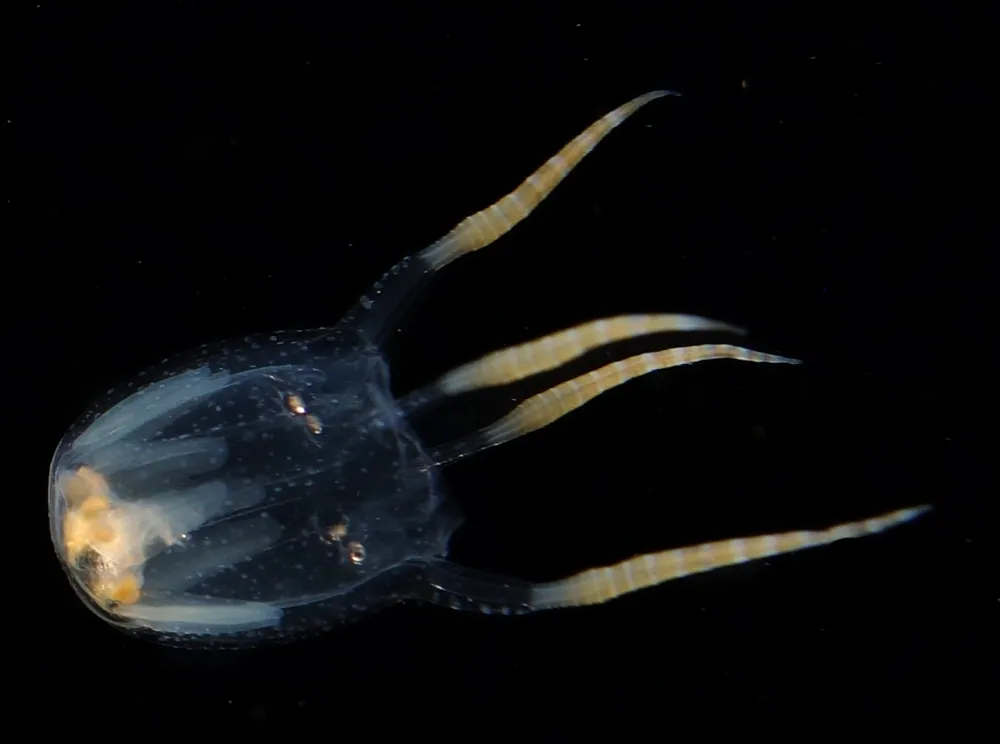
Copula sivickisi is a tiny box jellyfish, about 1 cm across, that lives in shallow warm seas. It is the only species in its genus and is active only at night. It is unusual among box jellyfish because it has a mating ritual and fertilises its eggs inside the body.1



 Como reconhecer
- The bell is boxy in shape, unlike the umbrella shape of true jellyfish.1
- It has four slender tentacles hanging from the rim, each banded with orange.1
- The eight gonads (reproductive organs) can be seen through the transparent bell. In males they are orange, and in females they are white-speckled.1
- Mature females have orange-brown markings around the edge of the bell.1
- It is most active at night and hides during the day, folding its tentacles inside the bell and flattening itself.1
Poder do veneno
Milhares de pequenas células que queimam disparam quando algo encosta nelas.
Qual é o perigo para as pessoas?
Perigo para as pessoas: LeveComo uma picada de abelha ou menos. Praticamente inofensivo para as pessoas.O que ele faz quando está com medo?
When disturbed by day it hides, folding its tentacles inside the bell and flattening itself against the seabed.1
 Se ele picar
- Saia da água e tire os tentáculos que ficaram (com luvas ou um pano).
- Para cubomedusas tropicais: jogue vinagre nas queimaduras por pelo menos 30 segundos, chame ajuda e esteja pronto para fazer RCP. Para caravelas-portuguesas e a maioria das outras: enxágue com água do mar e depois use água quente para a dor.
Sempre ligue primeiro para o número de emergência (112, 000, 911). Estas são orientações gerais de primeiros socorros, não um conselho médico. Primeiros socorros básicos
 Fique em segurança
- Nunca toque, pegue ou provoque um animal selvagem, mesmo que seja pequeno, e mesmo que pareça estar dormindo ou morto.
- Dê espaço a ele. Se encontrar um, fique calmo, dê alguns passos para trás devagar e deixe que ele siga o caminho dele.
- Se um deles picar você: fique calmo, fique parado, ligue para o número de emergência (112, 000, 911) ou vá rápido para um hospital. Lembre como ele era, uma foto ajuda.
Ele não está atrás de você. Usa o veneno para pegar comida ou se proteger, e prefere muito mais se esconder. Mais sobre como ficar em segurança
Em que lugar do mundo?
Qual é o tamanho dele?
Qual é o comprimento dele?
 tão pequeno que cabe na sua unha
Qual é o tamanho de Tiny clinging box jellyfish comparado com VOCÊ?
Só contas no seu navegador. Nada é salvo nem enviado para lugar nenhum.
Quão rápido ele é?


Informações
It has twenty-four eyes, grouped on four stalked structures called rhopalia on the rim of the bell.1
Unlike most box jellyfish, it has an elaborate mating ritual. A male grabs a female by one tentacle and pulls her around while they entwine.1
A female has been seen mating with several males, up to eight times in a two-hour period.1
It is attracted to light, and it chooses a spot on the seabed soon after dawn, spending a few minutes selecting a good location before settling there.1
Its average maximum swimming speed is 4.9 cm per second, which is faster than the currents near the surface of the shallow waters where it lives.1
The male passes a red bundle of sperm (a spermatophore) to one of the female's tentacles, which pushes it into her manubrium, the tube hanging from the underside of the bell.1
Para especialistas em veneno
- Nome científico
- Copula sivickisi
- Grupo
- Águas-vivas e outros bichos marinhos que queimam
- Família
- Tripedaliidae2
- Ordem
- Carybdeida
- Continentes
- Oceano Pacífico, Oceano Atlântico, Mar de Timor e de Arafura, Os oceanos
- Filhotes
- Eggs are fertilised inside the female's bell. About two or three days later she releases a mucous strand of embryos into the sea, and these develop into polyps.1
- Perigo para as pessoas
- 1 / 5: Leve3
De onde vêm as informações
- Copula sivickisi (Wikipedia (CC BY-SA 4.0))
- Copula sivickisi (iNaturalist): nomes e classificação.
- Venom Wiki: o nível de perigo, o tamanho típico e o palpite de velocidade são nossos. Veja como calculamos: Como avaliamos o perigo.
Cada informação desta página tem um número que leva à fonte. Se a gente errou alguma coisa, desculpe, somos fãs de animais, não uma revista científica. Avise a gente em [email protected] e nós corrigimos.
 O escorpião está com fome! O Venom Wiki é um projeto de uma pessoa só: grátis, sem anúncios e sem rastreadores. Uma pequena contribuição ajuda a manter o site no ar.Alimente o escorpião
Mais do mesmo grupo: Águas-vivas e outros bichos marinhos que queimam
 Vespa-do-marÁguas-vivas e outros bichos marinhos que queimamMortalNão toque
 Irukandji jellyfishÁguas-vivas e outros bichos marinhos que queimamPode matarNão toque
 Portuguese man o' warÁguas-vivas e outros bichos marinhos que queimamPrecisa de médicoNão toque
 Lion's mane jellyfishÁguas-vivas e outros bichos marinhos que queimamSó dóiNão toque
 Moon jellyfishÁguas-vivas e outros bichos marinhos que queimamInofensivo
 Common kingslayerÁguas-vivas e outros bichos marinhos que queimamPode matarNão toque
Também vive em: Oceano Pacífico
 Cone-geógrafoCaramujos-cone e polvosMortal
 Polvo-de-anéis-azuis-maiorCaramujos-cone e polvosMortal
 Baiacu-japonêsOutros animais venenososMortal
 Polvo-de-anéis-azuis-do-sulCaramujos-cone e polvosMortal
 Hawksbill sea turtleOutros animais venenososPode matar
 Reef stonefishPeixes peçonhentosPode matarNão toque