
 África
 Ásia
Ásia Europa
 América do Sul
 Austrália e Oceania
 Antártida
 Oceano Pacífico
 Oceano Atlântico
 Oceano Índico
 Oceano Ártico
 Mar Mediterrâneo
 Mar Vermelho
 Mar do Caribe
 Mar de Coral
 Mar do Sul da China
 Mar das Filipinas
 Mar de Andamão
 Mar do Norte
 Mar de Timor e de Arafura
 Golfo de Bengala
 Golfo da Califórnia
Western black widow
 Mordidas
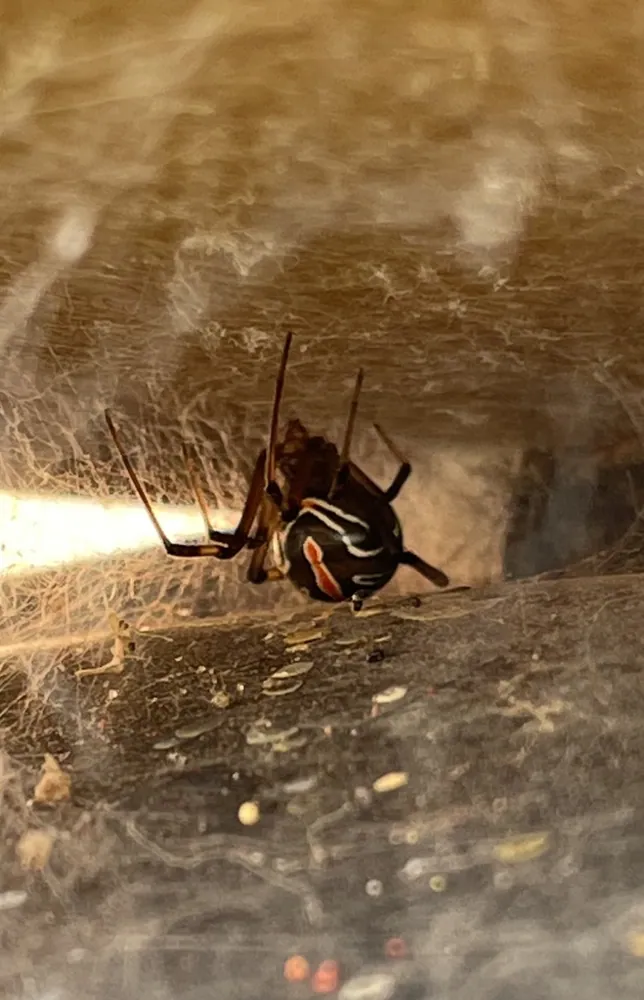
The western black widow is a venomous spider that lives in western North America. The female is black, often with a red hourglass mark on her belly, and her webs are tangled and irregular. Her venom is strong, so it is worth knowing what she looks like.1



 Como reconhecer
- The female is about 14–16 mm long and black, often with an hourglass-shaped mark on the lower abdomen.1
- The hourglass mark is usually red, but it can be yellow and, very rarely, white.1
- The male is about half the female's length and is generally beige, with lighter striping on the abdomen.1
- Its webs are irregular or tangled, with no obvious overall pattern.1
Muitas vezes confundido com: It was once described as a subspecies of Latrodectus mactans and is closely related to the northern species Latrodectus variolus.1
Poder do veneno
O veneno sai pelas presas ou pelos dentes quando ele morde.
O que o veneno dele faz?
The female's venom contains a neurotoxin called α-latrotoxin, which attacks the nerves. In humans, its symptoms include pain, nausea, vomiting, goosebumps and localised sweating.1
Qual é o perigo para as pessoas?
Perigo para as pessoas: GraveUma mordida precisa de médico. Mortes são muito raras.Historical reports gave fatality rates between 0.5% and 12%. However, recent studies have not been able to confirm any deaths from the U.S. species of Latrodectus, including zero deaths among 23,409 documented bites from 2000 through 2008.1
O que ele faz quando está com medo?
Juveniles and females can fling a sticky ball of silk at predators, which can stop most of them.1
 Se ele morder
- Lave a mordida e coloque uma bolsa de gelo para a dor. Procure ajuda médica se a dor for forte, se espalhar ou a pessoa se sentir mal.
Sempre ligue primeiro para o número de emergência (112, 000, 911). Estas são orientações gerais de primeiros socorros, não um conselho médico. Primeiros socorros básicos
 Fique em segurança
- Nunca toque, pegue ou provoque um animal selvagem, mesmo que seja pequeno, e mesmo que pareça estar dormindo ou morto.
- Dê espaço a ele. Se encontrar um, fique calmo, dê alguns passos para trás devagar e deixe que ele siga o caminho dele.
- Se um deles morder você: fique calmo, fique parado, ligue para o número de emergência (112, 000, 911) ou vá rápido para um hospital. Lembre como ele era, uma foto ajuda.
Ele não está atrás de você. Usa o veneno para pegar comida ou se proteger, e prefere muito mais se esconder. Mais sobre como ficar em segurança
Em que lugar do mundo?
Qual é o tamanho dele?
Qual é o comprimento dele?
 menor que o seu dedo mindinho
Qual é o tamanho de Western black widow comparado com VOCÊ?
Só contas no seu navegador. Nada é salvo nem enviado para lugar nenhum.
Quão rápido ele é?


Informações
When prey hits a gumfoot thread, the thread breaks and creates tension that pulls the line and prey up to the spider.1
This spider is an opportunistic cannibal, and it may eat other members of its own kind when prey is scarce, when it is very hungry, or in self-defence.1
The silk is strongly sticky, and its strength is similar to that of silk from orb-weaving spiders.1
Males can be preferred by females based on the webs, with well-fed females chosen over starved ones.1
Males may mate several times during their relatively short lives.1
Caça-mitos
Mito: A black widow bite is usually deadly.
Verdade: Recent studies have not confirmed any deaths from the U.S. species of Latrodectus, including zero deaths among 23,409 documented bites from 2000 through 2008.1
De onde vêm as informações
- Latrodectus hesperus (Wikipedia (CC BY-SA 4.0))
- Latrodectus hesperus (iNaturalist): nomes e classificação.
- Venom Wiki: o nível de perigo, o tamanho típico e o palpite de velocidade são nossos. Veja como calculamos: Como avaliamos o perigo.
Cada informação desta página tem um número que leva à fonte. Se a gente errou alguma coisa, desculpe, somos fãs de animais, não uma revista científica. Avise a gente em [email protected] e nós corrigimos.
 O escorpião está com fome! O Venom Wiki é um projeto de uma pessoa só: grátis, sem anúncios e sem rastreadores. Uma pequena contribuição ajuda a manter o site no ar.Alimente o escorpião
 Brown recluse
 Southern black widow
 Northern black widow
 Bold jumping spider
 Golden silk orb-weaver
 Central American wandering spider
 Terciopelo
 Eastern coral snake
 Eastern diamondback rattlesnake
 Eyelash viper
 Timber rattlesnake
 Western diamondback rattlesnake