
 África
 Ásia
Ásia Europa
 América do Sul
 Austrália e Oceania
 Antártida
 Oceano Pacífico
 Oceano Atlântico
 Oceano Índico
 Oceano Ártico
 Mar Mediterrâneo
 Mar Vermelho
 Mar do Caribe
 Mar de Coral
 Mar do Sul da China
 Mar das Filipinas
 Mar de Andamão
 Mar do Norte
 Mar de Timor e de Arafura
 Golfo de Bengala
 Golfo da Califórnia
Yellow stingray
 Picadas
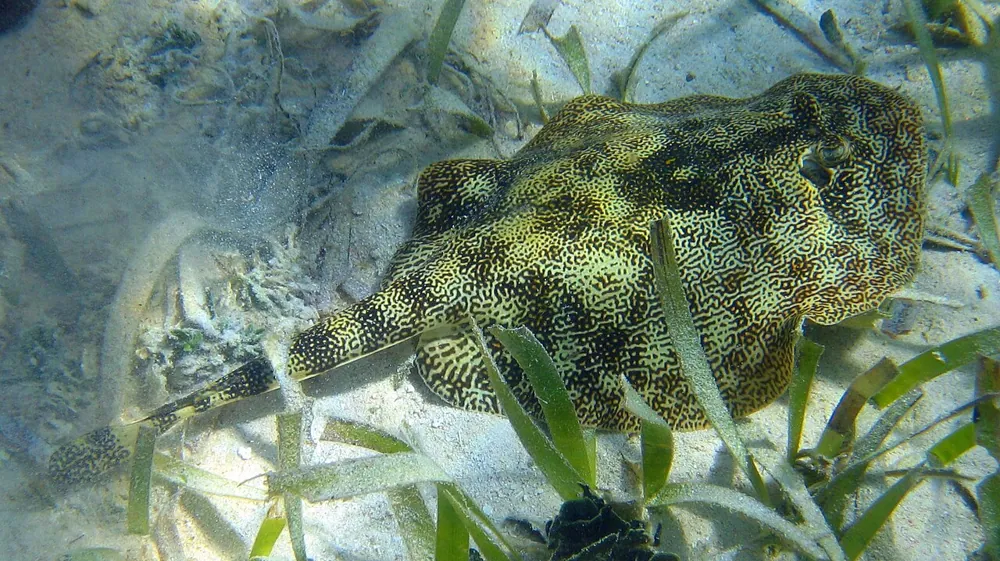
The yellow stingray is a small ray that lives on the sandy, muddy or seagrass bottoms of shallow coastal waters in the western Atlantic, the Gulf of Mexico and the Caribbean. It spends much of the day buried under sand or lying still. It can sting with a venomous spine on its tail, but it usually ignores divers unless it is stepped on or provoked.1



 Como reconhecer
- Nearly round pectoral fin disc with a short tail and a small, leaf-shaped tail fin.1
- Pattern of spots and blotches, either light on dark or dark on light, which varies a lot between individuals.1
- Can quickly change the tone and contrast of its colour to match its surroundings.1
- Underside is yellowish, greenish or brownish white, with small darker spots near the edge of the disc and the tail.1
- A serrated spine sits about halfway along the tail.1
Poder do veneno
O veneno sai por um ferrão.
O que o veneno dele faz?
The tail spine is coated in potent venom. The wound it causes is extremely painful, but it is seldom life-threatening.1
Qual é o perigo para as pessoas?
Perigo para as pessoas: DolorosoPode doer bastante, mas quase nunca é grave.It is not aggressive towards people. It injures people only when it is stepped on or otherwise provoked, and the resulting wound is very painful but seldom life-threatening.1
O que ele faz quando está com medo?
When threatened it mostly stays still, buried under sediment or lying in vegetation, and if stepped on or provoked it defends itself with its tail spine.1
 Se ele picar
- Coloque o ferimento em água quente, tão quente quanto a pessoa aguentar sem se queimar (teste com a sua própria mão), por 30 a 90 minutos. Procure ajuda médica, principalmente no caso de peixes-pedra e arraias.
Sempre ligue primeiro para o número de emergência (112, 000, 911). Estas são orientações gerais de primeiros socorros, não um conselho médico. Primeiros socorros básicos
 Fique em segurança
- Nunca toque, pegue ou provoque um animal selvagem, mesmo que seja pequeno, e mesmo que pareça estar dormindo ou morto.
- Dê espaço a ele. Se encontrar um, fique calmo, dê alguns passos para trás devagar e deixe que ele siga o caminho dele.
- Se um deles picar você: fique calmo, fique parado, ligue para o número de emergência (112, 000, 911) ou vá rápido para um hospital. Lembre como ele era, uma foto ajuda.
Ele não está atrás de você. Usa o veneno para pegar comida ou se proteger, e prefere muito mais se esconder. Mais sobre como ficar em segurança
Em que lugar do mundo?
Qual é o tamanho dele?
Qual é o comprimento dele?
 tem o comprimento de 4 bananas enfileiradas
 poderia nadar o comprimento de uma piscina grande (50 m) em 13 segundos
Qual é o tamanho de Yellow stingray comparado com VOCÊ?
Só contas no seu navegador. Nada é salvo nem enviado para lugar nenhum.
Quão rápido ele é?


Informações
It glows green when lit by blue or ultraviolet light, a effect called biofluorescence that may help it communicate and camouflage itself.1
It can raise the front of its disc to form a shaded 'cave' that draws in small creatures looking for shelter.1
Off Jamaica, up to one yellow stingray per square metre gathers under mangrove roosts used by cattle egrets, possibly because bird droppings feed the small animals that attract the rays.1
Its eyes give it a 360° view of its surroundings, and each eye has a covering that controls how much light enters.1
It can live for 15 to 25 years.1
Caça-mitos
Mito: Stingrays attack people in the water.
Verdade: Yellow stingrays generally pay little attention to divers and can be approached closely. They only sting when they are stepped on or otherwise provoked.1
Para especialistas em veneno
- Nome científico
- Urobatis jamaicensis
- Grupo
- Peixes peçonhentos
- Família
- Urotrygonidae2
- Ordem
- Myliobatiformes
- Continentes
- Oceano Atlântico, Mar do Caribe, Golfo do México, Os oceanos
- Filhotes
- It gives birth to live young, with litters of up to seven. Females have two litters a year in seagrass beds after a gestation period of 5–6 months.1
- Tempo de vida
- uns 25 anos1
- Como ele está na natureza
- Least Concern1
- Perigo para as pessoas
- 2 / 5: Doloroso3
De onde vêm as informações
- Yellow stingray (Wikipedia (CC BY-SA 4.0))
- Urobatis jamaicensis (iNaturalist): nomes e classificação.
- Venom Wiki: o nível de perigo, o tamanho típico e o palpite de velocidade são nossos. Veja como calculamos: Como avaliamos o perigo.
Cada informação desta página tem um número que leva à fonte. Se a gente errou alguma coisa, desculpe, somos fãs de animais, não uma revista científica. Avise a gente em [email protected] e nós corrigimos.
 O escorpião está com fome! O Venom Wiki é um projeto de uma pessoa só: grátis, sem anúncios e sem rastreadores. Uma pequena contribuição ajuda a manter o site no ar.Alimente o escorpião
Mais do mesmo grupo: Peixes peçonhentos
 Reef stonefishPeixes peçonhentosPode matarNão toque
 Red lionfishPeixes peçonhentosPrecisa de médicoNão toque
 Estuarine stonefishPeixes peçonhentosPode matarNão toque
 Short-tail stingrayPeixes peçonhentosPode matar
 Striped eel catfishPeixes peçonhentosPode matarNão toque
 Bluespotted ribbontail rayPeixes peçonhentosPrecisa de médico
Também vive em: Oceano Atlântico
 Hawksbill sea turtleOutros animais venenososPode matar
 Portuguese man o' warÁguas-vivas e outros bichos marinhos que queimamPrecisa de médicoNão toque
 Blue sea dragonCaramujos-cone e polvosSó dói
 Greenland sharkOutros animais venenososSó dói
 Lion's mane jellyfishÁguas-vivas e outros bichos marinhos que queimamSó dóiNão toque
 Common octopusCaramujos-cone e polvosInofensivo