
 África
 Ásia
Ásia Europa
 América do Sul
 Austrália e Oceânia
 Antártida
 Oceano Pacífico
 Oceano Atlântico
 Oceano Índico
 Oceano Ártico
 Mar Mediterrâneo
 Mar Vermelho
 Mar das Caraíbas
 Mar de Coral
 Mar da China Meridional
 Mar das Filipinas
 Mar de Andamão
 Mar do Norte
 Mar de Timor e de Arafura
 Golfo de Bengala
 Golfo da Califórnia
Gooty sapphire tarantula
 Mordeduras
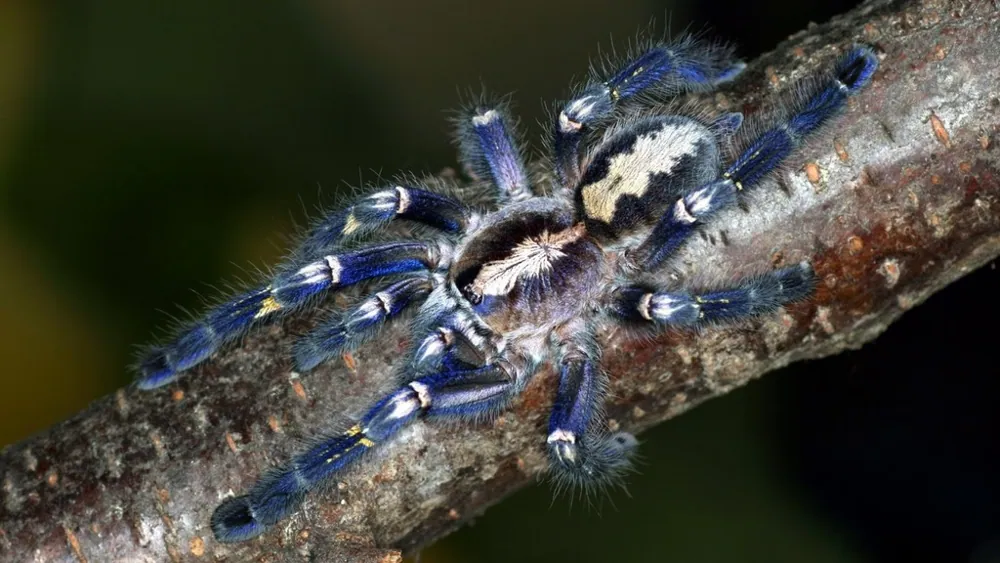
The Gooty sapphire tarantula is a large spider with bright blue hair, the only blue species in its genus. It lives in a small patch of forest in southern India, where it makes its home in holes in tall trees. It is critically endangered, so it is rare and needs protection.1

 Como reconhecê-lo
- Covered in blue hair, the only blue species in the genus Poecilotheria1
- An intricate, fractal-like geometric pattern on the abdomen1
- Young spiders are less colourful; the blue becomes stronger as they mature1
- Mature males are more slender, with longer legs than females1
- Full-grown leg span of 15 to 20 cm1
Poder do veneno
O veneno sai pelas presas ou pelos dentes quando morde.
O que faz o seu veneno?
Its venom may cause intense pain, although this is judged from the experience of keepers bitten by other spiders in the genus. A bite may cause a rise in heart rate, followed by sweating, headache, stinging, cramping or swelling. These effects can last for up to a week.1
Quão perigoso é para as pessoas?
Perigo para as pessoas: GraveUma mordedura precisa de médico. As mortes são muito raras.No human death from its bite has ever been recorded. Its bite is still considered medically significant. Most bites are dry bites, where no venom is injected. It can move quickly and may defend itself when cornered.1
O que faz quando tem medo?
It is skittish and will try to flee first. It also flees from light, as it is sensitive to it. If provoked, it may bite.1
 Se morder
- Lava a mordedura e arrefece-a. Procura ajuda médica se a dor for forte ou a pessoa se sentir mal.
Liga sempre primeiro para o teu número de emergência (112, 000, 911). Isto são orientações gerais de primeiros socorros, não conselho médico. Primeiros socorros básicos
 Fica em segurança
- Nunca toques, apanhes ou provoques um animal selvagem, mesmo pequeno, e mesmo que pareça a dormir ou morto.
- Dá-lhe espaço. Se encontrares um, mantém a calma, recua devagar e deixa-o seguir o seu caminho.
- Se te morder: mantém a calma, fica quieto, liga para o teu número de emergência (112, 000, 911) ou vai depressa para um hospital. Lembra-te de como era, uma foto ajuda.
Não anda atrás de ti. Usa o veneno para caçar ou para se proteger, e prefere muito mais esconder-se. Mais sobre como estar seguro
Que tamanho tem?
Quanto mede?
 tão comprido como 6 peças de construção em fila
 conseguia percorrer 100 metros em 200 segundos (o humano mais rápido precisa de 9,6)
Que tamanho tem Gooty sapphire tarantula comparado contigo?
São só contas no teu navegador. Nada é guardado nem enviado para lado nenhum.
Quão rápido é?


Factos
Its vivid blue colour comes from tiny structures in its hair that reflect light, so the colour shifts when viewed from different angles.1
Its adult fangs can reach nearly 3/4 of an inch (about 1.9 cm) in length.1
Females typically live for 11 to 12 years, and males live for 3 to 4 years.1
Some blue tarantulas may use their colour in choosing mates or in contests for mates.1
It has been bred in captivity for more than ten years and is popular with tarantula enthusiasts.1
Caça-mitos
Mito: Its bite is deadly.
Verdade: No human death from its bite has ever been recorded, although the bite is considered medically significant.1
De onde vêm os factos
- Poecilotheria metallica (Wikipedia (CC BY-SA 4.0))
- Poecilotheria metallica (iNaturalist): nomes e classificação.
- Venom Wiki: o nível de perigo, o tamanho típico e a velocidade estimada são nossos. Vê como os calculamos: Como avaliamos o perigo.
Cada facto desta página tem um número que aponta para a sua fonte. Se nos enganámos em alguma coisa, desculpa, somos fãs de animais, não uma revista científica. Diz-nos em [email protected] e nós corrigimos.
 O escorpião tem fome! A Venom Wiki é um projeto de uma só pessoa: gratuito, sem anúncios e sem rastreadores. Uma pequena gorjeta ajuda a mantê-la online.Alimenta o escorpião
Mais do mesmo grupo: Tarântulas e aranhas-de-teia-em-funil
 Indian ornamental tarantulaTarântulas e aranhas-de-teia-em-funilPrecisa de médico
 Cobalt blue tarantulaTarântulas e aranhas-de-teia-em-funilSó dói
 Chinese bird spiderTarântulas e aranhas-de-teia-em-funilPrecisa de médico
 Chinese black earth tiger tarantulaTarântulas e aranhas-de-teia-em-funilPrecisa de médico
 Fringed ornamental tarantulaTarântulas e aranhas-de-teia-em-funilPrecisa de médico
 Japanese funnel-web spiderTarântulas e aranhas-de-teia-em-funilPrecisa de médico
 Escorpião-amarelo-palestino
 Cobra-indiana
 Víbora-de-escamas-serrilhadas-indiana
 Cobra-real
 Víbora-ladradora
 Víbora-de-russell