
 África
 Ásia
Ásia Europa
 América do Sul
 Austrália e Oceânia
 Antártida
 Oceano Pacífico
 Oceano Atlântico
 Oceano Índico
 Oceano Ártico
 Mar Mediterrâneo
 Mar Vermelho
 Mar das Caraíbas
 Mar de Coral
 Mar da China Meridional
 Mar das Filipinas
 Mar de Andamão
 Mar do Norte
 Mar de Timor e de Arafura
 Golfo de Bengala
 Golfo da Califórnia
Queensland whistling tarantula
 Mordeduras
The Queensland whistling tarantula is a large, shy spider from the east coast of Queensland in Australia. It is the largest spider in Australia, and it makes a hissing sound when it feels threatened. Its bite is venomous, but it is not fatal to people.1


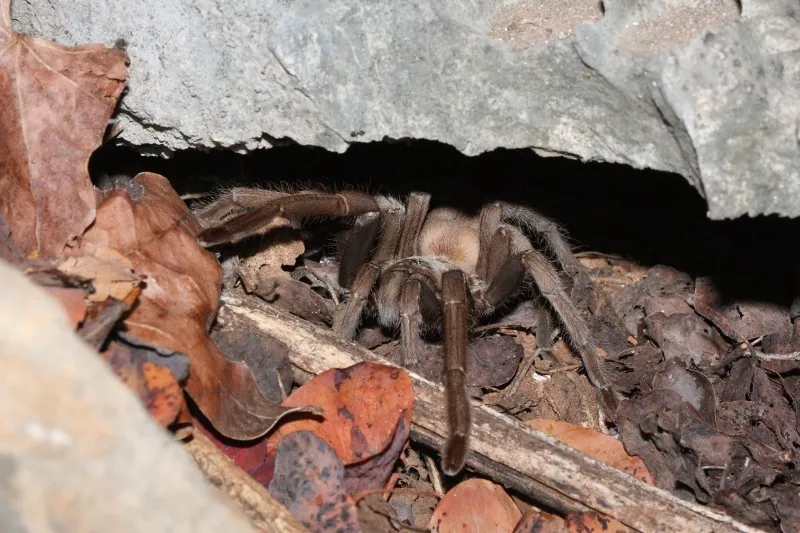
 Como reconhecê-lo
Poder do veneno
O veneno sai pelas presas ou pelos dentes quando morde.
O que faz o seu veneno?
It has venomous fangs up to 1 cm long. A bite can cause up to six hours of vomiting in people. In a 2010 case, a scientist bitten on a finger had intense pain, and the finger and hand became swollen and very sensitive within one hour. The swelling and pain were limited to the hand and lower arm, and eased after 26 hours. The venom can kill a dog or cat within thirty minutes.1
Quão perigoso é para as pessoas?
Perigo para as pessoas: DolorosoPode doer muito, mas quase nunca é grave.The bite is not fatal to humans. It can cause severe pain, swelling and up to six hours of vomiting. The venom can cause death in dogs and cats within thirty minutes.1
O que faz quando tem medo?
When provoked, it makes a hissing noise by rubbing a patch of hairs (setae) on its chelicerae, which are its mouthparts.1
 Se morder
- Lava a mordedura e arrefece-a. Procura ajuda médica se a dor for forte ou a pessoa se sentir mal.
- Na Austrália, trata qualquer mordedura de aranha preta grande como uma de aranha-de-teia-em-funil: Imobilização com pressão: enrola uma ligadura elástica firme sobre a mordedura e depois por todo o membro, imobiliza-o com uma tala e mantém a pessoa completamente quieta até chegar ajuda.
Liga sempre primeiro para o teu número de emergência (112, 000, 911). Isto são orientações gerais de primeiros socorros, não conselho médico. Primeiros socorros básicos
 Fica em segurança
- Nunca toques, apanhes ou provoques um animal selvagem, mesmo pequeno, e mesmo que pareça a dormir ou morto.
- Dá-lhe espaço. Se encontrares um, mantém a calma, recua devagar e deixa-o seguir o seu caminho.
- Se te morder: mantém a calma, fica quieto, liga para o teu número de emergência (112, 000, 911) ou vai depressa para um hospital. Lembra-te de como era, uma foto ajuda.
Não anda atrás de ti. Usa o veneno para caçar ou para se proteger, e prefere muito mais esconder-se. Mais sobre como estar seguro
Que tamanho tem?
Quanto mede?
 tão comprido como 7 peças de construção em fila
 conseguia percorrer 100 metros em 170 segundos (o humano mais rápido precisa de 9,6)
Que tamanho tem Queensland whistling tarantula comparado contigo?
São só contas no teu navegador. Nada é guardado nem enviado para lado nenhum.
Quão rápido é?


Factos
It is often called the barking spider because of the hissing sound it makes when approached.1
It is the largest spider in Australia, and its body can be up to 9 cm long.1
Adults dig silk-lined burrows up to 2 metres long, with a side tunnel leading up to an air pocket chamber that can last a few days.1
Females can live up to thirty years, while males live up to eight years.1
Many of these spiders are taken from the wild, often illegally, which threatens the wild population.1
It is a fast-growing spider and is widely sought after as a pet.1
Caça-mitos
Mito: It is a bird-eating spider.
Verdade: This nocturnal ground dweller is not likely to ever encounter or feed on birds. It mainly eats insects, other spiders, and small animals such as geckos, skinks and frogs.1
De onde vêm os factos
- Selenocosmia crassipes (Wikipedia (CC BY-SA 4.0))
- Selenocosmia crassipes (iNaturalist): nomes e classificação.
- Venom Wiki: o nível de perigo, o tamanho típico e a velocidade estimada são nossos. Vê como os calculamos: Como avaliamos o perigo.
Cada facto desta página tem um número que aponta para a sua fonte. Se nos enganámos em alguma coisa, desculpa, somos fãs de animais, não uma revista científica. Diz-nos em [email protected] e nós corrigimos.
 O escorpião tem fome! A Venom Wiki é um projeto de uma só pessoa: gratuito, sem anúncios e sem rastreadores. Uma pequena gorjeta ajuda a mantê-la online.Alimenta o escorpião
Mais do mesmo grupo: Tarântulas e aranhas-de-teia-em-funil
 Aranha-de-teia-em-funil-de-sydneyTarântulas e aranhas-de-teia-em-funilMortal
 Northern tree-dwelling funnel-web spiderTarântulas e aranhas-de-teia-em-funilMortal
 Red-headed mouse spiderTarântulas e aranhas-de-teia-em-funilPrecisa de médico
 Blue Mountains funnel-web spiderTarântulas e aranhas-de-teia-em-funilPode matar
 Darling Downs funnel-web spiderTarântulas e aranhas-de-teia-em-funilPode matar
 Illawarra funnel-web spiderTarântulas e aranhas-de-teia-em-funilPode matar
 Taipan-costeiro
 Víbora-da-morte-comum
 Cobra-castanha-oriental
 Taipan-do-interior
 Cobra-tigre
 Redback spider