
 África
 Ásia
Ásia Europa
 América do Sul
 Austrália e Oceânia
 Antártida
 Oceano Pacífico
 Oceano Atlântico
 Oceano Índico
 Oceano Ártico
 Mar Mediterrâneo
 Mar Vermelho
 Mar das Caraíbas
 Mar de Coral
 Mar da China Meridional
 Mar das Filipinas
 Mar de Andamão
 Mar do Norte
 Mar de Timor e de Arafura
 Golfo de Bengala
 Golfo da Califórnia
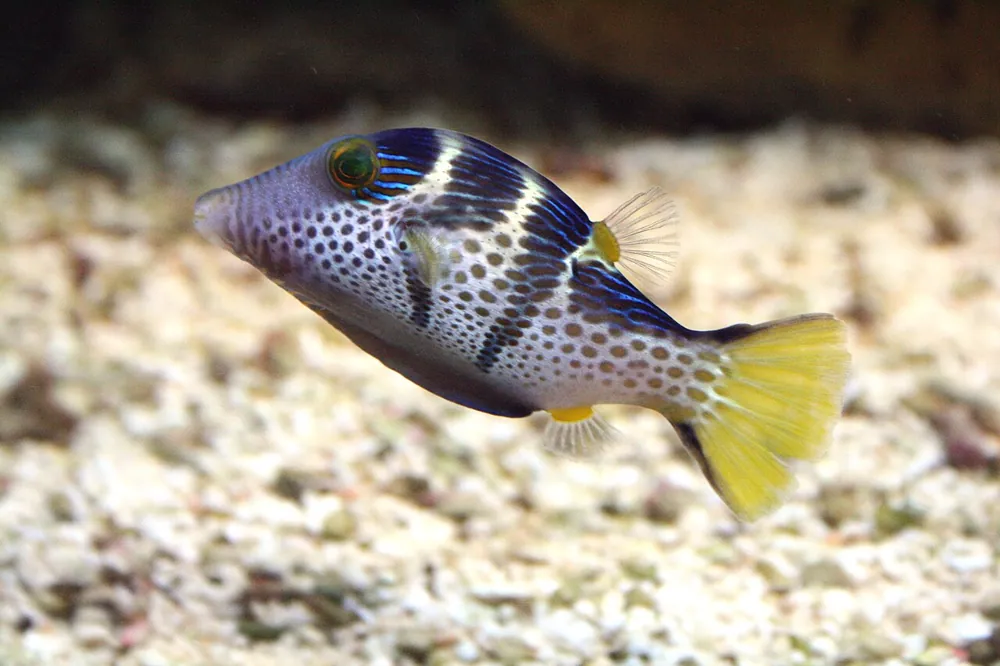
Valentin's sharpnose puffer
 Tóxico se for comido
Valentin's sharpnose puffer is a small reef fish with four black stripes across its back. It lives in warm seas across the Indian Ocean, the Red Sea and parts of the Pacific. It is special because its skin holds one of the most potent natural poisons known, which keeps most predators away.1



 Como reconhecê-lo
- Four distinct black stripes, called saddles, run across its back.1
- The head is blue-grey.1
- The main body is white, speckled with blue-grey spots.1
- The tail and fins show hints of yellow, and a rainbow streak sits behind the eyes.1
Muitas vezes confundido com: The filefish Paraluteres prionurus has similar colours and sometimes swims in schools with this puffer. It mimics the puffer's appearance for protection, but it is not toxic.1
Poder tóxico
Só faz mal se alguma coisa o comer.
O que faz a sua toxina?
Its skin and other tissues contain tetrodotoxin, a neurotoxin, which attacks the nerves. It is one of the most potent naturally occurring toxins and is lethal to many species of fish. This makes the fish unpalatable to predators.1
Quão perigoso é para as pessoas?
Perigo para as pessoas: GraveSe alguém o comer, é preciso ir ao médico. As mortes são muito raras.It is highly poisonous to eat.1
O que faz quando tem medo?
It gulps water to puff its body up to three or four times its normal volume, and its toxic skin deters predators.1
 Se alguém lhe tocou ou o comeu
- Se alguém o comeu ou tem sintomas depois de o comer: liga já para o número de emergência ou para o centro antivenenos.
Liga sempre primeiro para o teu número de emergência (112, 000, 911). Isto são orientações gerais de primeiros socorros, não conselho médico. Primeiros socorros básicos
 Fica em segurança
- Nunca toques, apanhes ou provoques um animal selvagem, mesmo pequeno, e mesmo que pareça a dormir ou morto.
- Dá-lhe espaço. Se encontrares um, mantém a calma, recua devagar e deixa-o seguir o seu caminho.
- Se lhe tocaste ou o comeste: não esfregues os olhos nem a boca, lava as mãos e procura ajuda médica.
Não anda atrás de ti. O veneno só existe para que nada o coma. Mais sobre como estar seguro
Onde no mundo?
Que tamanho tem?
Quanto mede?
 tão comprido como 3 peças de construção em fila
 conseguia nadar o comprimento de uma piscina grande (50 m) em 45 segundos
Que tamanho tem Valentin's sharpnose puffer comparado contigo?
São só contas no teu navegador. Nada é guardado nem enviado para lado nenhum.
Quão rápido é?
Factos
Its tetrodotoxin is one of the most potent naturally occurring toxins, and it is lethal to many fish.1
A non-toxic filefish, Paraluteres prionurus, has evolved to look like this puffer, which helps it avoid predators.1
Its eggs are unpalatable, so predatory fish rarely eat them, and any swallowed eggs are quickly passed out again. This means the parents need not guard them.1
Juveniles of the grouper Plectropomus laevis also mimic its colours.1
Its eggs, at 0.68 to 0.72 mm across, are among the smallest in the puffer family Tetraodontidae.1
Caça-mitos
Mito: Pufferfish hold their breath while they puff up.
Verdade: A 2014 study found that oxygen consumption actually increases while the fish is inflated. Oxygen intake through the gills is almost five times higher than normal.1
Para especialistas em veneno
- Nome científico
- Canthigaster valentini
- Grupo
- Outros animais tóxicos
- Família
- Tetraodontidae2
- Ordem
- Tetraodontiformes
- Continentes
- Oceano Pacífico, Oceano Índico, Mar Vermelho, Mar de Coral, Mar das Filipinas, Mar da China Meridional, Mar de Timor e de Arafura, Os oceanos
- Crias
- Females lay anywhere between fifteen and over 800 eggs at a time, every four to ten days depending on the season.1
- Perigo para as pessoas
- 3 / 5: Grave3
De onde vêm os factos
- Valentin's sharpnose puffer (Wikipedia (CC BY-SA 4.0))
- Canthigaster valentini (iNaturalist): nomes e classificação.
- Venom Wiki: o nível de perigo, o tamanho típico e a velocidade estimada são nossos. Vê como os calculamos: Como avaliamos o perigo.
Cada facto desta página tem um número que aponta para a sua fonte. Se nos enganámos em alguma coisa, desculpa, somos fãs de animais, não uma revista científica. Diz-nos em [email protected] e nós corrigimos.
 O escorpião tem fome! A Venom Wiki é um projeto de uma só pessoa: gratuito, sem anúncios e sem rastreadores. Uma pequena gorjeta ajuda a mantê-la online.Alimenta o escorpião
Mais do mesmo grupo: Outros animais tóxicos
 Baiacu-japonês
 Hawksbill sea turtle
 Greenland shark
 Silver-cheeked toadfish
 Blackspotted puffer
 White-spotted puffer
Também vive em: Oceano Pacífico
 Cubomedusa-australianaAlforrecas e picadores do marMortalNão tocar
 Cone-geográficoCaracóis-cone e polvosMortal
 Polvo-de-anéis-azuis-grandeCaracóis-cone e polvosMortal
 Polvo-de-anéis-azuis-do-sulCaracóis-cone e polvosMortal
 Irukandji jellyfishAlforrecas e picadores do marPode matarNão tocar
 Reef stonefishPeixes venenososPode matarNão tocar