
 Africa
 Asia
Asia Europa
 America de Sud
 Australia și Oceania
 Antarctica
 Oceanul Pacific
 Oceanul Atlantic
 Oceanul Indian
 Oceanul Arctic
 Marea Mediterană
 Marea Roșie
 Marea Caraibilor
 Marea Coralilor
 Marea Chinei de Sud
 Marea Filipinelor
 Marea Andaman
 Marea Nordului
 Marea Timor și Marea Arafura
 Golful Bengal
 Golful California
African crested rat
 Otravă în piele
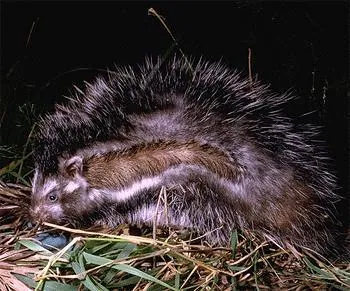
The African crested rat is a large, nocturnal rodent with long hair and a bushy tail. It looks a little like a porcupine. It lives in East Africa, where it is the world's only known poisonous rodent, coating itself in plant toxins to keep predators away.1



 Cum îl recunoști
- Large, nocturnal rodent with long, silver and black-tipped guard hairs over a woolly grey and white undercoat1
- A mane of longer black-and-white banded hairs runs from the top of the head to just beyond the base of the tail1
- A broad, white-bordered strip of glandular skin sits beside the mane, and it becomes visible when the animal is threatened1
- Bushy tail and short black fur on the face and limbs1
- Superficially resembles a porcupine1
Puterea otrăvii
Pielea lui e otrăvitoare. E periculos să-l atingi, să-l lingi sau să-l mănânci.
Ce face otrava lui?
This animal is poisonous rather than venomous, so it does not bite or sting to inject poison. It smears poison from the bark of the poison arrow tree onto the hairs of its glandular skin patch. A predator that bites it can be sickened or even killed by this poison.1
Cât de periculos e pentru oameni?
Pericol pentru oameni: GravDacă cineva îl atinge sau îl mănâncă, trebuie mers la medic. Decesele sunt foarte rare.Its poison is a risk to predators that try to bite it. The rat itself is not harmed by the toxins it stores.1
Ce face când se sperie?
When threatened or excited, the mane stands up and the glandular strip parts, exposing the skin that carries the poison.1
 Dacă cineva l-a atins sau l-a mâncat
- Dacă cineva l-a mâncat sau are simptome după ce l-a mâncat: sună imediat la numărul de urgență sau la centrul de toxicologie.
Sună mereu mai întâi la numărul de urgență (112, 000, 911). Acestea sunt sfaturi generale de prim ajutor, nu sfaturi medicale. Noțiuni de prim ajutor
 Fii în siguranță
- Nu atinge, nu prinde și nu necăji niciodată un animal sălbatic, nici măcar unul mic, chiar dacă pare adormit sau mort.
- Lasă-i loc. Dacă întâlnești unul, păstrează-ți calmul, dă-te încet înapoi și lasă-l să-și vadă de drum.
- Dacă l-ai atins sau l-ai mâncat: nu te freca la ochi sau la gură, spală-te pe mâini și cere ajutor medical.
Nu te vânează pe tine. Otrava lui există doar ca să nu-l mănânce nimeni. Mai multe despre siguranță
Cât de mare e?
Cât de lung e?
Cât cântărește?

 lung cât 10 cărămizi de construcție de jucărie în șir
 ar putea parcurge 100 de metri în 72 secunde (cel mai rapid om are nevoie de 9,6)
Cât de mare e African crested rat față de TINE?
Doar calcule în browserul tău. Nimic nu e salvat sau trimis nicăieri.
Cât de rapid e?


Informații
It is the world's only known poisonous rodent.1
It is the only rodent known to use and store toxins from a different species in nature to protect itself, and it suffers no known harm from them.1
Its stomach has five anatomically distinct sections, a feature found in very few rodents.1
The skull is covered with small bony projections that give it a pebbled look.1
Its large size may allow microbes in its foregut to break down cellulose from plants by fermentation.1
Spărgătorul de mituri
Mit: The maned rat was believed to be solitary.
Adevăr: It is now known to be somewhat sociable. Several animals are found in the same territory, and they purr and groom one another, so they may form family groups of a male, a female and their young.1
Pentru experții în venin
- Nume științific
- Lophiomys imhausi
- Grupă
- Alte animale otrăvitoare
- Familie
- Muridae2
- Ordin
- Rodentia
- Continente
- Africa
- Puii
- Litters have 1 to 3 young. The young are slightly haired at birth, their eyes open by day 13, and they are weaned by day 40.1
- Cum îi merge în natură
- Least Concern1
- Pericol pentru oameni
- 3 / 5: Grav3
De unde vin informațiile
- Maned rat (Wikipedia (CC BY-SA 4.0))
- Lophiomys imhausi (iNaturalist): nume și clasificare.
- Venom Wiki: nivelul de pericol, mărimea obișnuită și viteza estimată sunt ale noastre. Vezi cum le calculăm: Cum evaluăm pericolul.
Fiecare informație de pe pagina asta are un număr care duce la sursa ei. Dacă am greșit ceva, ne pare rău, suntem fani ai animalelor, nu o revistă științifică. Spune-ne la [email protected] și corectăm.
 Scorpionului îi e foame! Venom Wiki este proiectul unui singur om: gratuit, fără reclame și fără trackere. Un mic bacșiș îl ajută să rămână online.Hrănește scorpionul
Mai multe din aceeași grupă: Alte animale otrăvitoare
 Common quailAlte animale otrăvitoareDoar doare
 Spur-winged gooseAlte animale otrăvitoareDoar doare
 Fahaka pufferfishAlte animale otrăvitoarePoate ucide
 Red-striped oil beetleAlte animale otrăvitoareDoar doareNu atinge
 Pește-balon japonezAlte animale otrăvitoareMortal
 Hawksbill sea turtleAlte animale otrăvitoarePoate ucide
 Mamba neagră
 Scorpion galben palestinian
 Cobra egipteană
 Vipera șuierătoare
 Boomslang
 Fat-tailed scorpion