
 Africa
 Asia
Asia Europa
 America de Sud
 Australia și Oceania
 Antarctica
 Oceanul Pacific
 Oceanul Atlantic
 Oceanul Indian
 Oceanul Arctic
 Marea Mediterană
 Marea Roșie
 Marea Caraibilor
 Marea Coralilor
 Marea Chinei de Sud
 Marea Filipinelor
 Marea Andaman
 Marea Nordului
 Marea Timor și Marea Arafura
 Golful Bengal
 Golful California
Aquatic coral snake
 Mușcături
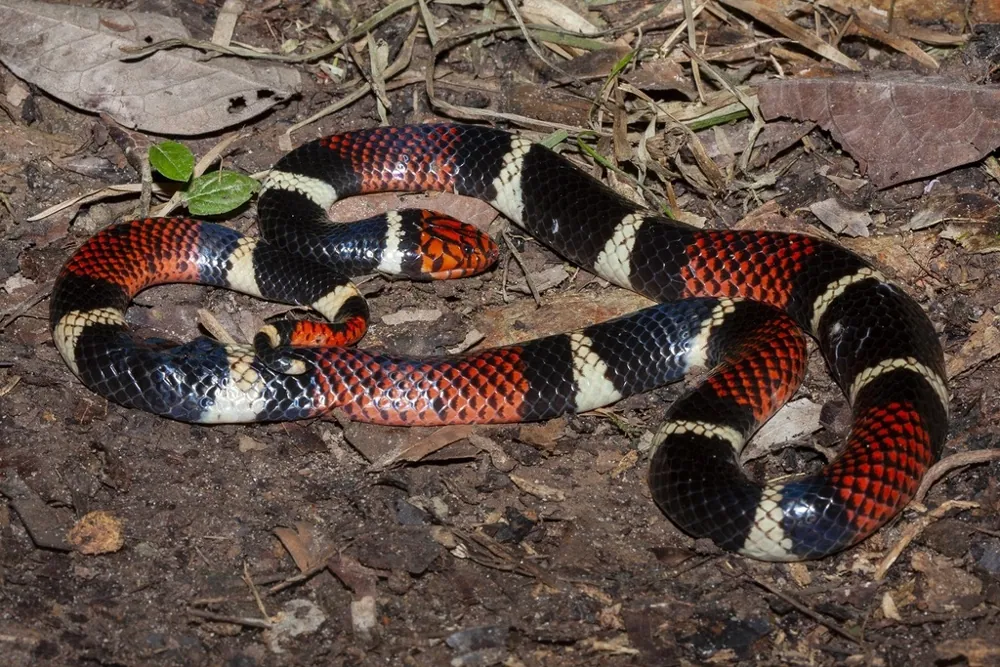
The aquatic coral snake is a venomous snake that spends much of its time in water. It is one of the heaviest and sturdiest coral snakes, and it lives in the forests of northern South America. It is special because it swims well and can stay underwater for a long time.1



 Cum îl recunoști
- The head is mainly red with black edging on the scales.1
- The head is large with a long snout, and the eyes and nostrils sit higher on the head than in other coral snakes.1
- The body has wide red rings separated by groups of three black rings, with narrow cream or yellowish rings between the black bands.1
- The scales are smooth and shiny, and arranged in 15 rows.1
- Adults usually measure 80 to 100 cm, tail included.1
Puterea veninului
Veninul iese prin colți sau dinți când mușcă.
Ce face veninul lui?
Its venom is neurotoxic, meaning it attacks the nerves. It blocks signals between nerves and muscles, which causes paralysis. Symptoms can include blurred vision, difficulty speaking, swallowing and walking, and breathing failure. In a well-reported case in the Amazon, the victim reached hospital about 20 minutes after the bite.1
Cât de periculos e pentru oameni?
Pericol pentru oameni: Foarte periculosPoate ucide un om care nu primește tratament.Bites are rare, but the venom can cause paralysis of the cranial nerves and can be fatal. The estimated lethal dose for an adult human is 18–20 mg, which is higher than the 4–7 mg for smaller coral snake species. Because it is a large snake, it can carry a lot of venom, with an average yield of 56 mg and a maximum of 160 mg when milked by scientists.1
 Vestea bună: medicii au un medicament (serul antiveninos) sau un tratament pentru asta.1
Ce face când se sperie?
When threatened, it flattens its body and raises its tail.1
 Dacă mușcă
- A bite needs hospital care. In a recorded case, the victim needed mechanical ventilation because paralysis of the breathing muscles made it hard to breathe, and was given specific Micrurus antivenom.1
- Ține persoana nemișcată și calmă și du-o repede la spital, chiar dacă mușcătura pare mică: simptomele pot începe după câteva ore.
Sună mereu mai întâi la numărul de urgență (112, 000, 911). Acestea sunt sfaturi generale de prim ajutor, nu sfaturi medicale. Noțiuni de prim ajutor
 Fii în siguranță
- Nu atinge, nu prinde și nu necăji niciodată un animal sălbatic, nici măcar unul mic, chiar dacă pare adormit sau mort.
- Lasă-i loc. Dacă întâlnești unul, păstrează-ți calmul, dă-te încet înapoi și lasă-l să-și vadă de drum.
- Dacă te mușcă unul: păstrează-ți calmul, stai nemișcat, sună la numărul de urgență (112, 000, 911) sau mergi repede la spital. Ține minte cum arăta, o poză ajută.
Nu te vânează pe tine. Își folosește veninul ca să prindă hrană sau să se apere și ar prefera de departe să se ascundă. Mai multe despre siguranță
Cât de mare e?
Cât de lung e?
 lung cât 2,5 pisici de casă de la nas la coadă
 lung cât 8 banane puse cap la cap
 ar putea parcurge 100 de metri în 68 secunde (cel mai rapid om are nevoie de 9,6)
Cât de mare e Aquatic coral snake față de TINE?
Doar calcule în browserul tău. Nimic nu e salvat sau trimis nicăieri.
Cât de rapid e?


Informații
It swims very well and can stay submerged for a long period.1
Although its venom is weaker than that of smaller members of its genus, it can carry a large amount of venom because of its size.1
It is one of the heaviest and most robust coral snakes.1
It is mainly active at night, though it can also be active during the day.1
It is not aggressive towards humans.1
De unde vin informațiile
- Aquatic coral snake (Wikipedia (CC BY-SA 4.0))
- Micrurus surinamensis (iNaturalist): nume și clasificare.
- Venom Wiki: nivelul de pericol, mărimea obișnuită și viteza estimată sunt ale noastre. Vezi cum le calculăm: Cum evaluăm pericolul.
Fiecare informație de pe pagina asta are un număr care duce la sursa ei. Dacă am greșit ceva, ne pare rău, suntem fani ai animalelor, nu o revistă științifică. Spune-ne la [email protected] și corectăm.
 Scorpionului îi e foame! Venom Wiki este proiectul unui singur om: gratuit, fără reclame și fără trackere. Un mic bacșiș îl ajută să rămână online.Hrănește scorpionul
Mai multe din aceeași grupă: Șerpi-coral
 Central American coral snake
 Amazonian coral snake
 Argentinian coral snake
 Caatinga coral snake
 Dumeril's coral snake
 Mesopotamian coral snake
Mai trăiește în: America de Sud
 Broască aurie otrăvitoareBroaște otrăvitoare, broaște râioase și tritoniMortalNu atinge
 TerciopeloVipere cu gropițeMortal
 Brazilian wandering spiderPăianjeniPoate ucide
 Eyelash viperVipere cu gropițePoate ucide
 Golden lanceheadVipere cu gropițePoate ucide
 South American bushmasterVipere cu gropițePoate ucide