
 Africa
 Asia
Asia Europa
 America de Sud
 Australia și Oceania
 Antarctica
 Oceanul Pacific
 Oceanul Atlantic
 Oceanul Indian
 Oceanul Arctic
 Marea Mediterană
 Marea Roșie
 Marea Caraibilor
 Marea Coralilor
 Marea Chinei de Sud
 Marea Filipinelor
 Marea Andaman
 Marea Nordului
 Marea Timor și Marea Arafura
 Golful Bengal
 Golful California
Bald-faced hornet
 Înțepături
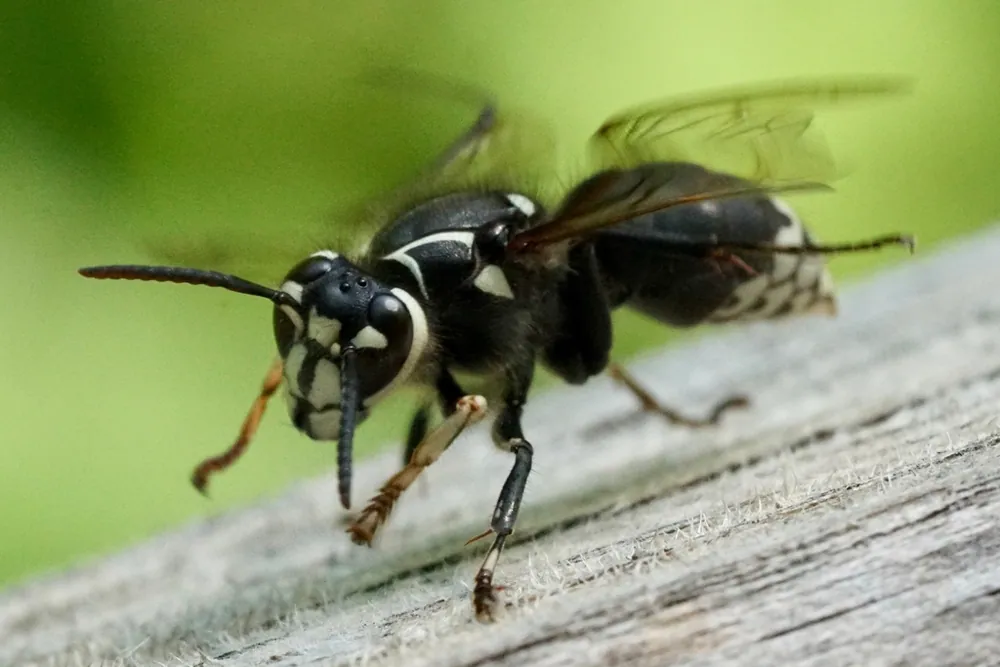
The bald-faced hornet is a wasp with a striking black and white body and a white face. It builds large, hanging paper nests in trees and bushes across North America. Its workers will defend the nest by stinging repeatedly, so it is important to keep well away from its nests.1



 Cum îl recunoști
- Black and white colouring, unlike other yellowjackets of its genus, which are mostly black and yellow1
- A white or "bald" face1
- Three white stripes at the end of the body1
- Adults average about 19 mm long, larger than other Dolichovespula species1
- A large, egg-shaped, grey paper nest that hangs from trees or bushes, up to 58 cm long1
Adesea confundat cu: Other Dolichovespula wasps are mostly black and yellow. The bald-faced hornet's black and white colouring and white face set it apart. It is not one of the true hornets, which belong to the genus Vespa.1
Puterea veninului
Veninul iese printr-un ac.
Ce face veninul lui?
Workers can squirt venom from the stinger into the eyes of animals that intrude on the nest. The venom makes the eyes water immediately and causes temporary blindness.1
Cât de periculos e pentru oameni?
Pericol pentru oameni: DurerosPoate durea tare, dar aproape niciodată nu e grav.It is aggressive when defending its nest. Workers sting repeatedly, and colonies can have 400 to 700 workers. The risk is highest when people walk too close to a nest or when a nest is built near homes.1
Ce face când se sperie?
Workers defend the nest by stinging repeatedly and can squirt venom into the eyes of intruders.1
 Dacă înțeapă
- Scoate acul de albină răzuindu-l și răcește locul.
- Dacă persoana respiră greu, are fața sau gâtul umflate sau simte că leșină, e o urgență alergică: sună la numărul de urgență și folosește autoinjectorul ei de adrenalină, dacă are unul.
Sună mereu mai întâi la numărul de urgență (112, 000, 911). Acestea sunt sfaturi generale de prim ajutor, nu sfaturi medicale. Noțiuni de prim ajutor
 Fii în siguranță
- Nu atinge, nu prinde și nu necăji niciodată un animal sălbatic, nici măcar unul mic, chiar dacă pare adormit sau mort.
- Lasă-i loc. Dacă întâlnești unul, păstrează-ți calmul, dă-te încet înapoi și lasă-l să-și vadă de drum.
- Dacă te înțeapă unul: păstrează-ți calmul, stai nemișcat, sună la numărul de urgență (112, 000, 911) sau mergi repede la spital. Ține minte cum arăta, o poză ajută.
Nu te vânează pe tine. Își folosește veninul ca să prindă hrană sau să se apere și ar prefera de departe să se ascundă. Mai multe despre siguranță
Cât de mare e?
Cât de lung e?
 mai scurt decât degetul tău mic
 ar putea traversa în zbor un teren întreg de fotbal în 15 secunde
Cât de mare e Bald-faced hornet față de TINE?
Doar calcule în browserul tău. Nimic nu e salvat sau trimis nicăieri.
Cât de rapid e?


Informații
It can spray venom from its stinger into the eyes of nest intruders, causing temporary blindness.1
Its colony can have 400 to 700 workers, the largest recorded colony size in its genus, Dolichovespula.1
Female bee moths can lay eggs in its nests, and the hatched larvae feed on the eggs, larvae and pupae inside, sometimes destroying large parts of the nest.1
Its nests are made from chewed wood fibres mixed with saliva, which dries into a papery structure.1
A colony lasts about 4 months in Washington, from mid-May to mid-September. Colonies in lower latitudes last longer.1
Spărgătorul de mituri
Mit: It is a true hornet.
Adevăr: It is a yellowjacket wasp. True hornets belong to the genus Vespa.1
Pentru experții în venin
- Nume științific
- Dolichovespula maculata
- Grupă
- Albine, viespi și gărgăuni
- Familie
- Vespidae2
- Ordin
- Hymenoptera
- Continente
- America de Nord
- Puii
- A single queen starts each new nest in spring, laying eggs that hatch into workers, and later lays eggs that become males and new queens.1
- Pericol pentru oameni
- 2 / 5: Dureros3
De unde vin informațiile
- Dolichovespula maculata (Wikipedia (CC BY-SA 4.0))
- Dolichovespula maculata (iNaturalist): nume și clasificare.
- Venom Wiki: nivelul de pericol, mărimea obișnuită și viteza estimată sunt ale noastre. Vezi cum le calculăm: Cum evaluăm pericolul.
Fiecare informație de pe pagina asta are un număr care duce la sursa ei. Dacă am greșit ceva, ne pare rău, suntem fani ai animalelor, nu o revistă științifică. Spune-ne la [email protected] și corectăm.
 Scorpionului îi e foame! Venom Wiki este proiectul unui singur om: gratuit, fără reclame și fără trackere. Un mic bacșiș îl ajută să rămână online.Hrănește scorpionul
Mai multe din aceeași grupă: Albine, viespi și gărgăuni
 Tarantula hawkAlbine, viespi și gărgăuniDoar doare
 Executioner waspAlbine, viespi și gărgăuniAre nevoie de un medic
 Warrior waspAlbine, viespi și gărgăuniAre nevoie de un medic
 Cow killer velvet antAlbine, viespi și gărgăuniDoar doare
 Eastern cicada killerAlbine, viespi și gărgăuniInofensiv
 Aerial yellowjacketAlbine, viespi și gărgăuniDoar doare
 Terciopelo
 Eastern coral snake
 Eastern diamondback rattlesnake
 Eyelash viper
 Timber rattlesnake
 Western diamondback rattlesnake