
 Africa
 Asia
Asia Europa
 America de Sud
 Australia și Oceania
 Antarctica
 Oceanul Pacific
 Oceanul Atlantic
 Oceanul Indian
 Oceanul Arctic
 Marea Mediterană
 Marea Roșie
 Marea Caraibilor
 Marea Coralilor
 Marea Chinei de Sud
 Marea Filipinelor
 Marea Andaman
 Marea Nordului
 Marea Timor și Marea Arafura
 Golful Bengal
 Golful California
Bat ray
 Înțepături
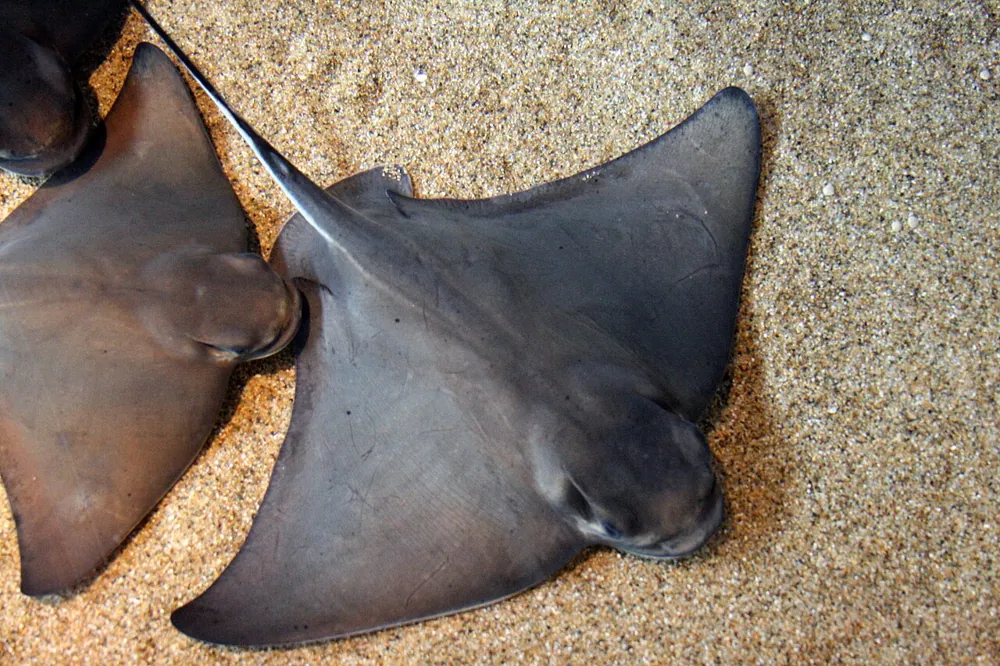
The bat ray is a flat, diamond-shaped fish related to sharks, with wing-like fins that it flaps to swim. It lives in shallow coastal waters from central Oregon in the USA down to the Gulf of California in Mexico, and around the Galápagos Islands. It has a venomous spine near the base of its tail, but it uses it only when it feels threatened.1



 Cum îl recunoști
- Diamond-shaped body, with wing-like pectoral fins that end in blunt points1
- Broad head raised higher than the fins, with eyes set on the sides of the head1
- Dark back, black or dark brown, with a white underside1
- Whip-like tail with at least one venomous spine at its base1
- Usually two small cephalic horns (projections from the front of the head) used for pushing food into the mouth1
Puterea veninului
Veninul iese printr-un ac.
Cât de periculos e pentru oameni?
Pericol pentru oameni: DurerosPoate durea tare, dar aproape niciodată nu e grav.The bat ray is not considered dangerous to people. It uses its venomous tail spine only when it is attacked or frightened.1
Ce face când se sperie?
The bat ray camouflages itself in the sand and uses its tail spine only when attacked or frightened.1
 Dacă înțeapă
- Pune rana în apă fierbinte, cât de fierbinte poate suporta persoana fără să se ardă (încearcă apa cu mâna ta), timp de 30 până la 90 de minute. Cere ajutor medical, mai ales pentru peștele-piatră și pisicile-de-mare.
Sună mereu mai întâi la numărul de urgență (112, 000, 911). Acestea sunt sfaturi generale de prim ajutor, nu sfaturi medicale. Noțiuni de prim ajutor
 Fii în siguranță
- Nu atinge, nu prinde și nu necăji niciodată un animal sălbatic, nici măcar unul mic, chiar dacă pare adormit sau mort.
- Lasă-i loc. Dacă întâlnești unul, păstrează-ți calmul, dă-te încet înapoi și lasă-l să-și vadă de drum.
- Dacă te înțeapă unul: păstrează-ți calmul, stai nemișcat, sună la numărul de urgență (112, 000, 911) sau mergi repede la spital. Ține minte cum arăta, o poză ajută.
Nu te vânează pe tine. Își folosește veninul ca să prindă hrană sau să se apere și ar prefera de departe să se ascundă. Mai multe despre siguranță
Unde în lume?
Cât de mare e?
Cât de lung e?
Cât cântărește?

 lung cât 4 pisici de casă de la nas la coadă
 lung cât 10 banane puse cap la cap
 ar putea înota lungimea unei piscine mari (50 m) în 8,2 secunde
Cât de mare e Bat ray față de TINE?
Doar calcule în browserul tău. Nimic nu e salvat sau trimis nicăieri.
Cât de rapid e?


Informații
Bat rays dig pits in the seabed that can be up to 4 m long, and small fish gather to eat the creatures the rays expose.1
The bat ray's young are born with the spine's sheath, which falls off within hours of birth.1
Bat rays can grow to a wingspan of 1.8 m, and the largest individuals weigh about 91 kg.1
Some bat rays live alone, while others form schools of thousands.1
Bat rays have teeth that are replaced continuously, as is the case with all elasmobranchs (sharks, rays and their relatives).1
Spărgătorul de mituri
Mit: Bat rays are dangerous to people because of their venomous spine.
Adevăr: Bat rays are not considered dangerous. They use the spine only when attacked or frightened, and people can avoid it by shuffling their feet when walking through shallow sand.1
Pentru experții în venin
- Nume științific
- Myliobatis californica
- Grupă
- Pești veninoși
- Familie
- Myliobatidae2
- Ordin
- Myliobatiformes
- Continente
- Oceanul Pacific, Golful California, Oceanele
- Puii
- Bat rays are ovoviviparous, so the eggs hatch inside the mother and the young are born live. A litter has two to ten pups, which are born tail first with their fins wrapped around their bodies.1
- Durata de viață
- cam 23 ani1
- Cum îi merge în natură
- Least Concern1
- Pericol pentru oameni
- 2 / 5: Dureros3
De unde vin informațiile
- Bat ray (Wikipedia (CC BY-SA 4.0))
- Myliobatis californica (iNaturalist): nume și clasificare.
- Venom Wiki: nivelul de pericol, mărimea obișnuită și viteza estimată sunt ale noastre. Vezi cum le calculăm: Cum evaluăm pericolul.
Fiecare informație de pe pagina asta are un număr care duce la sursa ei. Dacă am greșit ceva, ne pare rău, suntem fani ai animalelor, nu o revistă științifică. Spune-ne la [email protected] și corectăm.
 Scorpionului îi e foame! Venom Wiki este proiectul unui singur om: gratuit, fără reclame și fără trackere. Un mic bacșiș îl ajută să rămână online.Hrănește scorpionul
Mai multe din aceeași grupă: Pești veninoși
 Reef stonefishPești veninoșiPoate ucideNu atinge
 Red lionfishPești veninoșiAre nevoie de un medicNu atinge
 Estuarine stonefishPești veninoșiPoate ucideNu atinge
 Short-tail stingrayPești veninoșiPoate ucide
 Striped eel catfishPești veninoșiPoate ucideNu atinge
 Bluespotted ribbontail rayPești veninoșiAre nevoie de un medic
Mai trăiește în: Oceanul Pacific
 Australian box jellyfishMeduze și alte înțepătoare marineMortalNu atinge
 Geography coneMelci-con și caracatițeMortal
 Greater blue-ringed octopusMelci-con și caracatițeMortal
 Japanese pufferfishAlte animale otrăvitoareMortal
 Southern blue-ringed octopusMelci-con și caracatițeMortal
 Hawksbill sea turtleAlte animale otrăvitoarePoate ucide