
 Africa
 Asia
Asia Europa
 America de Sud
 Australia și Oceania
 Antarctica
 Oceanul Pacific
 Oceanul Atlantic
 Oceanul Indian
 Oceanul Arctic
 Marea Mediterană
 Marea Roșie
 Marea Caraibilor
 Marea Coralilor
 Marea Chinei de Sud
 Marea Filipinelor
 Marea Andaman
 Marea Nordului
 Marea Timor și Marea Arafura
 Golful Bengal
 Golful California
Fire salamander
 Otravă în pieleMănâncă: InsecteOtrăvitor, nu veninos
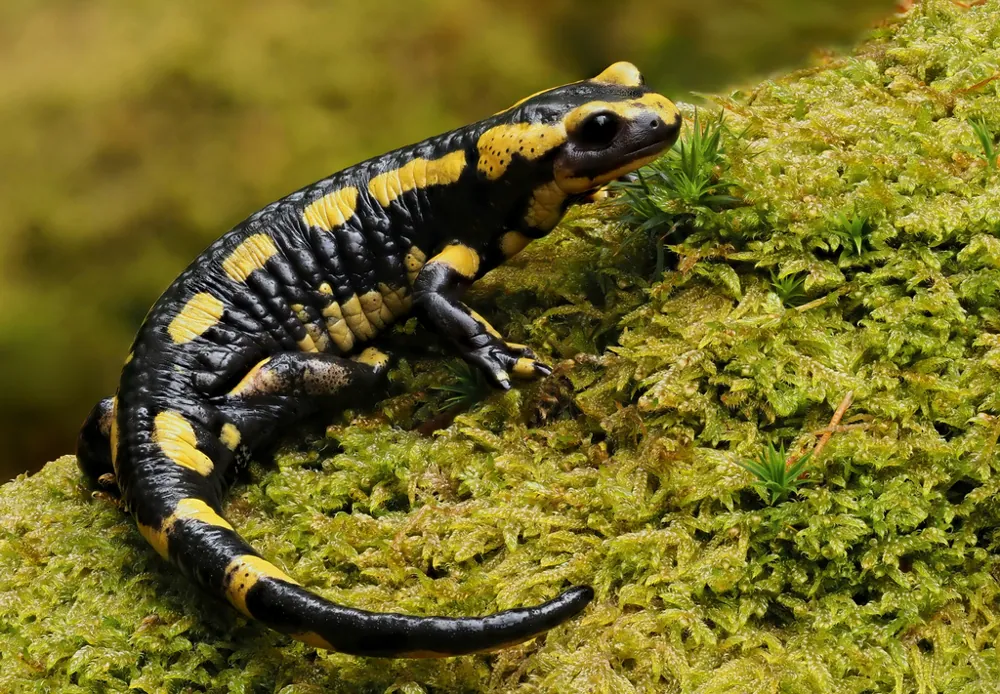
The fire salamander is a black amphibian with bright yellow, and sometimes red or orange, markings. It lives in forests across most of southern and central Europe. Its bright colours warn predators that its skin is poisonous.1
 Cum îl recunoști
- Black with yellow spots or stripes; the amount of yellow varies, and some are almost completely black1
- Shades of red or orange may appear, replacing or mixing with the yellow, depending on the subspecies1
- Grows to 15 to 25 cm long, making it one of Europe's largest salamanders1
- Males and females look very similar, except in the breeding season, when the male has a swollen gland near his vent1
Puterea otrăvii
Pielea lui e otrăvitoare. E periculos să-l atingi, să-l lingi sau să-l mănânci.
Ce face otrava lui?
The fire salamander is poisonous rather than venomous, so it does not inject venom with a bite. Its skin secretions contain alkaloid toxins, mainly samandarin, which cause strong muscle convulsions and high blood pressure, combined with fast breathing, in all vertebrates. Another alkaloid, samandarone, has also been found in its skin secretions. The poison comes from glands concentrated around the head and along the back.1
Cât de periculos e pentru oameni?
Pericol pentru oameni: DurerosPoate durea tare, dar aproape niciodată nu e grav.Some compounds in its skin secretions are potentially dangerous to human life. Touching the animal or handling its skin can expose people to the poison.1
Ce face când se sperie?
Its bright yellow, red or orange colours warn predators that it is poisonous, and it releases toxins from its skin glands.1
 Dacă cineva l-a atins sau l-a mâncat
- Dacă cineva a atins unul: spală bine mâinile și nu atinge ochii sau gura. Dacă un copil sau un animal de companie a lins sau a mâncat unul: sună la centrul de toxicologie sau la numărul de urgență.
Sună mereu mai întâi la numărul de urgență (112, 000, 911). Acestea sunt sfaturi generale de prim ajutor, nu sfaturi medicale. Noțiuni de prim ajutor
 Fii în siguranță
- Nu atinge, nu prinde și nu necăji niciodată un animal sălbatic, nici măcar unul mic, chiar dacă pare adormit sau mort.
- Lasă-i loc. Dacă întâlnești unul, păstrează-ți calmul, dă-te încet înapoi și lasă-l să-și vadă de drum.
- Dacă l-ai atins sau l-ai mâncat: nu te freca la ochi sau la gură, spală-te pe mâini și cere ajutor medical.
Nu te vânează pe tine. Otrava lui există doar ca să nu-l mănânce nimeni. Mai multe despre siguranță
Cât de mare e?
Cât de lung e?
Cât cântărește?

 lung cât 8 cărămizi de construcție de jucărie în șir
Cât de mare e Fire salamander față de TINE?
Doar calcule în browserul tău. Nimic nu e salvat sau trimis nicăieri.
Cât de rapid e?


Informații
One fire salamander lived for more than 50 years in Museum Koenig, a natural history museum in Germany.1
Larvae do not make the poison. It develops as the salamander matures, in the ovaries, liver and testes.1
Its skin poison may also help protect it against bacterial and fungal infections of the skin.1
Its bright colours are a warning signal. Scientists call this aposematism, meaning the animal advertises that it is poisonous.1
Some subspecies give birth to live young, while others release larvae into water. Only two subspecies, fastuosa and bernadezi, give birth to fully formed young.1
In captivity, females can store sperm for a long time and use it to produce another clutch of eggs. This has not been seen in the wild.1
Pentru experții în venin
- Nume științific
- Salamandra salamandra
- Grupă
- Broaște otrăvitoare, broaște râioase și tritoni
- Familie
- Salamandridae2
- Ordin
- Caudata
- Continente
- Europa
- Puii
- Eggs develop inside the female, and she puts the larvae into water as they hatch. In some subspecies, the young develop inside the female until she gives birth to fully formed young.1
- Durata de viață
- cam 50 ani1
- Cum îi merge în natură
- Vulnerable (IUCN Red List, 2023)1
- Pericol pentru oameni
- 2 / 5: Dureros3
De unde vin informațiile
- Fire salamander (Wikipedia (CC BY-SA 4.0))
- Salamandra salamandra (iNaturalist): nume și clasificare.
- Venom Wiki: nivelul de pericol, mărimea obișnuită și viteza estimată sunt ale noastre. Vezi cum le calculăm: Cum evaluăm pericolul.
Fiecare informație de pe pagina asta are un număr care duce la sursa ei. Dacă am greșit ceva, ne pare rău, suntem fani ai animalelor, nu o revistă științifică. Spune-ne la [email protected] și corectăm.
 Scorpionului îi e foame! Venom Wiki este proiectul unui singur om: gratuit, fără reclame și fără trackere. Un mic bacșiș îl ajută să rămână online.Hrănește scorpionul
Mai multe din aceeași grupă: Broaște otrăvitoare, broaște râioase și tritoni
 Common toadBroaște otrăvitoare, broaște râioase și tritoniDoar doareNu atinge
 European fire-bellied toadBroaște otrăvitoare, broaște râioase și tritoniInofensiv
 Iberian ribbed newtBroaște otrăvitoare, broaște râioase și tritoniInofensiv
 Natterjack toadBroaște otrăvitoare, broaște râioase și tritoniInofensiv
 Alpine salamanderBroaște otrăvitoare, broaște râioase și tritoniInofensiv
 European green toadBroaște otrăvitoare, broaște râioase și tritoniInofensiv
Mai trăiește în: Europa
 Common European adderVipereAre nevoie de un medic
 Spanish flyAlte animale otrăvitoareAre nevoie de un medicNu atinge
 Common waspAlbine, viespi și gărgăuniDoar doare
 European hornetAlbine, viespi și gărgăuniDoar doare
 Western honey beeAlbine, viespi și gărgăuniDoar doare
 Blunt-nosed viperViperePoate ucide