
 Africa
 Asia
Asia Europa
 America de Sud
 Australia și Oceania
 Antarctica
 Oceanul Pacific
 Oceanul Atlantic
 Oceanul Indian
 Oceanul Arctic
 Marea Mediterană
 Marea Roșie
 Marea Caraibilor
 Marea Coralilor
 Marea Chinei de Sud
 Marea Filipinelor
 Marea Andaman
 Marea Nordului
 Marea Timor și Marea Arafura
 Golful Bengal
 Golful California
Greenland shark
 Otrăvitor dacă e mâncat
The Greenland shark is a huge, slow shark that lives in the cold, deep waters of the North Atlantic and Arctic Oceans. It is famous for living longer than any known vertebrate (animal with a backbone). Its flesh is poisonous to eat unless it is specially prepared.1



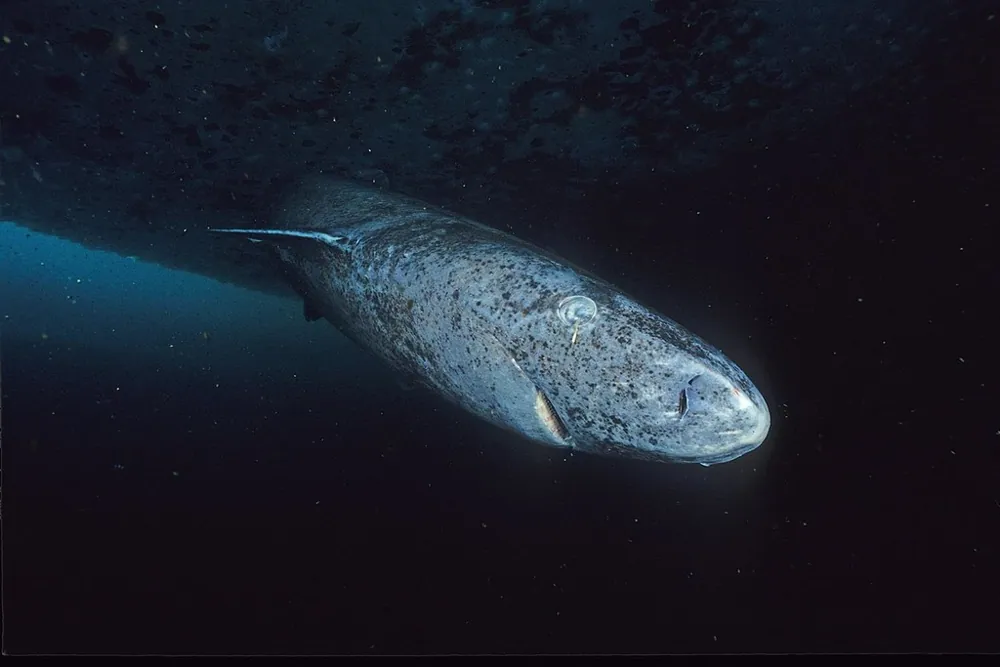
 Cum îl recunoști
- A thickset, heavy body with a short, rounded snout1
- Small eyes and small dorsal and pectoral fins1
- Five very small gill openings for its size1
- Colour ranges from pale creamy-grey to blackish-brown, usually uniform, sometimes with whitish spots or faint dark streaks on the back1
- Often has small parasitic copepods (crustaceans) attached to its eyes1
Puterea otrăvii
E periculos doar dacă îl mănâncă ceva.
Ce face otrava lui?
The shark is not venomous. Its meat is poisonous to mammals because it contains high levels of trimethylamine N-oxide (TMAO), a natural chemical that makes the flesh toxic.1
Cât de periculos e pentru oameni?
Pericol pentru oameni: DurerosPoate durea tare, dar aproape niciodată nu e grav.Greenland sharks are not considered a threat to people, because they live deep in remote, cold waters. Only one possible attack is recorded, in 1936, and it was never linked to this species. One unverified report from around 1859 describes a human leg found in a shark's stomach.1
Ce face când se sperie?
When hauled onto a boat, it thrashes its tail so violently that it is dangerous to stand near it, and its muscles can still twitch after death.1
 Dacă cineva l-a atins sau l-a mâncat
- Dacă cineva l-a mâncat sau are simptome după ce l-a mâncat: sună imediat la numărul de urgență sau la centrul de toxicologie.
Sună mereu mai întâi la numărul de urgență (112, 000, 911). Acestea sunt sfaturi generale de prim ajutor, nu sfaturi medicale. Noțiuni de prim ajutor
 Fii în siguranță
- Nu atinge, nu prinde și nu necăji niciodată un animal sălbatic, nici măcar unul mic, chiar dacă pare adormit sau mort.
- Lasă-i loc. Dacă întâlnești unul, păstrează-ți calmul, dă-te încet înapoi și lasă-l să-și vadă de drum.
- Dacă l-ai atins sau l-ai mâncat: nu te freca la ochi sau la gură, spală-te pe mâini și cere ajutor medical.
Nu te vânează pe tine. Otrava lui există doar ca să nu-l mănânce nimeni. Mai multe despre siguranță
Unde în lume?
Cât de mare e?
Cât de lung e?
Cât cântărește?
 lung cât 6 câini de la nas la coadă
 lung cât 36 banane puse cap la cap
 ar putea înota lungimea unei piscine mari (50 m) în 69 secunde
Cât de mare e Greenland shark față de TINE?
Doar calcule în browserul tău. Nimic nu e salvat sau trimis nicăieri.
Cât de rapid e?

Informații
It is thought to have the longest lifespan of any known vertebrate, estimated at between 272 and 510 years.1
It is one of the slowest-swimming fish for its size, with a fastest cruising speed of about 2.7 km/h.1
Parasitic copepods often attach to its eyes and can damage them, but this does not seem to shorten its life, because it relies mainly on smell and hearing.1
It is one of the largest shark species alive, with the largest confirmed specimen weighing around 1,023 kg.1
In Iceland, a specially treated form of its meat is eaten as a pungent delicacy called kæstur hákarl.1
Its slow metabolism is thought to be linked to its very long life, although this is still a hypothesis.1
Spărgătorul de mituri
Mit: The Greenland shark is a dangerous threat to humans.
Adevăr: It is not considered a threat to people. It lives deep in cold, remote waters, and the only report of a possible attack was never confirmed as this species.1
Pentru experții în venin
- Nume științific
- Somniosus microcephalus
- Grupă
- Alte animale otrăvitoare
- Familie
- Somniosidae2
- Ordin
- Squaliformes
- Continente
- Oceanul Arctic, Oceanul Atlantic, Oceanele
- Puii
- Pups are born alive, after an estimated gestation period of 8 to 18 years. Females reach sexual maturity at around 150 years of age.1
- Pericol pentru oameni
- 2 / 5: Dureros3
De unde vin informațiile
- Greenland shark (Wikipedia (CC BY-SA 4.0))
- Somniosus microcephalus (iNaturalist): nume și clasificare.
- Venom Wiki: nivelul de pericol, mărimea obișnuită și viteza estimată sunt ale noastre. Vezi cum le calculăm: Cum evaluăm pericolul.
Fiecare informație de pe pagina asta are un număr care duce la sursa ei. Dacă am greșit ceva, ne pare rău, suntem fani ai animalelor, nu o revistă științifică. Spune-ne la [email protected] și corectăm.
 Scorpionului îi e foame! Venom Wiki este proiectul unui singur om: gratuit, fără reclame și fără trackere. Un mic bacșiș îl ajută să rămână online.Hrănește scorpionul
Mai multe din aceeași grupă: Alte animale otrăvitoare
 Pește-balon japonezAlte animale otrăvitoareMortal
 Hawksbill sea turtleAlte animale otrăvitoarePoate ucide
 Silver-cheeked toadfishAlte animale otrăvitoareMortal
 Blackspotted pufferAlte animale otrăvitoarePoate ucide
 White-spotted pufferAlte animale otrăvitoarePoate ucide
 Long-spine porcupinefishAlte animale otrăvitoareAre nevoie de un medic
 Lion's mane jellyfish
 Moon jellyfish
 Spiny dogfish
 Bootlace worm