
 Africa
 Asia
Asia Europa
 America de Sud
 Australia și Oceania
 Antarctica
 Oceanul Pacific
 Oceanul Atlantic
 Oceanul Indian
 Oceanul Arctic
 Marea Mediterană
 Marea Roșie
 Marea Caraibilor
 Marea Coralilor
 Marea Chinei de Sud
 Marea Filipinelor
 Marea Andaman
 Marea Nordului
 Marea Timor și Marea Arafura
 Golful Bengal
 Golful California
Rhinoceros viper
 Mușcături
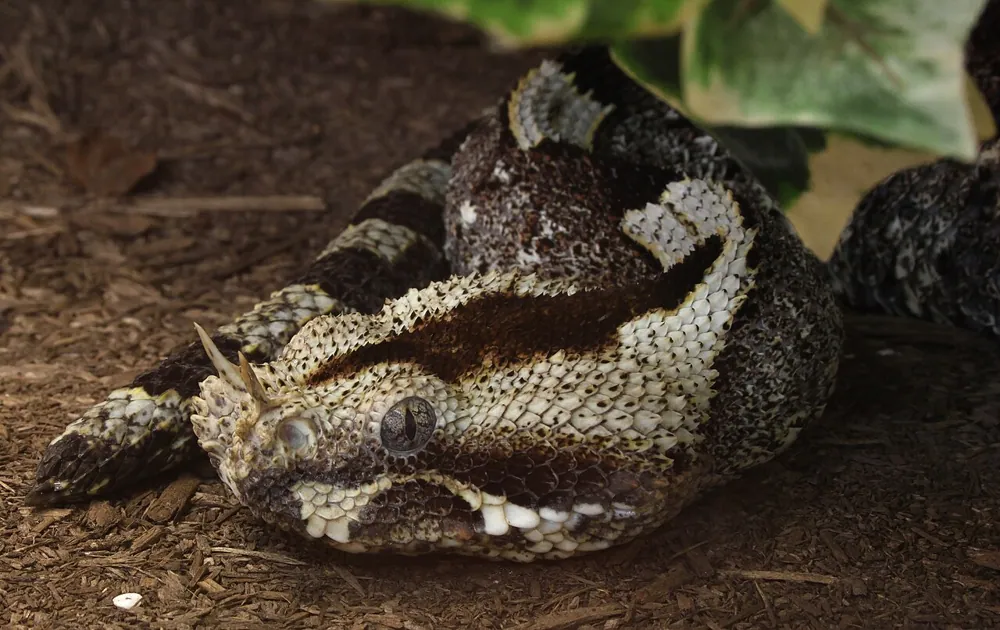
The rhinoceros viper is a large, stout snake with bright colours and two or three horn-like scales on its nose. It lives in forests across West and Central Africa. It is venomous, and its venom is mainly hemotoxic, meaning it attacks the blood and circulation.1



 Cum îl recunoști
- Large and stout, with rough, heavily keeled scales1
- Two or three horn-like scales on the end of the nose, the front pair often long1
- Series of blue or blue-green oblong markings, each with a lemon-yellow line down the centre, set within black blotches1
- Dark crimson triangles down the flanks, bordered with green or blue1
- Top of the head blue or green, with a black arrow mark1
Adesea confundat cu: The name horned puff adder is also used for Bitis caudalis (horned adder), which is a different species. Because of this, names can cause confusion, so the name butterfly viper is preferred.1
Puterea veninului
Veninul iese prin colți sau dinți când mușcă.
Ce face veninul lui?
Its venom is mainly hemotoxic, which attacks the circulatory system, destroying tissue and blood vessels and causing internal bleeding. It also has a neurotoxic component, which attacks the nerves. Small doses of the venom can be deadly. In the few detailed reports of human bites, massive swelling was described, which may lead to necrosis (death of tissue).1
Cât de periculos e pentru oameni?
Pericol pentru oameni: Foarte periculosPoate ucide un om care nu primește tratament.Because its range is restricted, few bites have been reported and no statistics are available. In 2003 a man in Dayton, Ohio, who kept one as a pet, was bitten and died.1
 Vestea bună: medicii au un medicament (serul antiveninos) sau un tratament pentru asta.1
Ce face când se sperie?
When approached it often reveals its presence with a very loud hiss, almost a shriek, and it can strike quickly forwards or sideways without coiling first or giving a warning.1
 Dacă mușcă
- Ține persoana nemișcată și calmă, ține membrul mușcat la nivelul inimii, scoate inelele și lucrurile strânse și du-o repede la spital.
Sună mereu mai întâi la numărul de urgență (112, 000, 911). Acestea sunt sfaturi generale de prim ajutor, nu sfaturi medicale. Noțiuni de prim ajutor
 Fii în siguranță
- Nu atinge, nu prinde și nu necăji niciodată un animal sălbatic, nici măcar unul mic, chiar dacă pare adormit sau mort.
- Lasă-i loc. Dacă întâlnești unul, păstrează-ți calmul, dă-te încet înapoi și lasă-l să-și vadă de drum.
- Dacă te mușcă unul: păstrează-ți calmul, stai nemișcat, sună la numărul de urgență (112, 000, 911) sau mergi repede la spital. Ține minte cum arăta, o poză ajută.
Nu te vânează pe tine. Își folosește veninul ca să prindă hrană sau să se apere și ar prefera de departe să se ascundă. Mai multe despre siguranță
Cât de mare e?
Cât de lung e?
 lung cât 2 pisici de casă de la nas la coadă
 lung cât 6 banane puse cap la cap
 ar putea parcurge 100 de metri în 100 secunde (cel mai rapid om are nevoie de 9,6)
Cât de mare e Rhinoceros viper față de TINE?
Doar calcule în browserul tău. Nimic nu e salvat sau trimis nicăieri.
Cât de rapid e?


Informații
Its scales are so rough that they can cut people who handle a snake that is struggling.1
Its vivid colours break up its outline in the dappled light of the forest floor, so it is very hard to see.1
Its fangs are not large, rarely more than 1.5 cm long, and when not in use they fold up into the roof of its mouth.1
Its bright colours fade quickly after it sheds its skin, as silt from its moist habitat builds up on its rough scales.1
At least one antivenom, called India Antiserum Africa Polyvalent, protects specifically against bites from this species.1
Spărgătorul de mituri
Mit: Its bright colours make it easy to spot in the forest.
Adevăr: Its colours give it excellent camouflage in the dappled light of the forest floor, which can make it almost invisible.1
De unde vin informațiile
- Bitis nasicornis (Wikipedia (CC BY-SA 4.0))
- Bitis nasicornis (iNaturalist): nume și clasificare.
- Venom Wiki: nivelul de pericol, mărimea obișnuită și viteza estimată sunt ale noastre. Vezi cum le calculăm: Cum evaluăm pericolul.
Fiecare informație de pe pagina asta are un număr care duce la sursa ei. Dacă am greșit ceva, ne pare rău, suntem fani ai animalelor, nu o revistă științifică. Spune-ne la [email protected] și corectăm.
 Scorpionului îi e foame! Venom Wiki este proiectul unui singur om: gratuit, fără reclame și fără trackere. Un mic bacșiș îl ajută să rămână online.Hrănește scorpionul
 Vipera șuierătoare
 Gaboon viper
 Northeast African carpet viper
 West African carpet viper
 West African Gaboon viper
 Horned adder
 Mamba neagră
 Scorpion galben palestinian
 Cobra egipteană
 Boomslang
 Fat-tailed scorpion
 Western honey bee
.jpg)