
 Afrika
 Ázia
Ázia Európa
 Južná Amerika
 Austrália a Oceánia
 Antarktída
 Tichý oceán
 Atlantický oceán
 Indický oceán
 Severný ľadový oceán
 Stredozemné more
 Červené more
 Karibské more
 Koralové more
 Juhočínske more
 Filipínske more
 Andamanské more
 Severné more
 Timorské a Arafurské more
 Bengálsky záliv
 Kalifornský záliv
Savigny's long-spined urchin
 Jedovaté ostne
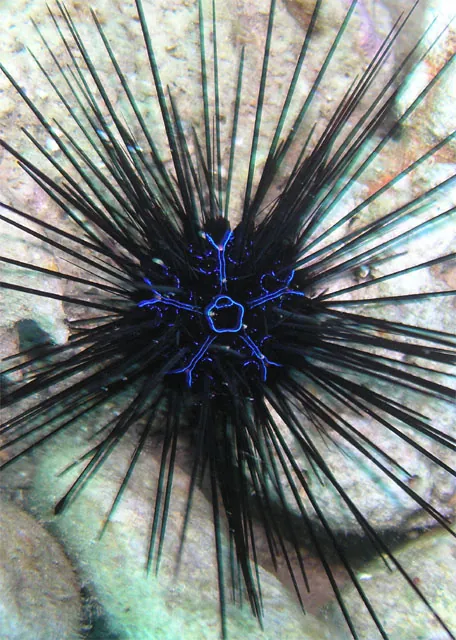
Savigny's long-spined urchin is a spiny sea animal that lives on reefs and in shallow lagoons. It has very long, thin spines that can grow up to 25 cm, and it comes out at night to graze on algae. Its spines are the part that can hurt people, so it is worth giving it plenty of room.1


 Ako ho spoznať
- Usually black, with a rounded body (called a test) up to about 9 cm across1
- Long, thin, hollow spines that grow in tufts and can reach 25 cm; they are usually black but can be grey, dark brown or purple1
- Juveniles may have bands of lighter and darker shades, and the occasional individual is completely white1
- Iridescent green or blue lines around the interambulacral areas and around the periproct (the cone-shaped region surrounding the anus)1
Často sa zamieňa s: It is very similar to Diadema setosum, which shares much of its range and often lives in the same groups. Savigny's long-spined urchin lacks the thin orange ring around the periproct that Diadema setosum has.1
Sila jedu
Jed je v ostrých ostňoch. Šliapnuť naň alebo ho chytiť bolí.
Aké nebezpečné je pre ľudí?
Nebezpečenstvo pre ľudí: BolestivéMôže to poriadne bolieť, ale skoro nikdy to nie je vážne.Čo robí, keď sa bojí?
When a shadow falls on it, it angles its spines towards the possible attacker.1
 Ak ťa bodnú jeho ostne
- Ponor ranu do horúcej vody, takej horúcej, akú postihnutý vydrží bez popálenia, a vyhľadaj lekársku pomoc, aby ostne vybral lekár. Nevydlubávaj ich sám.
Vždy najprv zavolaj na tiesňovú linku (112, 000, 911). Toto sú všeobecné rady prvej pomoci, nie lekárska rada. Základy prvej pomoci
 Buď v bezpečí
- Nikdy sa nedotýkaj divého zvieraťa, nechytaj ho ani ho nedráždi, aj keď je malé a aj keď vyzerá, že spí alebo je mŕtve.
- Nechaj mu priestor. Ak nejaké stretneš, zostaň pokojný, pomaly cúvni a nechaj ho ísť svojou cestou.
- Ak ťa bodnú jeho ostne: zostaň pokojný, nehýb sa, zavolaj na tiesňovú linku (112, 000, 911) alebo sa rýchlo dostaň do nemocnice. Zapamätaj si, ako vyzeralo, fotka pomôže.
Nejde po tebe. Jed používa na chytanie potravy alebo na obranu a oveľa radšej sa schová. Viac o tom, ako zostať v bezpečí
Kde na svete?
Aké je veľké?
Aké je dlhé?
 dlhé ako 3 kociek stavebnice v rade
 pomalšie ako záhradný slimák
Aký veľký je Savigny's long-spined urchin v porovnaní s TEBOU?
Iba matematika v tvojom prehliadači. Nič sa neukladá ani nikam neposiela.
Aké je rýchle?


Fakty
Its spines are brittle, thin and hollow, and grow in tufts that can be as long as 25 cm.1
Small fish such as cardinal fish, flatworms and shrimps sometimes shelter among its long spines.1
It spawns just after the full moon, while its close relative Diadema setosum mostly spawns around days eight to ten of the lunar cycle, which keeps the two species from interbreeding.1
Its grazing helps control algae, which might otherwise smother corals.1
It is nocturnal, hiding in crevices or under boulders by day, though several individuals sometimes huddle together in the open.1
Its predators include pufferfish, porcupinefish, lobsters and snails.1
Pre znalcov jedov
- Vedecký názov
- Diadema savignyi
- Skupina
- Ježovky, hviezdice a červy
- Rodina
- Diadematidae2
- Rad
- Diadematoida
- Kontinenty
- Indický oceán, Tichý oceán, Červené more, Arabské more a Perzský záliv, Timorské a Arafurské more, Bengálsky záliv, Oceány
- Mláďatá
- It does not have live young. Instead it releases eggs and sperm into the water (spawning), mainly during the north-east monsoon period, peaking in May, and timed to the lunar cycle.1
- Nebezpečenstvo pre ľudí
- 2 / 5: Bolestivé3
Odkiaľ sú fakty
- Diadema savignyi (Wikipedia (CC BY-SA 4.0))
- Diadema savignyi (iNaturalist): mená a klasifikácia.
- Venom Wiki: úroveň nebezpečenstva, typická veľkosť a odhad rýchlosti sú naše vlastné. Pozri, ako ich určujeme: Ako hodnotíme nebezpečenstvo.
Každý fakt na tejto stránke má číslo, ktoré ukazuje na jeho zdroj. Ak sme sa v niečom pomýlili, prepáč, sme fanúšikovia zvierat, nie vedecký časopis. Napíš nám na [email protected] a opravíme to.
 Škorpión je hladný! Venom Wiki je projekt jedného človeka: zadarmo, bez reklám a bez sledovania. Malý príspevok pomôže udržať ho online.Nakŕm škorpióna
Viac z tej istej skupiny: Ježovky, hviezdice a červy
 Crown-of-thorns starfishJežovky, hviezdice a červyTreba lekáraNedotýkaj sa
 Flower urchinJežovky, hviezdice a červyMôže zabiť
 Fire urchinJežovky, hviezdice a červyTreba lekáraNedotýkaj sa
 Bearded firewormJežovky, hviezdice a červyLen to bolíNedotýkaj sa
 Black long-spined urchinJežovky, hviezdice a červyLen to bolíNedotýkaj sa
 BloodwormJežovky, hviezdice a červyLen to bolí
Žije aj v: Indický oceán
 Štvorhranka FleckerovaMedúzy a morskí pŕhlivciSmrteľne nebezpečnéNedotýkaj sa
 Kužeľovka geografickáKužeľovky a chobotniceSmrteľne nebezpečné
 Chobotnica modrokrúžkovaná veľkáKužeľovky a chobotniceSmrteľne nebezpečné
 Chobotnica modrokrúžkovaná južnáKužeľovky a chobotniceSmrteľne nebezpečné
 Hawksbill sea turtleĎalšie toxické zvieratáMôže zabiť
 Irukandji jellyfishMedúzy a morskí pŕhlivciMôže zabiťNedotýkaj sa