
 Afrika
 Aasiya
 Yurub
Yurub Koonfurta Ameerika
 Awstaraaliya iyo Oceania
 Antaarktika
 Badweynta Baasifigga
 Badweynta Atlantik
 Badweynta Hindiya
 Badweynta Arktik
 Badda Dhexe
 Badda Cas
 Badda Karibiyaanka
 Badda Kooraal
 Badda Koonfurta Shiinaha
 Badda Filibiin
 Badda Andaman
 Badda Waqooyi
 Badda Timor iyo Arafura
 Gacanka Bengaal
 Gacanka Kaliforniya
Brazilian yellow scorpion
 Mudid
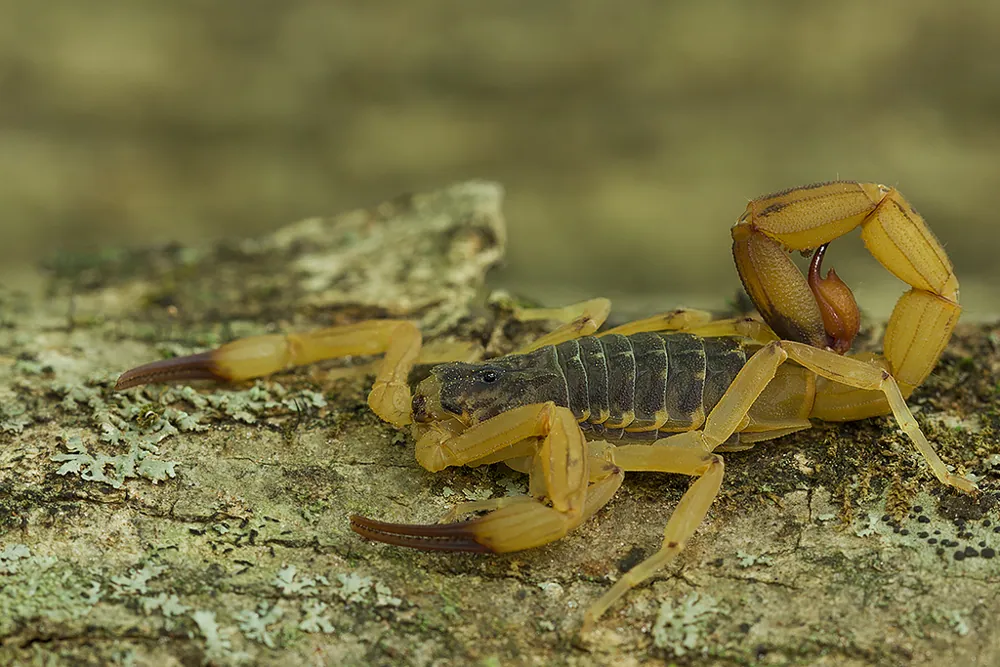
MudidThe Brazilian yellow scorpion is a small scorpion that lives in Brazil, often in towns and cities. Its venom is extremely toxic, and it is the most dangerous scorpion in South America.1

 Sida loo aqoonsado
- Adults are usually 5 to 7 cm long.1
- Legs and pedipalps are pale yellow, while the body and the tip of the tail are a darker yellowish brown.1
- The tail is bulbous and segmented, with prominent ridges and serrations, and is often carried curved forward over the back.1
- The tail ends in a venom-injecting barb.1
Awoodda sunta
Suntu waxay ka soo baxdaa mudde.
Maxay samaysaa suntiisa (qaniin ama mudid)?
Its venom contains an excitatory neurotoxin, which attacks the nerves that control involuntary body functions and releases adrenaline and related chemicals. Mild cases cause mainly localised pain, while more serious cases can bring fever, sweating, tremors, vomiting, agitation, a fast heartbeat and inflammation of the pancreas. Deaths can occur within 1 to 6 hours, or 12 to 14 hours, depending on age, health and the amount of venom injected.1
Intee buu dadka khatar ugu yahay?
Khatarta dadka: Aad u khatar badanWuxuu dili karaa qof aan daaweyn helin.It is responsible for more medically significant accidents than any other scorpion in Brazil, and most of the country's fatal scorpion cases. Mortality rates are 1.0 to 2.0% among children and elderly people. In a nationwide study from 2000 to 2012, Brazil recorded 482,616 scorpion accidents and 728 deaths, and this species was believed to cause most of those deaths.1
Muxuu sameeyaa marka uu baqo?
It uses its tail barb to deliver defensive strikes.1
 Haddii uu mudo
- Meesha la muday ku qabooji kiish baraf ah oo qofka ka dhig mid aan dhaqaaqin. Si degdeg ah u hel caawimaad caafimaad, gaar ahaan carruurta: dabaqallooc qaarkood waxay u dilaan carruurta.
Marka hore had iyo jeer wac lambarka gurmadka degdegga ah (112, 000, 911). Kani waa hage guud oo gargaar degdeg ah, ma aha talo caafimaad. Aasaaska gargaarka degdegga ah
 Badbaado
- Weligaa ha taaban, ha qaban, hana ku ciyaarin xayawaan duurjoog ah, xitaa mid yar, xitaa haddii uu u muuqdo inuu hurdo ama dhintay.
- Meel u bannee. Haddii aad mid la kulanto, deg, tartiib dib ugu noqo oo u daa inuu jidkiisa maro.
- Haddii mid ku mudo: deg, ha dhaqaaqin, wac lambarka gurmadka degdegga ah (112, 000, 911) ama si degdeg ah u tag isbitaalka. Xusuuso sida uu u egyahay, sawir ayaa caawiya.
Kuma raadinayo. Suntiisa wuxuu u isticmaalaa inuu cunto ku qabsado ama isku difaaco, wuxuuna aad u door bidaa inuu dhuunto. Wax badan oo ku saabsan badbaadada
Intee buu le'eg yahay?
Intee buu dherer le'eg yahay?
 dhererka 2 xabbadood oo dhismaha ciyaarta ah oo saf ah
 100 mitir wuxuu ku gooyn karaa 260 ilbiriqsi (qofka ugu dheereeya wuxuu u baahan yahay 9.6)
Intee buu Brazilian yellow scorpion le'eg yahay marka ADIGA laguu barbar dhigo?
Xisaab keliya oo browser-kaaga ku jirta. Waxba lama keydiyo, meelna looma diro.
Intee buu u dheereeyaa?


Xaqiiqooyin
Reported scorpion stings in Brazil rose from 12,000 in 2000 to 140,000 by 2018.1
It has a low metabolic rate, so it can survive for months without eating.1
Scorpion numbers have grown in Brazilian cities, helped by plenty of cockroaches to eat and few predators.1
Its venom varies by region. Scorpions from Distrito Federal have an LD50 of 51.6 μg/kg, compared with 26 μg/kg for those from Minas Gerais. LD50 is the dose that kills half of the animals tested.1
Its tail is bulbous and segmented, with ridges and serrations, and it often curls forward over its back.1
Meesha xaqiiqooyinku ka yimaadaan
- Tityus serrulatus (Wikipedia (CC BY-SA 4.0))
- Tityus serrulatus (iNaturalist): magacyada iyo kala soocidda.
- Venom Wiki: heerka khatarta, cabbirka caadiga ah iyo qiyaasta xawaaraha annaga ayaa sameeyay. Eeg sida aan u xisaabinno: Sida aan u qiimeyno khatarta.
Xaqiiq kasta oo boggan ku jirta waxay leedahay lambar tilmaamaya ilaha laga keenay. Haddii aan wax khaldanno, raalli ahaw, waxaan nahay dad xayawaanka jecel, ma aha joornaal saynis. Nagu soo sheeg [email protected] waana saxaynaynaa.
 Dabaqalloocu waa gaajaysan yahay! Venom Wiki waa mashruuc hal qof leeyahay: waa bilaash, xayaysiis iyo raadraac midna ma leh. Deeq yar ayaa caawisa inuu internetka ku sii jiro.Quudi dabaqallooca
Wax kale oo isla kooxda ah: Dabaqallooc
 Amazonian black scorpionDabaqalloocWuu dili karaa
 Caracas scorpionDabaqalloocWuu dili karaa
 Panamanian black scorpionDabaqalloocWuu dili karaa
 Zulia scorpionDabaqalloocWuu dili karaa
 Amazon forest scorpionDabaqalloocWuxuu u baahan yahay dhakhtar
 Argentine striped scorpionDabaqalloocWuxuu u baahan yahay dhakhtar
Sidoo kale wuxuu ku nool yahay: Koonfurta Ameerika
 Golden poison frogRahyada sunta leh, raha dhulka iyo newtDilaHa taaban
 TerciopeloFiibarka godadka leh (pit viper)Dila
 Brazilian wandering spiderCaarooyinWuu dili karaa
 Eyelash viperFiibarka godadka leh (pit viper)Wuu dili karaa
 Golden lanceheadFiibarka godadka leh (pit viper)Wuu dili karaa
 South American bushmasterFiibarka godadka leh (pit viper)Wuu dili karaa